Sunday, March 15, 2020

Unexpected Intimacy: The Story of Moses and the Israelites

Due to safety concerns, Payson Park Church has canceled services for this Sunday. But I'd already put together my lesson for the Alleluia Class, our Sunday School class for 2nd through 8th graders. So I figured I might as well share it for any others who are missing out on worship services today!


For the past few weeks, we've been talking about how the Bible is really a series of family stories, stories about the family of God. Just like our families tell stories about things that happened before we were born, the Bible tells us stories of our ancestors in the faith. We thank God for stories! Let's open with a prayer:

Thank you, God, for stories: 
stories of problems and mistakes, 
stories of love and forgiveness, 
stories of Your care and concern for people in trouble, 
stories that help us learn about You and Your love. 
Amen.

Problems and mistakes, and love and forgiveness, have been part of all of the stories of the people in the Bible we’ve been talking about over the past few weeks. Adam and Eve made mistakes, and God forgave and cared for them. Abraham and Sarah didn’t always trust God – Sarah laughed when God told her she would have a baby in her old age! They made mistakes, but God still blessed them and fulfilled his promise to them.

When our story ended last week, Abram and his family had traveled from Ur, to Haran, to Canaan, and then to Egypt.

Eventually they came back to Canaan, and when Abram was 99 years old, God again promised that he would have many descendants, and changed his name from Abram, which means “Father is Exalted,” to Abraham, which means “Father of a Multitude.” Sarai was 90 years old, and God changed her name from Sarai, which means “contentious” (a word that means likely to argue, or disagreeable), to Sarah, which means “princess.” God did fulfill his promise to them, and Sarah gave birth to a son, Isaac, and through him Abraham and Sarah’s descendants formed the nation of Israel.

Let’s jump ahead to our next Bible character, Moses. By the time of Moses, the Israelites – the descendants of Abraham and Sarah – were captives in Egypt. God heard their prayers and sent a leader to help them. Let’s look at some of the stories from Moses’ life. 

When Moses was just a newborn baby, Pharaoh tried to kill all the Hebrew babies, but Moses’ mother and sister put him in a basket where the Pharaoh’s daughter would find him. She adopted him and raised him in Pharaoh’s palace, as her own son. When he grew up, Moses saw a slave driver punishing his slaves cruelly, and they got into a fight and Moses killed the slave driver. Because of that, he had to run away from Egypt to a country called Midian. 

Another famous story happened in Midian. God appeared to Moses in the form of a bush that was on fire but didn’t burn up. God spoke to Moses from the fire and told him to go back to Egypt and tell Pharaoh to free the Israelites. Which leads to another story: Moses and Pharaoh.

What did Pharaoh do when Moses told him to let the Israelites go free? He refused! So God sent a series of plagues on Pharaoh's people, the Egyptians. Each time Pharaoh relented, but as soon as God stopped the plagues, Pharaoh changed his mind. Finally, God sent the angel of death to kill the firstborn of all Egypt, people and animals alike. God told the Israelites to slaughter a lamb and put blood over their doors, so the angel would pass over their homes safely. Finally, Pharaoh told the Israelites to get out!

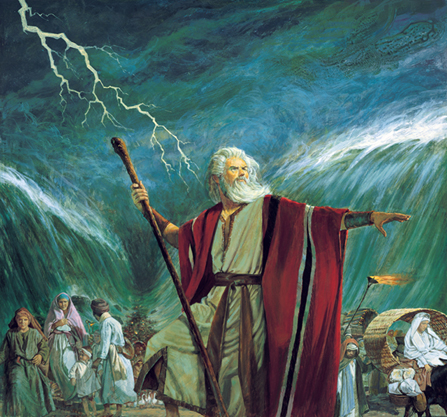
But even then, as soon as the Israelites left, Pharaoh changed his mind and chased after them with his army. The army trapped the Israelites against the bank of the Red Sea, but God told Moses to strike the water with his staff, and the waters parted, making a dry path on the bottom of the sea so they could cross in safety.

As soon as they crossed over and the army started to follow, the water closed in and drowned the whole Egyptian army. God's people were again safe.

So now the Israelites were free, but they spent the next 40 years wandering in the desert. How do you think they felt? Was it better than being slaves in Egypt? What difficulties do you think they had being in the desert for so long? Let’s see what the Bible says about it.

The story of the Israelites wandering in the desert is in the book of Exodus, chapters 15 and 16. A lot of Bibles add headings to certain stories, almost like a chapter title. The titles in these sections in the Good News translation, the Bibles we use in our God's Garden classroom, are: The Song of Moses, the Song of Miriam, Bitter Water, and The Manna and the Quail. What hints do each of these headings give us about the story? What kind of song do you thing Moses and Miriam sang? What is "bitter water"? What are manna and quail and why might they be important to this story? Let's look at each story, one by one.

Moses and Miriam both sang their thanks to the Lord for saving them from slavery and from the Egyptian army, and the Israelites sang along with them. They encouraged the people to publicly express their thankfulness to God for His faithfulness and care for them. Miriam especially encouraged the women to sing and celebrate their freedom and victory in God.

After the people crossed the Red Sea, they began to travel away from the sea, into the desert. Water became scarce. They needed water to survive, but they had walked for three days without finding any. When they finally found some, the water was bitter and unsafe to drink. But Moses prayed to God, and God told him to throw a piece of wood into the water, and it became sweet and safe to drink.

In addition to water, the Israelites needed to find food. As they grew more and more hungry, they began to complain to Moses and his brother Aaron, who was helping to lead them. "Why didn't God just kill us in Egypt, if He was going to let us die of starvation in the desert anyway?", they complained. They lost their faith in God because of their hunger. God told Moses that He would  "rain food down from the sky" for them. God told Moses to tell the people that He would send them meat to eat at the end of the day, and bread in the morning, so they would know it was God providing for their needs.

That evening, a large flock of quail, a type of bird like a pigeon, flew into camp, and the people were able to catch them easily. And the next morning when they got up, there was dew all over the camp, and when it dried, there were delicate white flakes left behind. The Israelites asked each other, "What is it?" (which sounds like "manna" in Hebrew), and Moses told them it was the food that God had promised them. And God continued to send them manna for the rest of the time they were wandering in the desert - for all 40 years!

Let’s read from the next chapter, Exodus 17, to see how the people behaved after this.

The whole Israelite community left the desert, moving from one place to another at the command of the Lord. They camped at Rephidim, but there was no water there to drink. They complained to Moses and said, “Give us water to drink.” Moses answered, “Why are you complaining? Why are you putting the Lord to the test?” But the people were very thirsty and continued to complain to Moses. They said, “Why did you bring us out of Egypt? To kill us and our children and our livestock with thirst?” Moses prayed earnestly to the Lord and said, “What can I do with these people? They are almost ready to stone me.” The Lord said to Moses, “Take some of the leaders of Israel with you, and go on ahead of the people. Take along the stick with which you struck the Nile. I will stand before you on a rock at Mount Sinai. Strike the rock, and water will come out of it for the people to drink.” Moses did so in the presence of the leaders of Israel. The place was named Massah and Meribah [which mean “testing” and “complaining”], because the Israelites complained and put the Lord to the test when they asked, “Is the Lord with us or not?”

Why did the Israelites grumble? Do you think they had good reason to be upset? Try to imagine: they were slaves, then they were free, then they were being chased by an army, then God miraculously saved them, they wandered in the desert, God provided them water and food, but now they were without water AGAIN. Whom did they blame for their troubles? What were they really afraid of? How did Moses respond? What did God do? Did God get angry with the people for complaining?

Do you think God listens when we grumble and complain about things? Do we have to be always good and making good choices for God to listen to our prayers? Of course not! God listens to us even when we make mistakes and bad choices, even when we disobey Him. What kinds of things do you grumble about? Homework, chores, bullies, not getting what you want? Do you ever talk to God about those problems? We can talk to God about all our problems, large and small. He always listens.

Let’s think about how Moses talked to God. He talked to Him like a friend, asking for advice. “What can I do about these people?”, he asked God. Do you think we can talk to God the way Moses did, like a friend who gives good advice? Does God speak to us face-to-face like Moses? Not usually, but He does speak to us through the Bible, through worship and discussion, through our consciences, even through advice from other Christians.

Not long after this story, God gave Moses the Ten Commandments on Mt. Sinai. God’s laws are a way that God speaks to us! God's laws teach us how to behave, and can help guide our decisions and let us know if we're doing the right thing. And not just the Ten Commandments, but everything we learn from scripture about how God wants us to live and love each other.

Let’s end our lesson with prayer.

Thank you, God, for your love and care. 
You cared for Adam and Eve after they disobeyed you. 
You saved Noah and his family from the flood. 
You saved Moses as a baby and spoke to him as a friend. 
You brought the Israelites out of slavery and supplied their needs as they wandered in the desert. 
You help us in our times of difficulty. 
Amen.


Bookmark and Share

Friday, March 13, 2020

Surviving the COVID-19 School Closure

As someone who works for my local school district, I am fortunate to be home with my kids while their schools as well as mine are closed due to the COVID-19 outbreak. As of this moment, the schools are only scheduled to be closed for today. But I have no doubt that my city will follow the lead of many others around us and close for at least several weeks. So what to do to make sure my kids aren't spending all that time goofing off and playing video games? Here's my list of things I'm planning to do with my kids that might work for you, too, if you're also fortunate (or unfortunate) enough to be staying at home with your kids while the schools are closed down.

Cook Something
My kids love to cook and bake with me. Depending on how old your kids are and how comfortable they are in the kitchen, "cooking something" could be as simple as learning to fry an egg or make boxed mac and cheese, or as complicated as learning to make a complete dish from a family recipe. I love baking bread with my kids, so we're making challah. It's just enough different from plain sandwich bread to feel like a real treat, and the kneading and braiding steps are fun for kids of all ages to help with.

Cooking can also be a great opportunity to practice reading skills, math skills (cut a recipe in half or convert grams to cups!), and fine motor skills. You can even discuss the chemistry behind some of the ingredients and techniques, especially when you're baking instead of cooking.

Fix Something
If your house is like mine, there are always little fix-it projects waiting to be done. Maybe you have a squeaky door hinge that needs a squirt of WD-40, or there's a small rip in a pillowcase that needs mending or a button that's falling off a shirt, or the signal light in your car needs a new bulb, or there's a spot of grout in the bathroom that needs re-caulking. What a great time to not only get something crossed off your to-do list, but also to teach your kids some practical skills! And if it's something you don't really know how to fix, show your kids how to look for help online or call a handy neighbor or friend for tips.

Research Something
In addition to looking for fix-it help online, getting your kids to research an answer to a question is a great use of their time. Assign them a person that they might be interested in (a car designer or a fashion designer or a video game designer, an astronaut or computer pioneer, a politician or activist) or a historical event, or a general topic. Maybe even let them come up with the topic themselves. Have them discuss what they learned with the whole family over dinner. Let THEM teach YOU something for a change!

Learn Something
There are lots of great online education and tutoring sites for all ages, and many of them are free. Here are just a few ideas to get you started:

Khan Academy - I used this site a lot when I was homeschooling my son. Kids progress at their own rate, the explanations are clear, and the site covers math, science, grammar, and history, as well as SAT prep for older kids

Starfall - Although limited to pre-K through grade 3, this site teaches reading and is especially helpful for those struggling with the skill due to dyslexia, ESL/ELL, and other learning difficulties. The free content can also be upgraded for a fee.

Cool Math - Cool Math is actually three related sites: Cool Math Games for preschoolers, Cool Math 4 Kids for ages 3 through 12, and Cool Math itself for ages 13 and up. Since everything is in the form of games rather than exercises or worksheets, kids are more willing to spend time on the site without complaining. In addition to math, there are quizzes on geography, history, science and nature, and other topics. There are also links with tips and tricks for parents and teachers.

How Stuff Works - With a list of categories including health, science, home and garden, auto, tech, money, culture, animals, and more, there's sure to be a topic that intrigues any child. (And I do mean ANY; one of today's featured topics is "How Do Boogers Form in Your Nose?" Not the topic I'd pick, but hey, it's legitimate science.) The quiz section gets into stupid stuff like "Fill Your Makeup Bag and We'll Tell You When You'll Get Married," but there are also a few gems like, "Can You Name All the Cities Taken Over by the Roman Empire?".

Clean Something
Cleaning tasks don't stop when school does, so take advantage of teaching your kids how to help. Teach them to do laundry, clean the oven, scrub the bathroom, rake the yard, strip and remake the beds, hand wash pots and pans. It teaches them practical life skills and makes your life easier. Win-win!

Look at Something
One of my favorite spring traditions that I've been doing with my kids since they were babies is going for a walk to look for signs of spring. We make note of flower and tree buds emerging, listen for birds singing their mating calls, check the neighbors' doors for spring and Easter decorations, and keep our eyes peeled for baby bunnies and other animals. It gets them (and you!) out in the fresh air, gets you a bit of exercise, and works on observation skills and making logical connections between the changing seasons and what they see outside. You can also make it a scavenger hunt and give them a list of things to look for: a robin with a twig in its beak, an Easter egg decoration, a yellow flower, a red car, a chipmunk, a rock that's bigger than a loaf of bread, someone pushing a baby carriage, someone walking a dog, two of the same kind of bird, etc.

Play Something
My kids love games, and we just don't get to play them often enough through the year. Our family favorites include chess, Catan Junior, Ticket to Ride, Monopoly, Mousetrap, Clue, Connect 4, Jenga, and Frozen Surprise Slides.

Listen to Something
And finally, I love spending time with my kids just talking and listening to each other. I tell them family stories, they tell me about their friends. We read each other stories - I'm continually amazed at the classic literature my kids will happily have read to them that they'd never read on their own. Our personal favorite classics include Treasure Island, The Invisible Man, Peter Pan, Julie of the Wolves, Robin HoodCall of the Wild, and The Secret Garden.

We also love listening to classical music. Even if you're not a big classical music fan, there are some wonderful story-songs designed for children. Try Tubby the Tuba, Prokofiev's Peter and the Wolf (especially the David Bowie narration!), Vivaldi's Four Seasons narrated by Patrick Stewart, Saint-Saens' Carnival of the Animals, Grieg's In the Hall of the Mountain King, and the fabulous Classical Kids CDs, which include "Beethoven Lives Upstairs," "Mr. Bach Comes to Call," "Tchaikovsky Discovers America," "Vivaldi's Ring of Mystery," and "Mozart's Magic Fantasy."


Good luck surviving the quarantine!!

Bookmark and Share

Wednesday, December 11, 2019

Christmas Music Through the Decades

Anyone who knows me knows that my taste in music is hugely varied. And my taste in Christmas music is no exception. I love Christmas songs from many genres, from classical to country to pop to jazz, and from any time period from madrigals to...well, maybe not rap and hip hop, but certainly to contemporary times. Here are a few of my favorites from the various decades over the past century!

The 1910s
1910: "The Hallelujah Chorus" from The Messiah by the Mormon Tabernacle Choir
When I think of Christmas music, I think of the "Hallelujah Chorus" from Handel's Messiah, and when I think of the "Hallelujah Chorus," I think of the Mormon Tabernacle Choir. Messiah premiered in 1782, and the Mormon Tabernacle Choir first performed it in 1875, but the first recording by the choir was made in 1910 and included the "Hallelujah Chorus." What more joyful noise could possibly be made at Christmas?

1913: "Hail, Hail, Day of Days!" by the Edison Mixed Quartet
I recently discovered this delightful recording from 1913 - made on a wax cylinder! I love the overly deliberate diction with the rolled Rs, and alternation of a capella passages with sparse accompaniment including pretty little chimes after each repetition of the word "hail" and simple tuba oom-pahs and long tones in the background.

The 1920s
1923: "Parade of the Wooden Soldiers" by Paul Whiteman and His Orchestra
Originally written in 1897 by Leon Jessel as a solo piano piece entitled, "The Parade of the Tin Soldiers," Jessel arranged it for orchestra in 1905. In 1922, Ballard McDonald added lyrics and arranged the piece into a song called, "The Parade of the Wooden Soldiers." The song was popular throughout the 1920s, but in 1933 it was used to create a Betty Boop cartoon of the same name, and the Radio City Rockettes adopted it as one of their signature numbers in the Radio City Christmas Spectacular, a number they still perform today.

1929: "Savoy Christmas Medley" by Debroy Somers Band
This recording has such a 1920s sound, I can practically see them dancing the Lindy in their flared pinstriped pants during the interludes. I love the honky-sounding sax, the blatty brass, the perfectly square tempos, and the crisp diction and tight harmonies of the singers.

The 1930s
1934: "Troika" from Lieutenant Kije by Sergei Prokofiev
Although not technically a Christmas song, the word "Troika" refers to a sleigh drawn by three horses, and the sleigh bells and rousing, rhythmic percussion bring to mind horses' hooves, much like the better-known "Sleigh Ride" by Leroy Anderson. Being a brass player, I may be biased, but I love both playing and listening to this dynamic piece.

1936: "Swingin' Them Jingle Bells" by Fats Waller
"Jingle Bells" is probably one of the most played (and OVERplayed) Christmas songs ever, but you've never heard it until you've heard Fats Waller and his orchestra bring it home. "What's the matter wit' 'er?" "Jingle bells got 'er!" Priceless.

1936: "What Will Santa Claus Say?" by Louis Prima & His New Orleans Gang
Louis Prima is best known as King Louis in the original Jungle Book movie, but he had an impressive career as a bandleader and entertainer long before and after. Like many bandleaders of the era, Prima not only conducted, but also played the trumpet and provided lead vocals (with band members singing backup vocals) for many pieces, including this charming holiday song.

1939: "The Fairy on the Christmas Tree" by Gracie Fields
The chirpy sound of Fields' voice is reminiscent of Snow White in the 1937 Disney movie. This silly but sweet song is a perfect example of the style of this era, and it's a fun vintage visit to the late 1930s.

The 1940s
1942: "White Christmas" by Bing Crosby
Crosby was the ultimate crooner, and "White Christmas" is the ultimate croon. From Crosby's rich baritone to the women's backup harmonies to the sweet little whistled interlude, this song is about as perfect as it can get. There have been innumerable covers recorded since, but none of them can touch Crosby's original.

1944: "Holiday for Strings" by Glen Miller and the Army Air Force Orchestra
What I love most about this piece is how effortlessly it changes from peppy jazz to orchestral pizzicato to smooth swinging strings. I can picture someone rushing out to do their holiday shopping, then coming home and sitting by the fire wrapping presents. It doesn't include any recognizable holiday tunes, but it is still unmistakably Christmas.

1949: "Sleigh Ride" by The Boston Pops
The Boston Pops first recorded Leroy Anderson's "Sleigh Ride" under the baton of Arthur Fiedler, one year after its composition in 1948, and it quickly became one of the group's signature numbers. The Pops released four additional recordings of the piece under Fiedler's direction, another conducted by John Williams, and three more by the current Pops conductor, Keith Lockhart. The piece was originally purely instrumental, with lyrics by Mitchell Parish added in 1950. The first recording with lyrics was released by the Andrews Sisters that same year. If you're from anywhere near Boston, it's not Christmas until you've heard the trumpeter in the Pops play that distinctive whinny.

The 1950s
1952: "The Christmas Waltz" by Frank Sinatra
Like "White Christmas," "The Christmas Waltz" has been covered by many other artists, but Sinatra's laid-back version with swinging strings and soaring sopranos is still the one by which all others are measured.

1953: "Santa Baby" by Eartha Kitt
This song has been re-recorded umpteen times, usually in a very cutesy manner (see: Madonna, Taylor Swift, Ariana Grande), but Eartha's version is the only one that makes me believe that Santa did, indeed, bring her the entire contents of the Tiffany's catalog. And a yacht.

1957: "I Love Those J-I-N-G-L-E Bells" by Frank Sinatra
Another laid-back Sinatra carol, Frank is once again accompanied by a chorus of chirping sopranos and "bong"-ing basses. You can practically hear the ice jingle in his glass and see him waving his cigarette while he sings. Bong!

1958: "The Little Drummer Boy" by the Harry Simeone Chorale
Although this song, which is based on a traditional Czech carol, was written in 1940, the first recording wasn't released until 1951, performed by the Von Trapp Family Singers! But it was this 1958 recording by the Harry Simeone Chorale that really made it popular. This arrangement is so evocative of the 1950s age of chorale singing.

1959: "Christmas Festival" by the Boston Pops
Another Boston Pops Christmas classic by Leroy Anderson that the Pops have both performed and recorded numerous times, the 1959 recording under the baton of Arthur Fiedler is one of the best. Every Christmas I perform with a group that uses a slightly abbreviated version of this piece as their overture, and there is nothing quite as wonderful as standing at the back of the theater, waiting for my entrance, listening to this lovely medley of Christmas favorites.

The 1960s
1960: "Children, Go Where I Send Thee" by the Kingston Trio
If I were marooned on an island and could bring only one Christmas album, it would, without a doubt, be "The Last Month of the Year" by the Kingston Trio, and if I could listen to only one track, it would be "Children, Go Where I Send Thee." A counting song in the vein of "The 12 Days of Christmas," each number represents a Biblical concept, person, or group (for example, "3 for the Hebrew children" refers to Shadrach, Meshach, and Abednego, who were saved from the fiery furnace in the book of Daniel).

1961: "The Christmas Song" by Nat King Cole
Although it was written by Mel Torme and Bob Wells, Nat King Cole's version far outshone Torme's own recording. Cole's smooth vocals invite you to join him and sit right down by that open faaaahr - er, fire. It's just not Christmas without Cole's rendition of "The Christmas Song."

1966: "You're a Mean One, Mr. Grinch" by Thorl Ravenscroft
Not only is it from a classic children's book and television special by Dr. Seuss, featuring delicious lyrics like, "You have all the tender sweetness of a seasick crocodile" and "Your heart is full of unwashed socks," it is also performed by Thorl Ravenscroft, the voice of Tony the Tiger himself. Jim Carrey's version is fun, but it doesn't resonate in your soul the way Ravenscroft's does.

1967: "That's What Christmas Means to Me" by Stevie Wonder
Stevie Wonder's takes on various Christmas songs are often too non-traditional for me, but there's something so sincere about this song that I love it in all its Stevie Wonder poppiness. You can't help but boogie along to the beat while you're baking your Christmas cookies.

The 1970s
1970: "I Saw Mommy Kissing Santa Claus" by the Jackson 5
Christmas and Motown can be a weird combination, but Michael Jackson was at the height of his little-boy cuteness and was the perfect voice for this song. Add in the tight harmonies from the other brothers and you can practically see their bell-bottom choreography. This is the rare combination of a less than fantastic song and a less than fantastic genre combining to somehow make a great recording.

1976: "Pine Cones and Holly Berries/It's Beginning to Look a Lot Like Christmas" by the Osmonds
I love the way they take a classic Christmas song and combine it with a lesser-known tune for a much more fun and upbeat arrangement. I get this version stuck in my head every Christmas.

1977: "Peace on Earth/Little Drummer Boy" by Bing Crosby and David Bowie
As odd as this pairing seemed on the surface, and as cheesy as the setup was in the 1977 television special where they first performed the medley, it was a beautiful and moving piece, and Crosby's and Bowie's voices blended unexpectedly well. There was something touching about the two men from such widely varied backgrounds, genres, and generations coming together.

1978: "Have Yourself a Merry Little Christmas" by the Carpenters
Many other singers recorded this song before and after the Carpenters, most notably Judy Garland, but as much as I love Judy's poignant version, it's Karen Carpenter's throaty purr that tugs at my heartstrings. To me, this version is the best of the best.

The 1980s
1981: "Lo, How a Rose E'er Blooming" by the Cambridge Singers
There's nothing like the sound of a capella men's voices echoing throughout a stone cathedral. John Rutter's lovely arrangement of this traditional carol is haunting, yet festive.

1984: "Sleigh Ride/Winter Wonderland" by Dolly Parton
I'm the first to admit that Dolly's voice and style sometimes grate on me. But somehow this recording hits all the right notes for me. She sounds more like she's singing in her living room than in a recording studio - it's so natural and relaxed, just like Christmas should be..

1987: "Do You Hear What I Hear" by Whitney Houston
It's rare that a classic Christmas song is ever recorded in a very different arrangement yet becomes as much of a classic as the original, but Whitney's tour de force performance of "Do You Hear What I Hear" is one of the most powerful and moving Christmas songs I've ever heard. I still get chillbumps every time I listen to it. Oh, those pipes.

The 1990s
1992: "My Grownup Christmas List" by Amy Grant
If this song doesn't move you, you have a heart of stone. A beautiful melody; poignant, heartfelt lyrics; and Amy's gentle alto and soft Tennessee drawl are sure to melt the hardest of hearts.

1993: "(It Must Have Been Ol') Santa Claus" by Harry Connick, Jr.
Connick's music is a contemporary take on 1940s swing music, and this arrangement is no exception. With bright brasses, percussive rhythms, the band singing backup and clapping, and rocking piano licks, this jazzy number has it all.

The 2000s
2002: "The Nutcracker Suite" by the Brian Setzer Orchestra
BSO released the song in 2002 but it grew in popularity the following year when it was included on the soundtrack of the film "Elf." It's a jazzy, contemporary take on the traditional Nutcracker, including just enough traditional bits in between jazzing it up to please highbrow and lowbrow alike.

2004: "God Rest Ye Merry, Gentlemen/We Three Kings" by the Barenaked Ladies ft. Sarah McLachlan
Another unexpected pairing, I love the way the BNLs start off, then McLachlan slips in underneath with subtle harmonies before taking a verse in her own style, then the BNLs slip in under her with harmonies, finally ending with a canon-style repeat. The arrangement has something of an Appalachian feel with the simple guitar accompaniment and McLachlan's trademark near-yodel singing style.

2007: "What Child is This?" by Carrie Underwood
Sometimes I like it when an artist plays around with a traditional arrangement, adding their own embellishments and interpretations. But sometimes I like it when someone with a beautiful voice simply sings the traditional arrangement without feeling a need to muck around with it. Underwood does exactly that on this simple arrangement that starts with solo voice and guitar, then builds to a full orchestra and backing vocals, but keeps the traditional melody intact. No melisma, no glory notes, no unexpected harmonies (or melodies). Just a lovely voice singing a lovely song.

The 2010s
2012: "Carol of the Bells" by Pentatonix
Carol of the Bells. Pentatonix. 'Nough said.

2013: "Underneath the Tree" by Kelly Clarkson
I kind of love this song in spite of myself. It's a little angsty and overly belty, but Kelly sells it like nobody's business. I'd love to hang out underneath her Christmas tree, drinking spiked eggnog and dishing on guys. Yeah, it surprises me, too.

2014: "Baby, It's Cold Outside" by Michael Buble and Idina Menzel
A lot of people get their knickers in a twist over this song, claiming it's about date rape (it's not; it's about slut shaming, but that's another blog entirely). But Buble and Menzel change a few lyrics and add a couple of adorable lip-synching tweens to the video and the whole song becomes as sweet and Christmassy as a candy cane.

2015: "The Man with the Bag" by Jessie J
Kay Starr's original jazz version was great, but Jessie J's brassy, bold belt manages to outdo the original.

2016: "Mary Did You Know?" by Voctave ft. Mark Lowry
If you're not familiar with the group "Voctave," check them out. Amazing voices, amazing arrangements. This is one of my favorite arrangements of one of my favorite Christmas songs. (Side note: That crazy high soprano? I've heard her in person. Yeah, she really sings those notes. Yeah, she really sounds like that in person. No autotuning, no electronic sweetening. It's mind-blowing. Plus, she's just a doll.)


So that's my take on the last century of Christmas music. What era is your favorite?

Bookmark and Share

Monday, September 23, 2019

The 2019 Primetime Emmy Awards: Fashion Review

It's red carpet time again! Last night, I watched the Primetime Emmy Awards - well, I watched most of it. The writing was so terrible that I didn't even make it all the way to the end. The fashions weren't terrible, but they did seem to be somewhat...restrained, although there were a few notable exceptions. And there were most definitely a few trends. Here are some of the looks that caught my eye, for good or for ill.

The Reds and the Pinks
The red-pink combo was a popular look last night, appearing in a variety of silhouettes and styles.

Mandy Moore's gown paired a soft, cranberry red skirt with thigh-high slit and short train with a Barbie-pink satin bodice with an off-the-shoulder portrait neckline and 3/4-length puffed sleeves. Although the bodice was low enough to look a bit precarious for me, the particular shades of red and pink worked better together than some others, and I liked the mix of satin and matte fabrics. I loved the coordinating satin sandals, softly waved hairstyle, and natural makeup. Overall, a good look. 

Marisa Tomei's dress was a combination of a more vivid, "true" red and a nearly magenta shade of pink, which I didn't love, but I did love the way the two fabrics were swirled together, with the red predominating in the skirt and a bit less so in the bodice, but the pink taking center stage in the shoulder and waist drapes. The silhouette was lovely and flattering, and moved beautifully. The intensity of the colors worked well with her dark, sleek hair and fair complexion, and her lipstick managed to work with both shades. A very pretty if not outstanding look. 

Susan Kelechi Watson's dress was less successful for me. The base of the dress was a basic red strapless column with just a bit of flare in the skirt, which would have been fine except that it was too tight across the hips, which created unflattering stretch lines at the crotch (always a hazard with snugly-fitted dresses made of soft, drapy fabric). The shoulderless sleeves were pale pink satin poufs trimmed with long ribbons. The way the top of the sleeves angled outward made the whole dress appear droopy, and the poufs were bottom-heavy, giving the sleeves a weightiness that didn't coordinate with the floatier fabric of the rest of the gown. It looked like the sleeves were a last-minute addition that wasn't completely thought through. Slightly sturdier fabric in the dress and slightly lighter fabric in the sleeves and it might have worked.

Taraji P. Henson's gown had a bit of a Grecian-inspired look, with a beautifully draped and wrapped chiffon base in purplish-pink, cinched in with a sparkly, narrow belt, with the shoulders and part of the bodice in red, and long red panels forming a sort of cape. I loved everything about the dress except for the placement of the seams that connected the red and pink, which was just below the fullest part of the bust. Had the entire bodice been red, or if the seams were closer to the shoulders (more like a red yoke), I think the color transition would have looked less abrupt. But Henson clearly loved the gown, and she certainly made it work.

Gold and Silver Metallics
Metallic fabrics echoing the award statuettes themselves have always been popular on the red carpet, and the Emmys were no exception.

Isla Fisher was luminous in a pleated silver off-the-shoulder gown. The style was simple and elegant, with a cross-over, wrapped bodice and a tiny flare at the base of the skirt. With her strawberry blond hair, I was surprised at how flattering the silver was on her. I liked the pop of color in her bright lips and her sideswept hairstyle. Elegant and lovely. 


Natasha Lyone, on the other hand, chose a crinkled gold gown in a style that unfortunately came off as dated and matronly. Although the base of the gown, which was slightly bloused in the bodice, cinched in with a wide sash, and clinging from the waist down, was lovely, the addition of puffy sleeves with overly-long cuffs and a high neck with a large bow and heavy trailing ribbons, was reminiscent of officewear of the early 1980s. Rip off those sleeves and that bow and it would have been a nice look on her. Based on her expression on the red carpet, she seemed to agree that it wasn't her best look. 

Julia Louis-Dreyfus followed her usual formula of wearing a metallic column with a plunging neckline, a narrow self-belt, and a high slit, paired with long earrings and hair pulled partly back with a severe center part. It was a fine look, but a bit predictable. But I guess after you've won eight Emmys, the whole thing is a bit predictable. 

Black and White
Both all-black gowns and all-white gowns have always been popular on the red carpet, but of late, black-and-white combinations have been more and more trendy. 


I liked Catherine O'Hara's color-blocked black-and-white column. The simple design, with high round neck, long sleeves, and just-above-the-knee slit, was flattering, and the blocks of black and white added just enough visual interest to avoid being boring. I think it would have been more flattering if she were currently brunette (although she is rocking the platinum blond!), but I loved the bright pink lips and crazy high shoes. 

Viola Davis' black-and-white gown was a pretty black strapless column topped with a single-shouldered white overlay that gathered in at the right hip. The silhouette was lovely and flattering, with pretty accessories like a multi-strand pearl choker, a white clutch, and big curly hairdo. What I didn't like was the color choices for her makeup (blue eyeshadow and deep purple lipstick) and thick-soled sneakers (thankfully hidden in this photo) that caused her to walk like a trucker. It was one of those looks that looks good in a still photo but isn't nearly as flattering in real life when the wearer has to walk and sit down. 


The opposite was true of Phoebe Waller Bridge's stunning white tulle ballgown with plunging neckline - it was much lovelier than this picture indicates.Waller Bridge's alabaster skin and dark brown hair were perfectly set off by the barely off-white gown, which was trimmed at the waist with silver glitter and the narrowest of silver belts. The bodice was perfectly tailored and the skirt simply floated as she moved. This was definitely one of my favorite looks of the night. 

Padma Lakshmi opted for the simplest of the simple in a striking white, clinging, halter-style gown with a short train. The dress hugged her perfect figure, and her choice of a sleek, slicked-back hairstyle and subtle makeup let her natural beauty be the star. 

Patricia Arquette opted for a white gown that was loose and draped, which unfortunately came off as somewhat matronly. The white was a perfect pick for her icy blond coloring, but the high neck, long full sleeves, and droopy bodice just didn't work for me, I think in part because of the heavy knit fabric. Something a little floatier with similar lines would have been a better choice. I did love her severe, heavy bangs and natural makeup, but her gown was a fail for me. 


I had to look at Sian Clifford's white column for quite a while trying to decide if I loved it or if I hated it. I loved the simplicity of the column and the intricate silver beading on the arm panels, but the whole thing felt a bit too stiff for my taste. A little more softness in the fabric of the gown that allowed for just a bit of movement, and I think this would have been a win for me. 


Amy Adams' gown was a transparent black, patterned overlay over a narrower nude column. The peekaboo feel of the overlay and the deep v-neck were a nice contrast to primness of the long, full sleeves and the wide lapels. This gown was an excellent example of how voluminous sleeves in a lightweight fabric are more flattering than heavy poufs. A lovely, elegant, and unusual look. 


Kelly Osborne's solid black column, on the other hand, was an example of how heavy fabric with a lot of body can work well in the right style. Her gown had a horizontal keyhole just above the waist, echoed by a gap between the top of the bodice and the structured capelet that topped the gown. Her hair was a pretty shade of deep lavender (surely it was no coincidence that it was the exact shade of the carpet) that was nicely set off by the severe black, and the whimsical hair bow was a cute, unexpected detail. The one thing I disliked about the gown was that, as beautifully fitted as it looked when she was standing still, when she moved, the bodice and capelet didn't have quite enough give, and her cleavage bulged out from the gap between them. But overall, I did like this look. 

Sometimes a simple gown can become stunning due merely to the choice of fabric, and Betty Gilpin's star-studded ballgown was a good example. The gown was a standard off-the-shoulder ballgown silhouette, with a snugly fitted bodice showing off her tiny waist, and a beautifully flared skirt with a small train. But the cascade of sparkles which lessened from bodice to hem made this gown truly eye-catching. 


Maisie Williams' black gown also featured some star-studded fabric. Her gown intrigued me in that it was almost 2 different gowns pieced together, yet somehow it still worked. The left half of the snugly-fitted bodice was plain black satin, with a glittery crescent moon at the hip gathering a long fullness of soft fabric falling to the floor, whereas the right side was spangled with silver dots that continued, fitted to the hip, ending in a mid-calf length transparent polka-dotted overskirt over an opaque thigh-length solid black underskirt. It shouldn't have worked, but somehow it did. 

Nathalie Emmanuel was yet another star-spangled black gown, although the cut of her gown provided plenty of visual interest. The bodice was a modified halter style, with a triangular, all-silver panel from collarbone to waist topping an all-black bandeau that attached to the skirt only at the front, leaving wedge-shaped cutouts at the waist, and the skirt itself was flared and solid black except for a front panel with silver stars that lessened in number from waist to hem. I liked the peekaboo style, which was sexy without being revealing, and I liked the mix of solid black, solid silver, and silver-spangled black areas. A pretty, flattering and different-without-being-weird look. 

Icy Blue and Icy Green
Ever since Grace Kelly wore that iconic ice-blue satin gown to the 1955 Oscars, icy blues and greens have been popular on the red carpet, and the Emmys were no exception. 

Brittany Snow's strapless icy blue chiffon ballgown had a simple silhouette; fitted to the top of the hip, then flaring out to a full but soft skirt. I felt like the fitted bodice ended at a strange spot, lower than the waist but not quite as low as mid-hip, but the skirt flared gradually enough that it didn't bother me too much. I did find the overall look pretty but a little blah. Perhaps just a bit more blue and a bit less gray in the color might have perked it up a bit. 

Jameela Jamil proclaimed her look "over the top," but I thought it hit just the right notes. The way the bodice wrapped around and went almost over one shoulder, leaving just a tiny peep of skin at the waist, reminded me of a sari, a nice nod to her Indian and Pakistani heritage. The skirt was structured and full in true ballgown fashion, and although it did show some wrinkles and the hem was just a hair too long to skim the floor as it should have, the dress was nicely tailored and suited her gorgeous coloring and tall stature. 

Sarah Goldberg's long-sleeved, boat-necked, sashed column reminded me just the tiniest bit of some polyester chorus dresses I wore in the 1980s, but she somehow made it work. The fabric had just enough sheen to catch the light and bring the color to life, and the fullness of the skirt at the side created a pretty line. It looked simple and comfortable, but Goldberg managed to make it look glamorous as well. 

Regina King wore a lovely ice-blue halter, with a high neck, a narrow silver belt, and a full skirt with a long slit and a long train. I liked the little details of narrow straps at the shoulder and self-color spangles at the top of the bodice, as well as King's flippy, side-parted hairdo and subtle makeup. A truly elegant and glamorous look.

Pants
It used to be that the only version of pants women ever wore on the red carpet was a daringly female-tailored tuxedo. But now, pants, pantsuits, and jumpsuits in all kinds of styles regularly make appearances.

Although I liked Amy Poehler's gold lame jumpsuit in concept, the execution fell a bit short. The pants are a little too wide and too long for such a petite woman, and the gathering at the waist is not flattering on her slim but not narrow-waisted figure. The black scarf at the neck was an interesting touch, but given how similar her hair and skin tones are to the gold fabric, a touch of warm color might have been more flattering on her than black. It's cute, but we've seen her in much more flattering styles.

Angela Bassett looked absolutely amazing in this striking red pants ensemble. The pants were high-waisted, made even higher by an extra-wide waistband, and the off-the-shoulder curved top trailed into a long scarf that fell to the floor, and revealed the tiniest peep of skin. With gorgeous full curly hair and stark makeup that emphasized her amazing cheekbones and almond-shaped eyes, Bassett was FIERCE. 

Kerry Washington paired a simple white cotton shirt with popped collar and folded-back cuffs with a pair of snugly-fitted black sequined pants. Topped with a high ponytail and natural makeup, she should have looked too casual for the red carpet, yet she still looked just as glamorous and "done up" as anyone else wearing a ball gown. Win. 

Laura Linney's red carpet fashions are very much hit-or-miss for me, and if you had described this look to me, I probably would have called it a miss. And yet, the combination of what is essentially a metallic silver, single-sleeved column dress, gathered over one hip and worn over wide-legged black trouser pants, actually works for me. It doesn't hurt that her natural hair and makeup are sheer perfection. I'm genuinely surprised at how much I like this ensemble. 

Melanie Liburd's black-and-white outfit is another combination that doesn't sound like it would work on paper, yet turns out being fun and elegant in reality. She paired simple black trousers with a black peplum and black sequined sash with a strapless gathered white tulle bodice and a long, full white tulle train. It was a little 40s, a little 50s, even a little 80s with the high ponytail, but Liburd sold it well.

Miscellaneous
There are always some styles that don't follow the current trends, for good or for ill. Here are some looks that didn't fall neatly into any of the "trendy" categories.

Anna Chlumsky's strapless floral column was another dress that looked pretty on the red carpet, but tended to fall short as she moved. I liked the fullness of the skirt, especially as the floral pattern seemed to change as the gathering opened up, but her figure is so straight that the bodice looked like a 1970s tube top. I like Chlumsky a lot, and I get the impression that she's not really a gown-wearer, so I appreciate that she really made an effort here. And it's fine! But I think she would be more flattered by a bodice that adds a bit of fullness or volume at the bust. But I do love her feminine makeup and full curls.

Emilia Clarke looks adorable in anything, but she really has the right kind of figure for this midnight blue gown with what I like to refer to as a "suspender-strap bodice." You have to have a nipped-in waist but a small bust to avoid looking like a wardrobe malfunction about to happen, and that's exactly what Clarke has. I love the teeny peplum and the bow-tied sash, I love the train at the back that barely reaches the floor, but most of all I love that it has pockets and still looks great when she puts her hands in them. Another of my favorite looks of the night.

Alex Borstein went full-on 40s glam in this fabulous vivid purple wrapped gown with its sweetheart neckline (delightfully emblazoned with her initials) and accented by silver pointy-toed pumps and a gorgeously rolled updo. The deep purple is sheer perfection with her dark hair and fair skin, and the style is deliciously va-va-voom on her voluptuous figure. A really fun retro chic look. 

Kristen Bell's dress was very close to being a win for me, but I was really bothered by the straps that came in horizontally under the arms. The bodice just looked too much like an apron - or, even worse, a bib - that was supposed to have a shirt underneath it. That said, I adored the black skirt with shots of glittery colors running down it, and I loved the bolder bands of the same colors running down the bodice and around the neckline. But the bare skin at the sides and the bands coming in under the arms ruined the whole look for me. 

Laverne Cox can - and does - pull off looks that not many others can, and this lavender-and-black ballgown is definitely one of them. The layers upon layers of voluminous gathered tulle in the skirt would overwhelm most wearers, as would the giant black rosette on the right shoulder. But between Cox's height, her perfect posture, and her confidence, this was an absolutely amazing look.

Gwendoline Christie also has the height and the presence to pull off a lot of looks that others might not, but her Grecian-inspired look just didn't work for me. It reminded me too much of what King Herod wears in every children's Christmas pageant ever. I suppose it's flattering and well-tailored, but it just looks completely out of place at an awards show. Perhaps the intense coral lipstick was intended to add glamour and femininity, but it just drew the eye and overwhelmed her face. Too much costume, not enough couture. 

Michelle Williams wore another gown that paired a simple, predictable silhouette with a visually interesting fabric that made the whole look work. Not only was the column perfectly tailored to her figure, with the top of the bodice and the waist falling at just the right level to stay in place as she moved, the hints of deep turquoise throughout the busy, swirling pattern of the fabric were perfectly complementary for Williams' pale skin and platinum locks. The fabric was busy enough that the simple hairstyle and lack of accessories was exactly the right choice. 

Sophie Turner opted for a wrapped column of ice-pink satin. It was nicely tailored (although the waist was just a bit high for my taste), and I liked the way the front of the skirt angled back to reveal a bit of leg and Turner's strappy silver sandals. The diamond collar didn't really complement the gown, in terms of both length and (lack of) color, but it wasn't bad. I might have gone with a longer chain with a single, large, teardrop-shaped ruby or sapphire for a hint of color. But overall, a very pretty, if not especially memorable, look. 

Zendaya's dramatic emerald-green gown had beautiful structure. I loved the swirling panels of skirt that revealed her gazelle-like leg, but I didn't love the pseudo-transparent bodice. I'm rarely a fan of boning showing quite that much in a bodice, and up close, the lining seemed to be ill-fitting and wrinkled. Perhaps if the bodice had been lined with light green or even vivid coral instead of nude, I would have liked it better. But it was still flattering and interesting.

The Men
Most men at a red carpet event wear some variation of a basic tuxedo, with perhaps an unusual color or fabric, skinny trousers vs. wide-legged, wide lapels or no lapels, but still a tuxedo. But sometimes there are a few men who get creative enough to catch the eye. Here are the men who caught my eye last night.

Billy Porter is always worth looking for on the red carpet, and he did not disappoint. His double-breasted jacket with high lapels and wide-legged, extra-long trousers (and platform shoes allowing them to be even longer) had sparkling silver pinstripes that caught the light beautifully as he moved. The fabric was light and airy yet still nicely structured. In lieu of a necktie, Porter wore a long black chiffon scarf that hung nearly to his knees, which nicely echoed the floatiness of the suit. The oversized asymmetric hat was a little jarring for me, as it seemed like it should tip his head over to the left, but the idea was good even if the execution was a bit off. But all in all, a classy but still avant-garde look.

James Van Der Beek wore a coral velvet double-breasted tux jacket with a bow tie in a slightly darker shade and a dress shirt in a slightly lighter shade, paired with standard tux pants and tan suede shoes with no socks. I wish he'd managed to find suede shoes the color of the bow tie, and I always wish they wore socks, but other than those minor objections, I find this a fun and elegant look. Oh, and bonus points for the boutonniere!

It's not easy to describe what Karamo Brown was wearing. It was more than a shirt, but not quite a jacket, and although it wasn't much to look at when he was just standing there, when he moved around or the breeze picked up, the trailing black and white chiffon strips attached to the front and back yokes of his shirt were absolutely glamorous and sexy. The slightly flared, cropped pants and black boots reminded me of a young Captain Kirk, and the lines of the shirt somehow had a Han Solo/Lando Calrissian vibe, so I'm calling this a sexy space cowboy look and a big success.

I don't think anyone other than RuPaul could have made this pale pink satin suit emblazoned with black poppies work, but I absolutely loved it on him. The black satin lapels and high-necked black shirt framed his face and brought the focus back up, and the aqua glasses frames were the hint of a "poison color" that I love so much. Just spectacular. 

Terrence Howard's cobalt blue satin pants were fantastic, and I loved the layered white-over-black double shirt with its french cuffs tied with black ribbons. I loved that the dark metallic brocade vest had cobalt blue satin lapels matching the pants. But I didn't love that the vest was too tight and bunched up instead of skimming his body. Great ensemble, bad tailoring.

Tan France's outfit was a nice nod to his Pakistani heritage, with a short bolero jacket with mandarin collar and matching wrapped skirt, both made from an incredibly elaborately embroidered fabric, worn over black pants and accessorized with polished black boots and a series of gold chains that tied in to the gold trim of the fabric - and of course, his beautiful trademark salt and pepper hair. It was a distinguished and unique look, leaving no doubt as to his status as a fashion expert. 


Bookmark and Share