Saturday, September 12, 2020

Backyard Birds

When I moved to a new house a few months ago, one of the first things I did to "settle in" was to hang up my bird feeders: Two hummingbird feeders, two seed feeders, and a suet feeder. In the nearly 3 months since we've lived here, I've spent countless hours watching hundreds of little feathered visitors. Many of them were familiar, but I needed to look up a few that I didn't recognize. For those aspiring bird-watchers who'd like to know what kind of birds you're likely to see in your backyard, here's a list of some of the birds who come to mine. (Please note that I live in New England.)

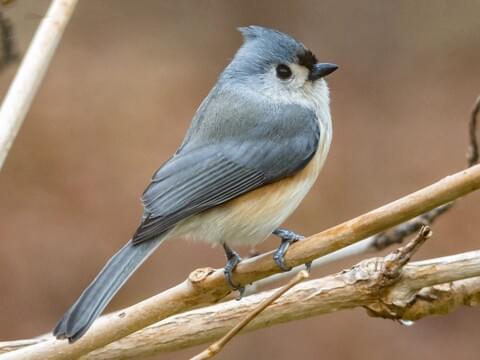
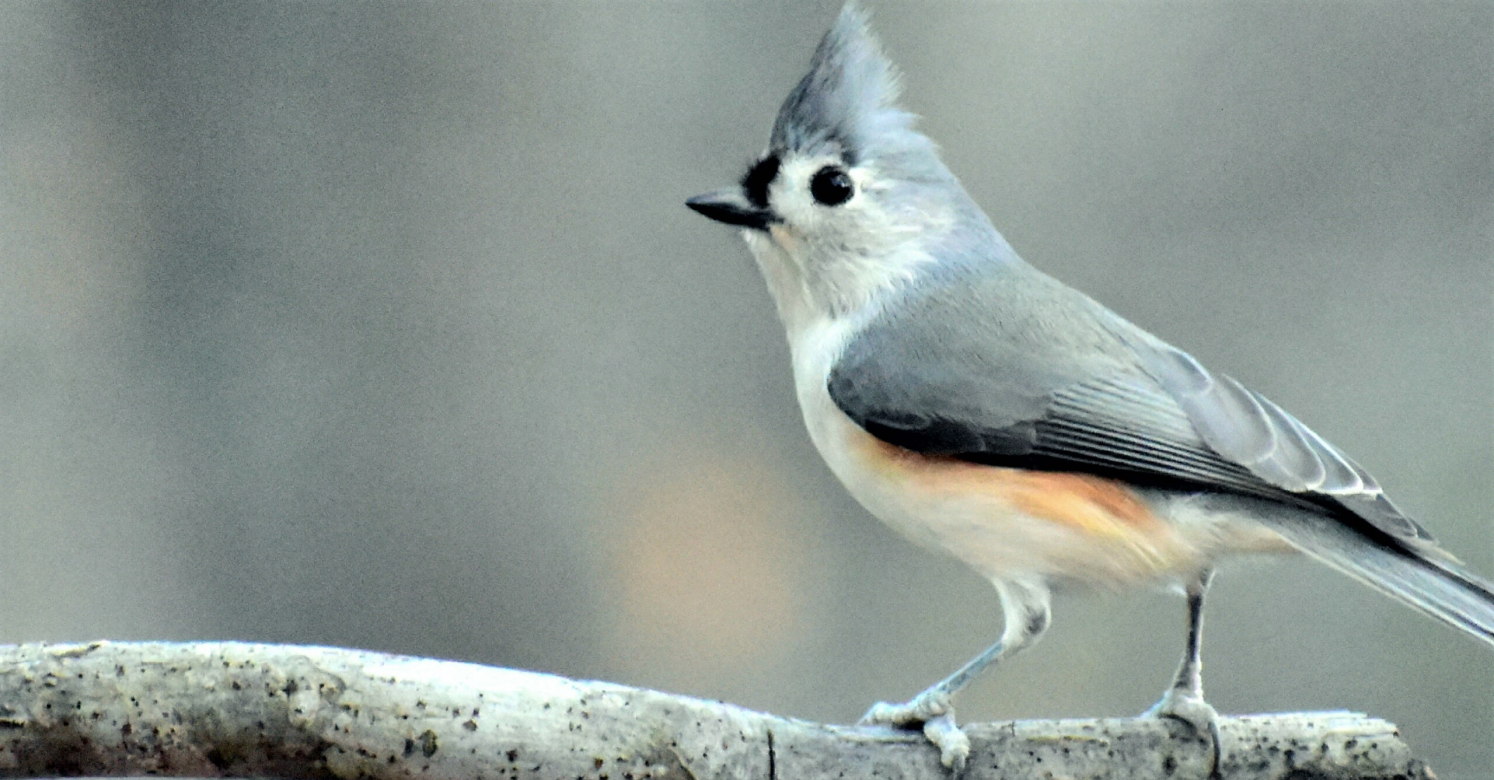
Tufted titmouse

One of the most common visitors to my feeder is the tufted titmouse. Titmice tend to announce themselves loudly when they land at the feeder. They have a variety of calls and songs, but the one I hear most often is listed on this link to the Audubon website as "tiska-say-say & other calls". Some of their calls sound very similar to a chickadee. Titmice often visit in groups, generally tolerating other birds sharing the feeder. Their most distinctive visual feature is the feathered crest on their head. One of their more distinctive behaviors is that they will take a seed from the feeder, fly to a nearby perch, hold the seed with their feet, peck it open and eat it, then return to the feeder and repeat numerous times. They will eat suet as well as seeds.

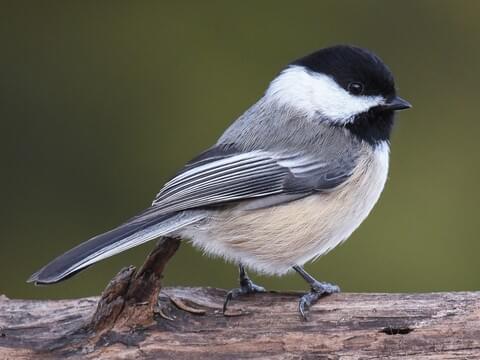
Black-capped chickadee

These little charmers are among the most tame of the birds I see. They're not afraid to hop very close to people, and if you are very patient and sit still for a long time, they will even take seeds from your hand. Their bodies look similar to titmice, with a dark back and pale breast with a bit of tan, but their heads have a distinctive black cap and chin patch. Like the titmice, they will often take a seed, eat it on a perch, then return for more. Their usual call is a recognizable "chicka-dee-dee-dee," and their love call is a plaintive "sweeeee-tie." They only eat from the seed feeder, and prefer sunflower seeds. 

American Goldfinch
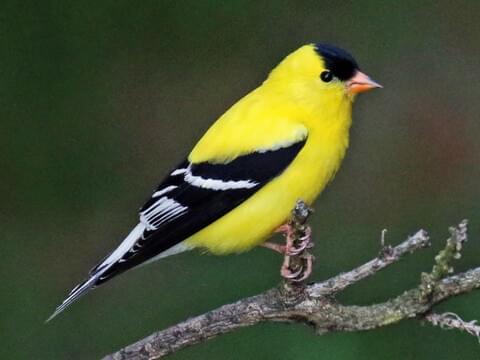
The male goldfinch is especially easy to identify by his vivid yellow plumage and contrasting black wings and tail. The females can range from a slightly faded yellow to a buffy brown with only a hint of gold. Both male and female tend to be brighter during the summer. They often come to the feeder in pairs. Unlike the titmice and chickadees, they will sit on the feeder for 10-15 minutes or more, eating their fill. They will also stop for a drink or even a quick bath if you have a birdbath. They have a lovely, twittery call, and will often chitter quietly while eating and frequently sing as they leave the feeder, as if to say "thank you." They eat from the regular seed feeder but prefer thistle seeds. They also love to eat sunflower seeds directly from the sunflower. 

Northern Cardinal
The cardinals also have a distinctive coloration difference between males and females, with males being a bright red, and females a buff color with darker back and tail with just a hint of red undertones. Both have a bright orange beak and a black mask, as well as the distinctive crest (which they are able to raise and lower somewhat). Cardinals prefer to feed on the ground, but will fly up to a tray feeder. They have a number of easily recognizable calls, the ones I hear most being a repeated chip-chip-chip (the alarm call) and a descending whistle that can turn into a Three Stooges-like "woob-woob-woob" mating call

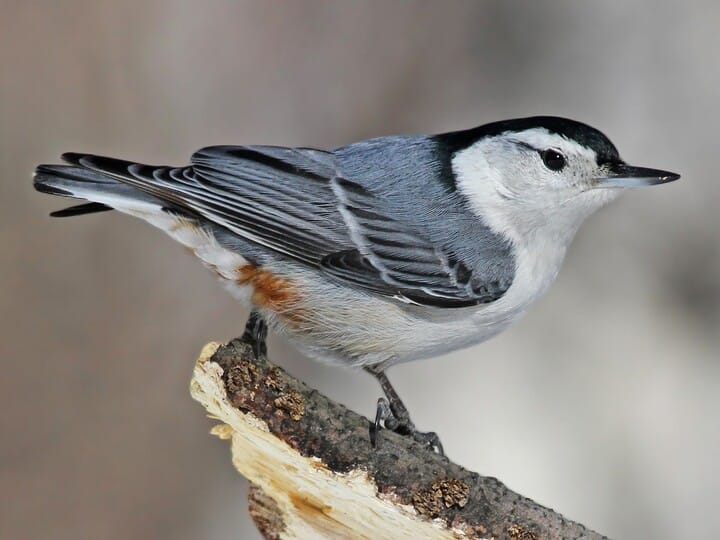
White-breasted Nuthatch
Nuthatches are easy to identify by their sleek shape and the black band over the top of their head, but also by their unusual habit of preferring to eat upside-down. They also have a distinctive and cartoonish-sounding "meep meep" call. They often come to the feeder several at a time, but occasionally get a little territorial and will flare their tails and squawk at other nuthatches. Nuthatches seem to enjoy seeds and suet equally.

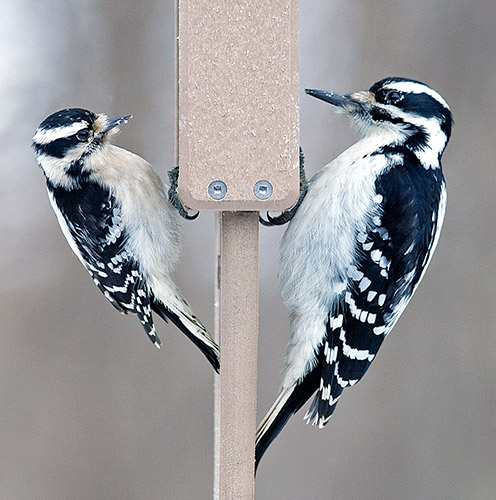
Hairy and Downy Woodpeckers
Downy (left) and hairy (right) woodpeckers are nearly identical, except that hairies are significantly larger and have a slightly heavier bill. I generally see downy woodpeckers at my feeder, but occasionally a hairy will visit. They prefer the suet feeder, but will also eat seeds now and then. They are quite shy and will not visit a new feeder right away. Males and females have similar coloring, except that the males have a bright red patch on their heads. They have a sharp, scolding call.

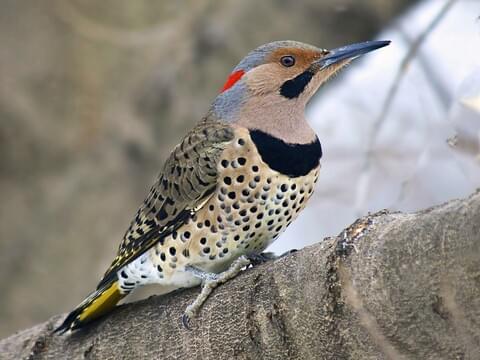
Northern Flicker and Pileated Woodpecker
Two fabulous but less-common woodpeckers that I've seen are the flicker (top) and the pileated woodpecker (bottom). The flicker tends to be a ground feeder and despite what looks like fantastical coloring, blends well into the grass with only its red head patch being noticeable. Its call is very similar to the downy woodpecker. The pileated woodpecker, on the other hand, has a loud, rather eerie, fast hoot that is unmistakable once you've heard it. It's also an impressively large bird, about the size of a crow, and with its large red crest, its silhouette when flying is a little reminiscent of a pterodactyl. 

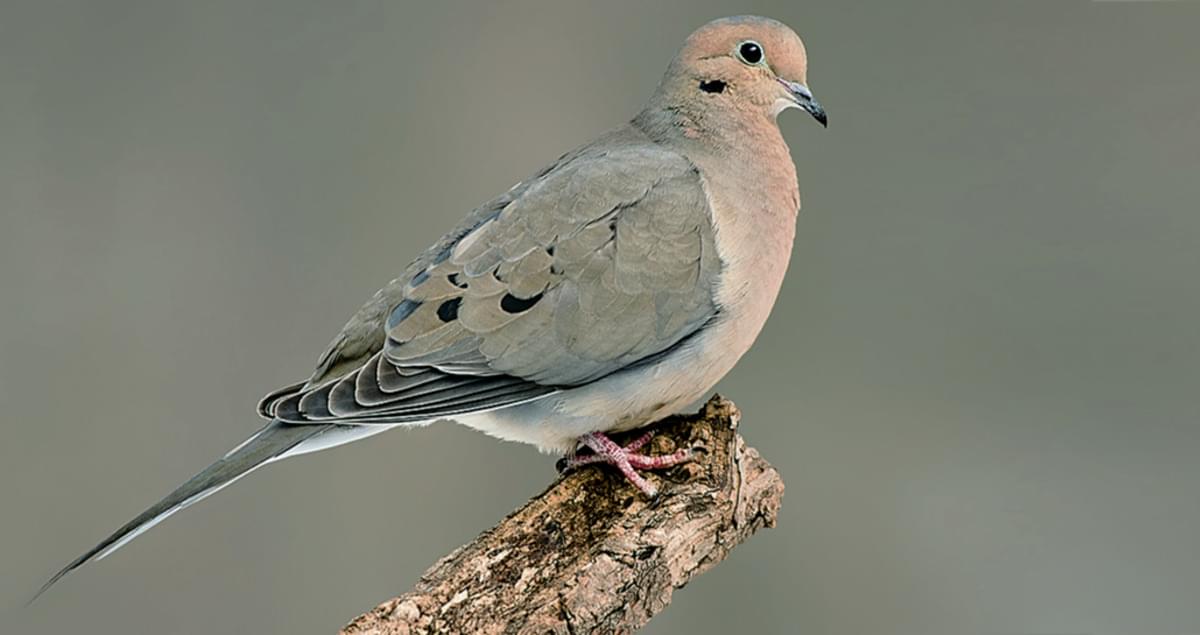
Mourning Dove
Mourning doves are ground feeders whose buffy brown coloring blends into the grass. When flying, they have distinctive white flashing visible along their tails, which are pointed. As well as the mournful hooting call that gives rise to their name, their wings make a distinctive sound called a "wing whistle" when they take off or land. 

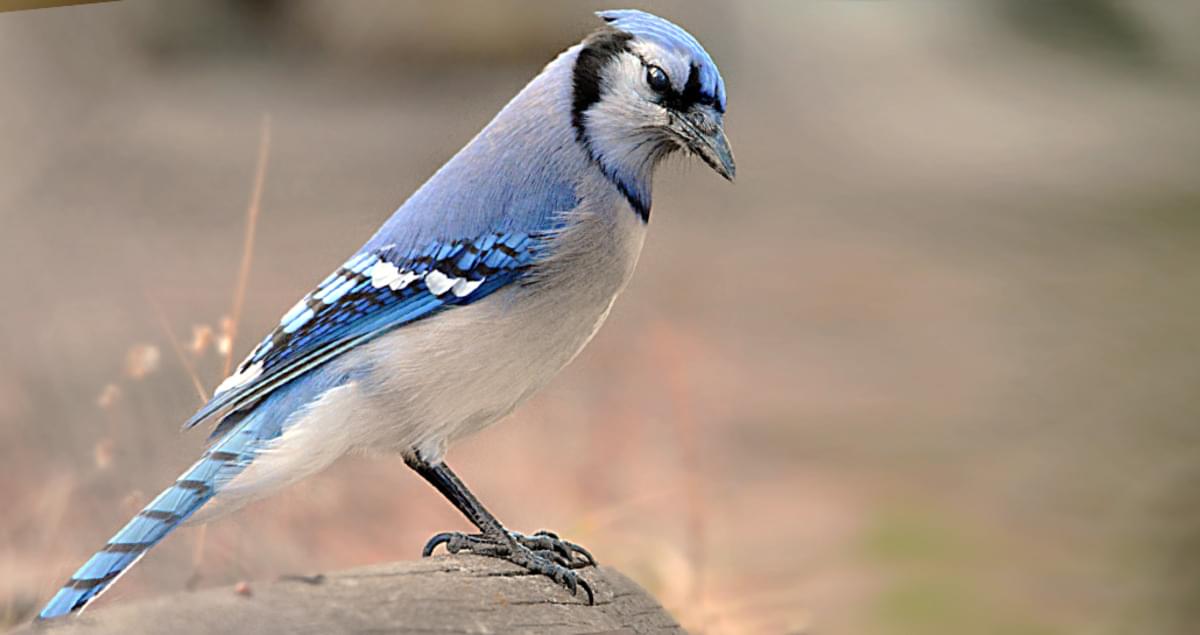
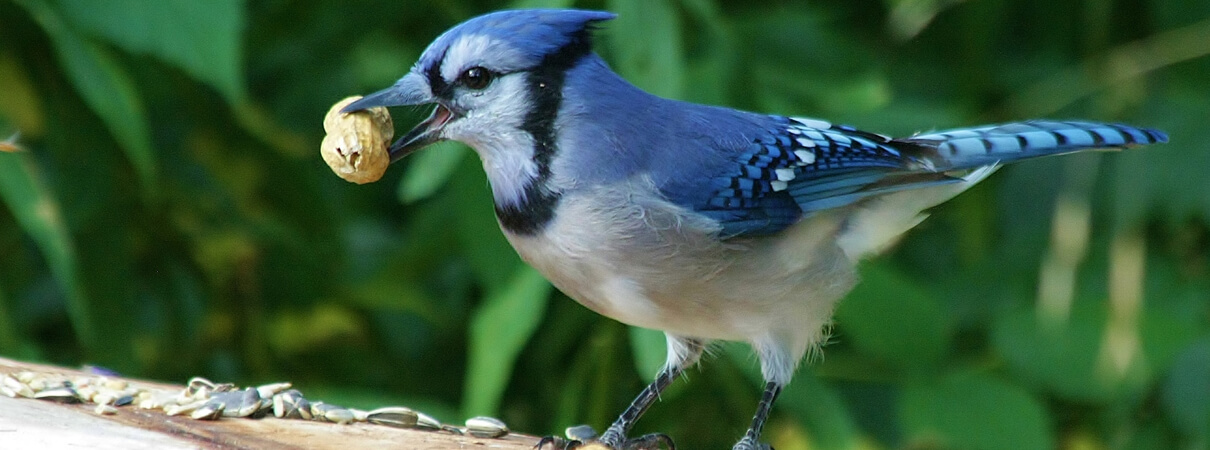
Blue Jay
The blue jay is one of the largest birds that comes to my feeder. They eat strictly from the suet feeder (and will also eat fallen bits of suet off the ground). They have a number of loud, strident calls and will frequently "shout" as soon as they land, especially if other jays are around. The most common is a monotone  "Jay! Jay!", but the also have a remarkable number of hugely varied sounds, including rattling their beaks and making a funny gargling noise. They frequently come to the feeder in twos and threes. They're somewhat clumsy (mainly because they're too big for the small suet feeder), and they're very funny to watch with their crazy antics in attempting to reach the feeder. 

Ruby-Throated Hummingbird
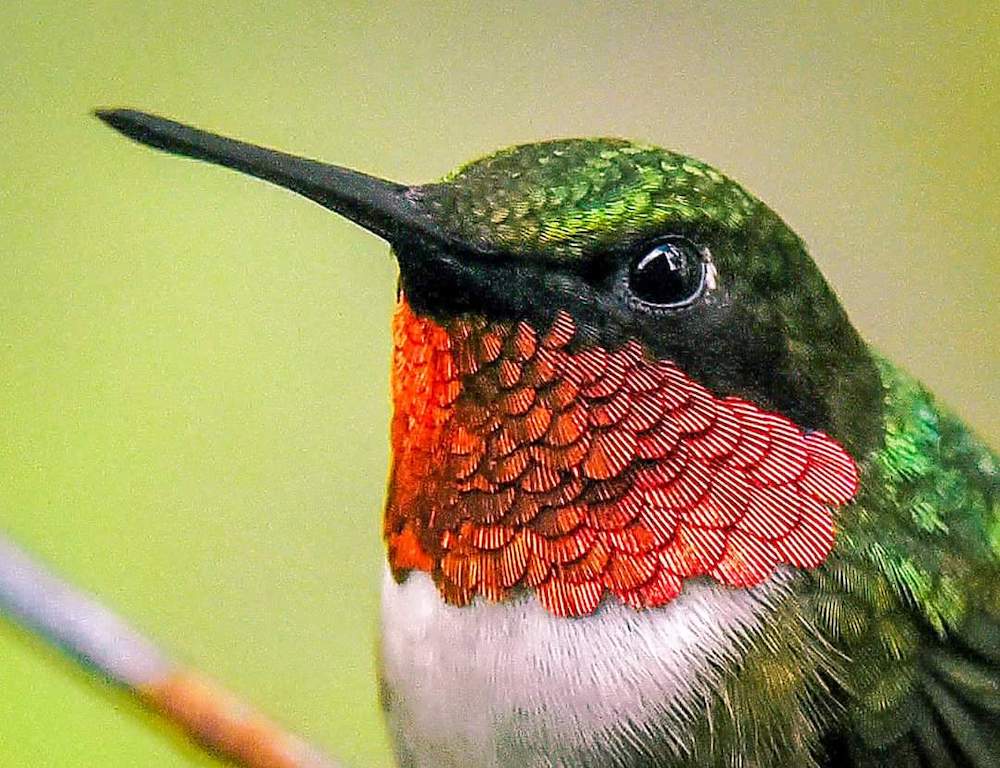
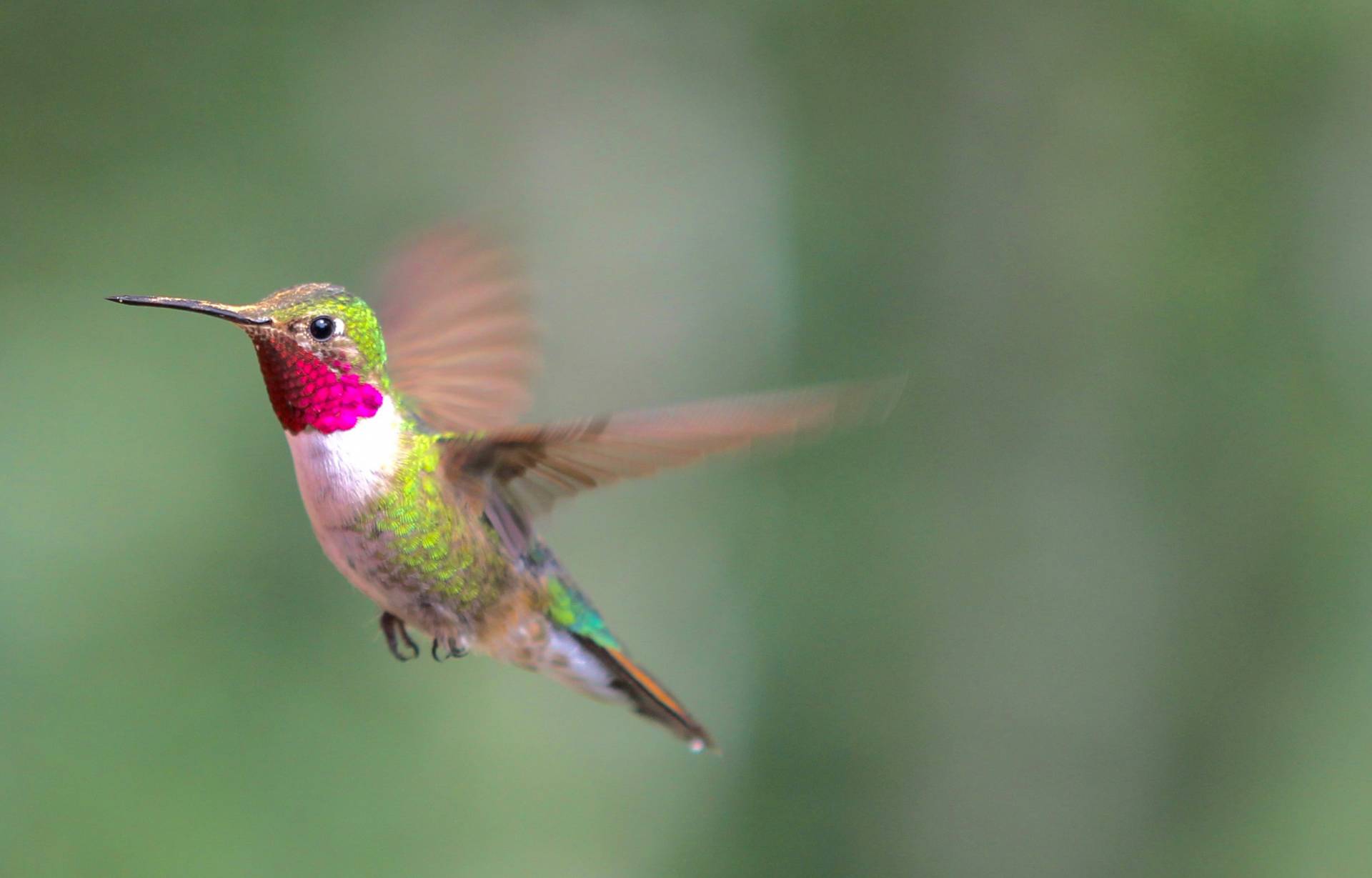
These tiny beauties are amazing to watch. The male has a bright red throat patch and is a slightly brighter shade of green. Hummingbirds are very territorial and will chase each other away from the feeder, spreading their tails and chittering furiously. Of all the birds that visit my feeder, the hummingbirds have the most individualized personalities. I've come to recognize a number of individuals by their behaviors: Captain Hook, who sits on the hook the feeder hangs from for a few minutes before eating; Kylo, whose wings make a light-saber-style WHOOSH when he comes to the feeder; Aunt Chatty, who twitters furiously to herself almost constantly; Parker. who frequently zooms over to within a few inches of the face of anyone sitting near the feeder. Some of them hover while eating while others stand on the perch. Most eat at one or two of the "flowers" on the feeder at each visit, while others only go to one, and a few circle around all the flowers before moving on. Next to the chickadees, the hummers are the tamest birds that come to the feeder. I suspect that if I had enough patience, I could hold a feeder in my hand and the hummers would come right up to me to eat. Their remarkable maneuverability is amazing to watch, as they stop and hover in midair, scoot backwards, and zoom at incredible speeds and to incredible heights. 

Other Rare Visitors
In addition to the flicker and pileated woodpecker, I've had a few other less common visitors. Here are some of my favorites.

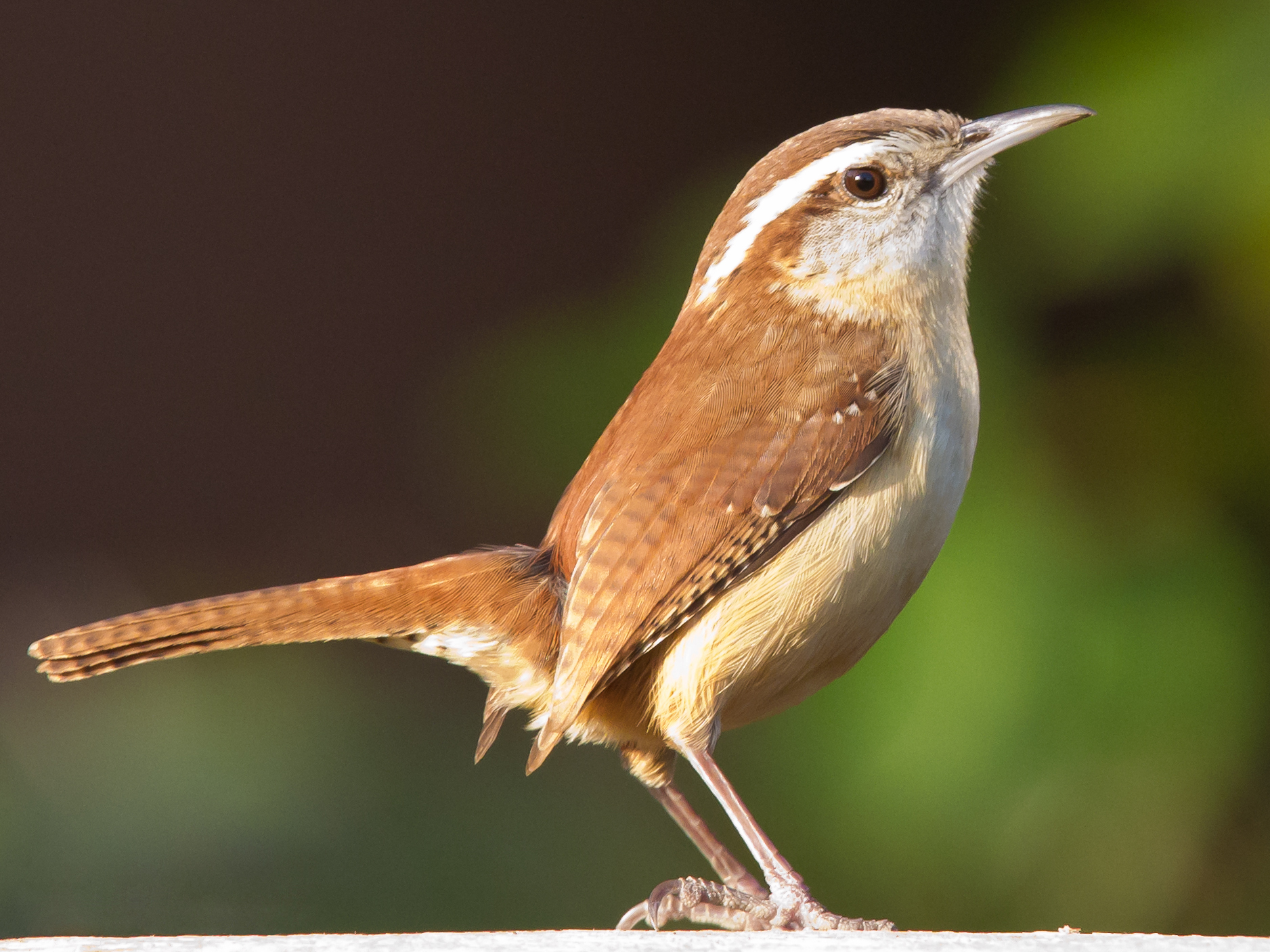
Carolina Wren
This bird looks unremarkable, but it has a beautiful voice. I frequently hear it singing in the trees, but I've only seen it once or twice. The first time I saw it, I had heard it singing and suspected it might be a Carolina wren, but I wasn't sure I was connecting the right voice with the right bird until it landed on my fence and posed beautifully while singing its song. The white eye bar helps to distinguish it from similarly-sized and -colored finches and sparrows. 

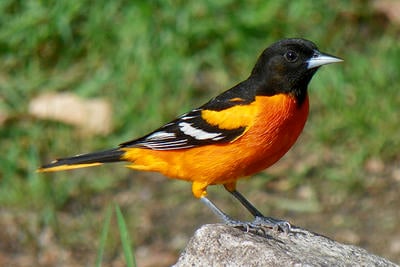
Baltimore Oriole
Oriole looks a bit like goldfinches, but their coloring is definitely more orange, and their entire heads are black. I haven't tried it, but I've read that hanging oranges cut in half will attract orioles even more than seed feeders. Their song is a musical whistle, frequently interspersed with "chucks". 

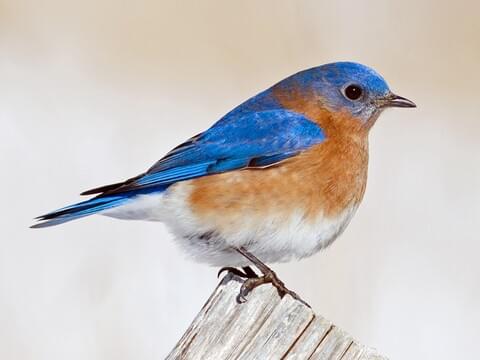
Eastern Bluebird
Bluebirds are an incredibly vivid shade of blue and are hard to mistake for any other bird. They tend to sing in brief bursts. Bluebirds are rare in New England due to invasive species like house sparrows and starlings, but they are beginning to come back, so sightings are uncommon but not unheard of. I've only spied one once not at my feeder but sitting on my fence, trilling contentedly. 

Northern Mockingbird and Gray Catbird
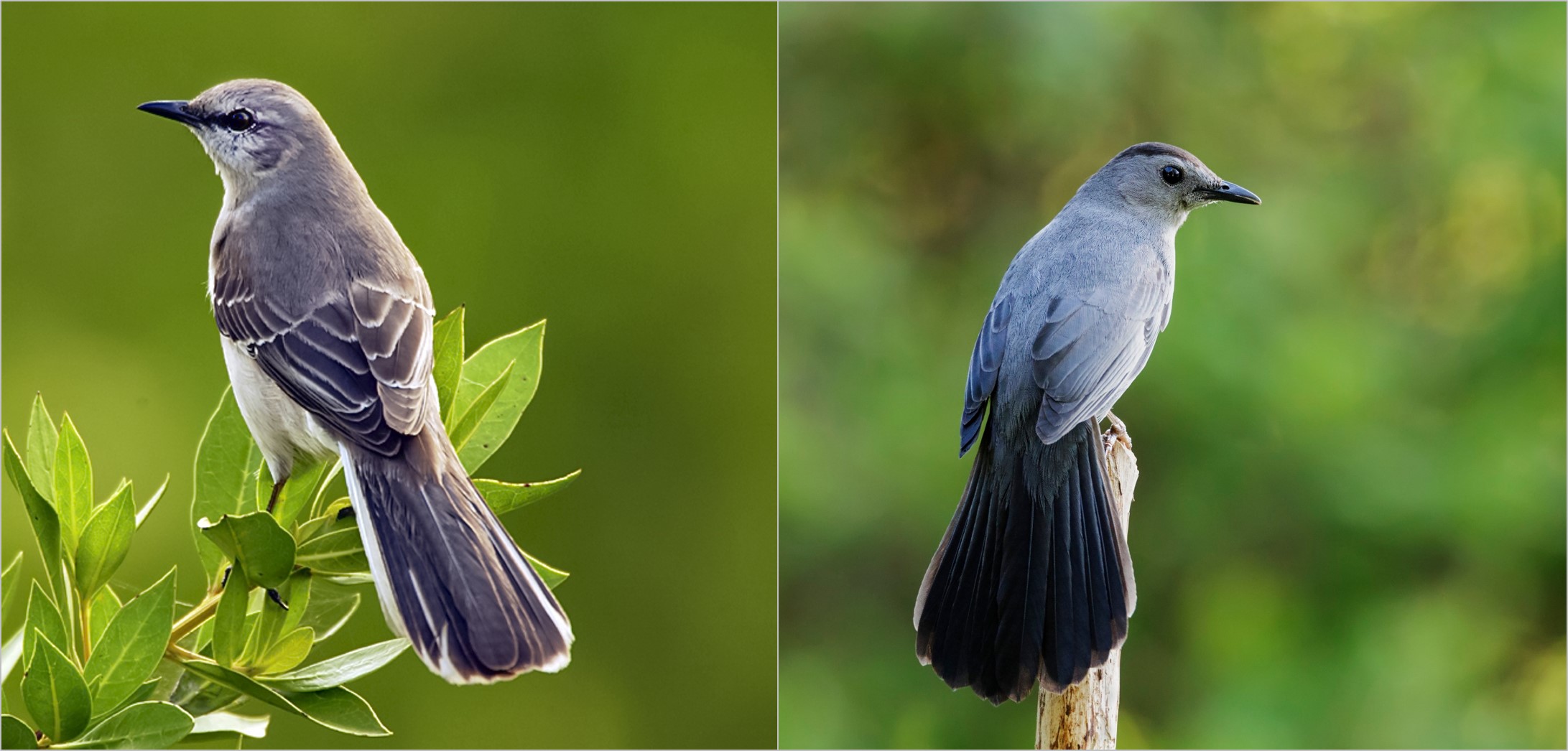
These two birds are easy to distinguish by their voices, but a little trickier visually. Mockingbirds can imitate a number of other bird calls (and other sounds, like car alarms) and will often rotate through their repertoire one after the other. It's entertaining until they start doing it at 4:30am outside your bedroom window. Catbirds are also capable of a large variety of sounds, but don't sing in the same repeating pattern as the mockingbirds. Their most recognizable call, from which they get their name, is a harsh, repeated "mew" reminiscent of a cat's meow. As for looks, they're a similar size, mostly gray with a flared tail, but the mockingbird has a paler breast and noticeable white flashing under the tail and wings which is especially visible when they fly. Both will often perch atop the highest branch of a tree and sing (which is the origin of the expression, "sitting in the catbird seat"). 

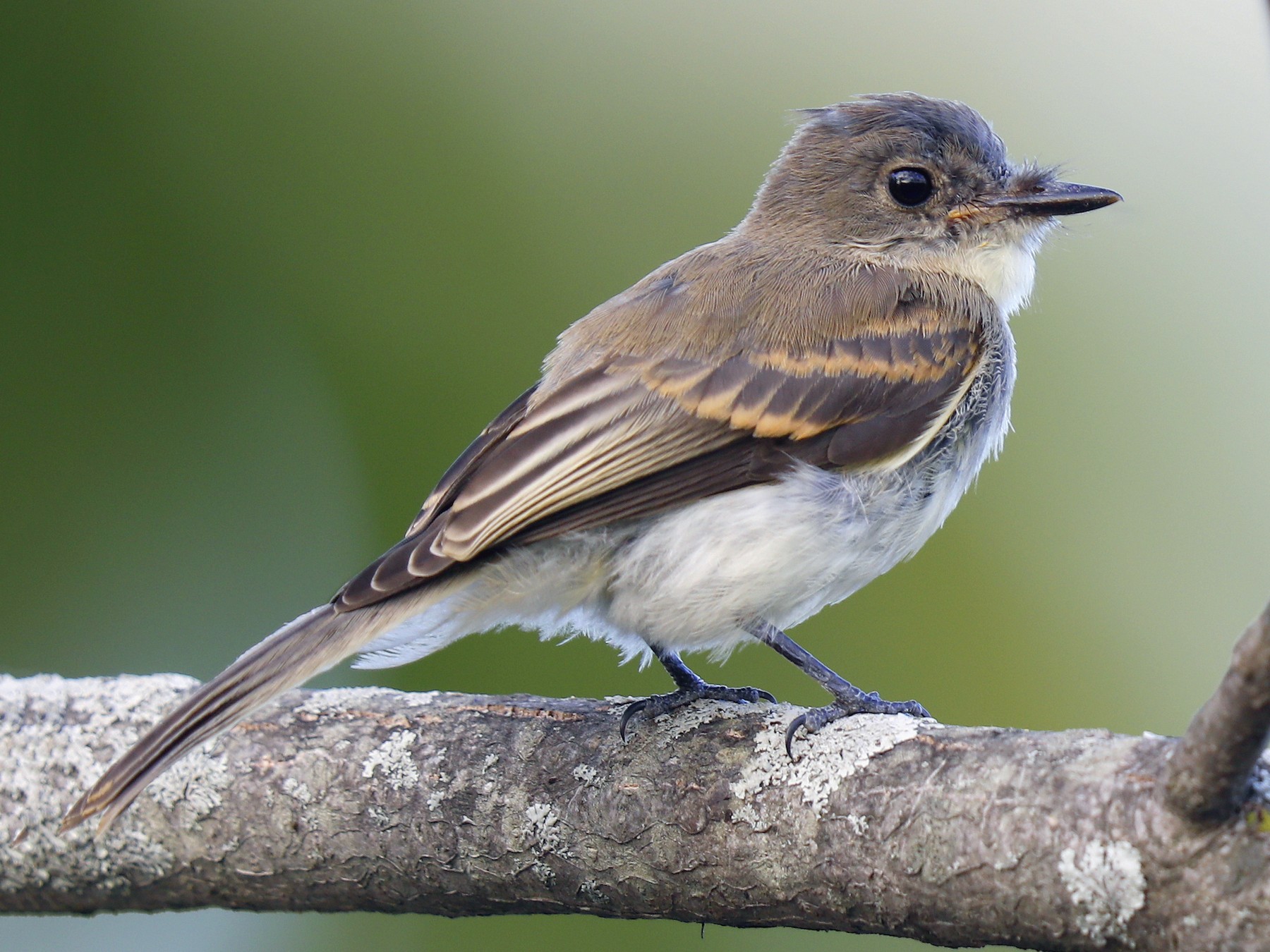
Eastern Phoebe
Another bird that I hear frequently but see rarely, the phoebe looks much like other finches and sparrows. Its voice is easier to identify than its looks. It sings its name: "Fee-bee!" I hear them in the trees most mornings, but I've only seen them near the feeder once or twice (although it's distinctly possible that I've seen them but mistaken them for house finches).

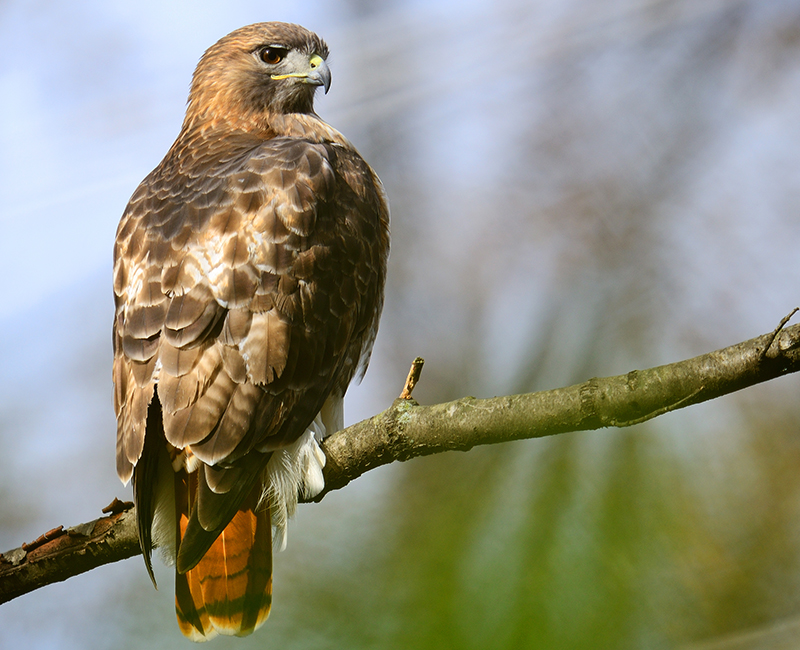
Red-tailed Hawk
We see these gorgeous creatures soaring overhead quite often, but on two occasions they've perched right in the yard, once in a tree and once on the fence right next to the bird feeder (no doubt, waiting for some of the birds coming for dinner to BECOME dinner). There are several species of hawks in our area, including Cooper's, red-shouldered, and harriers, but the ones we see most often by far are the red-tailed, which are easy to identify in flight because of their (surprise!) red tail. Its call is the recognizable screech of a raptor, which in movies is often dubbed over the much less intimidating "screech" of an eagle (which sounds more like  a seagull). 

Have fun watching and learning about your feathered neighbors!

Bookmark and Share

Wednesday, July 22, 2020

Cast of Characters

I have now lived in my new house for a little over a month, and in that time I've gotten to know many of the birds and critters that hang around. In fact, I've gotten to know them so well that I've named many of them. Let me share with you some of the characters that visit us regularly.

Lenny (and Jenny, and Benny, and Kenny, and Denny), the Bunnies

I can't take credit for naming the bunnies; my kids came up with the whole "-enny" naming scheme at our old house. We love watching the -ennies while we (and they) are enjoying dinner outside. Most of them are impossible to tell apart, but there is one who loves to flop down in the cool dirt at the side of the house, as well as several clearly younger, smaller bunnies, including the cutie in the video above.

Larry, Moe, and Curly, the Blue Jays

I'm pretty sure that Larry and Moe are Mom and Dad, and Curly is junior. Curly has a tendency to whine a lot, and he is also a bigger klutz than the other two combined (and that bar is set relatively high). They're all a little too big to sit comfortably on the suet feeder, so they have a habit of frantically flapping their wings while eating in an attempt to keep their balance. Larry and Moe teeter on the edge of control but Curly has fallen into the rhododendron on more than one occasion.

Captain Hook (aka "Cappy"), the Hummingbird

Most of the hummingbirds won't put up with another hummingbird at the feeder while they're eating, but Cappy takes it to the next level. Before he eats at the feeder, he sits on top of the hook it hangs from and surveys the area, as if daring other birds to come near. Should another bird approach while he's at the feeder, he chases it away, twittering furiously. And he doesn't just chase it a few feet away, he zooms around the yard following it for several minutes. He is clearly the alpha bird and makes sure everyone knows it.

Toby, the Groundhog

Toby is just a little guy, as groundhogs go, which makes me suspect he is a baby. He wanders around the back yard, hoovering weeds and clover like it's going out of style. He trundles around on his chubby little legs, staying as near as he dares when chased, cheekily peeking back at the aggressor (me) from his perch on top of a big rock at the edge of the woods. So far he's been quite well-behaved, not attempting to eat our herbs or tomatoes or even the flowers in the garden. As long as he only munches on the lawn and the weeds, I'm happy to have him around. Hopefully he's smart enough to understand that we'll leave him in peace as long as he stays away from the good stuff.

Stumpy and Wallenda, the Chipmunks

Stumpy was actually the very first animal I named at the new house. There were probably dozens of chipmunks that we saw on a regular basis, zipping back and forth between the pool yard, the gardens, and the woods, but Stumpy was distinctive because of his unusually short tail. Chipmunks, like warthogs, have a hilarious tendency to hold their tails straight up in the air when they run, so Stumpy was noticeable and identifiable even when moving.

Wallenda, on the other hand, may actually be more than one chipmunk, but since I have never seen two chippies attempt his acrobatics at the same time, I am inclined to think that Wallenda is a single individual. His distinctive behavior is his ability to climb the shepherd's crooks that the feeders hang from, and to acrobatically climb down into the feeders and gorge himself on the seeds inside. I have seen a number of chipmunks attempt this maneuver, but they all chicken out when they reach the top of the crook, or else they attempt to jump from post to feeder but fail miserably. Only Wallenda has displayed both the nerve and the physical ability to complete the maneuver.

Flower, the Skunk

Flower is the one animal on this list that I have never seen in person. But he (or she) makes an appearance several nights a week on our security camera, trundling around the pool yard in the middle of the night or the wee hours of the morning. And I assume he (or she) is also the cause of the occasional divot in the lawn that appears overnight. We have a terrible Japanese beetle problem, so Flower is welcome to eat as many adult beetles and grubs as he (or she) can hold. 

Rambo, the Attack Robin
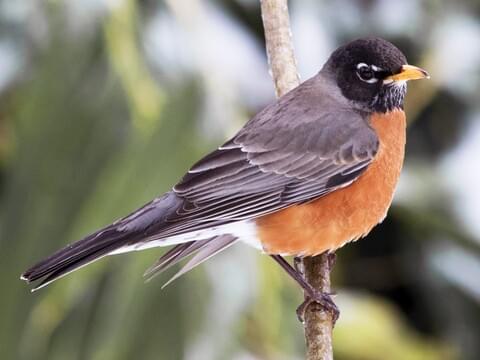
I have yet to capture Rambo on film, mostly because his best work takes the form of sneak attacks. Rambo hates blue jays. I mean, he HAAAAAATES blue jays, with the fire of a thousand suns. He will not allow them to have anything to do with the bird feeders while he is in the yard. If he catches sight of them, he screeches and dive bombs them and chases them out of the yard. He simply explodes out of nowhere and scares the bejeebers out of them (and often me). Even when there are three of them and only one of him, he does not hesitate to attack. I know that robins are territorial but I've only seen them exhibiting this behavior against other robins. Maybe Rambo is color blind and thinks the jays are robins; I just don't know. All I know is that Rambo is the Snape to Larry. Moe, and Curly's Harry, Ron. and Hermione.

I'm sure that over the course of time, I'll get to know more of my furred and feathered neighbors. I just hope they're all as funny and fascinating as the ones I've met so far!

Bookmark and Share

Thursday, July 16, 2020

If Birds Were Celebrities

The other day, my husband and I were laughing at the antics of some blue jays at our bird feeder. The jays like to eat from the suet feeder, but they're much larger than the usual birds that use it, so they tend to crash land and swing crazily for a few moments. I commented to my husband, "They're big, friendly, good-looking lugs. They're like the the golden retrievers of the bird world." Then I thought for a moment, and I added, "If they were people, they'd be Gronk."

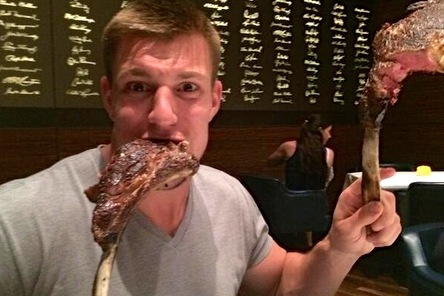
If you're not from New England, or if you're not a football fan, you might not recognize "Gronk" as former New England Patriot Rob Gronkowski, who is known for not only being an incredibly talented athlete, but also for being a hilarious, friendly goofball. He's handsome, he's clearly smart (at least in a certain way), but he's a big goof. He is, basically, a blue jay.

Blue jay = Rob Gronkowski

So, if blue jays are Gronk, what are the human equivalents of some of the other birds I frequently see at my feeder? Let's see...

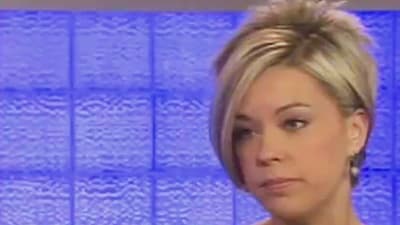
The titmice are the most frequent visitors to my yard. They have a tendency to loudly make their presence known as soon as they arrive. They nearly always sound angry or out of sorts. They rarely arrive alone; they seem to move about in large families. One of their most distinctive features is their unique "hairstyle," a little crest that sticks up at the back of their head. They can get a little grating after a while, but somehow you still feel the need to watch their antics. What celebrity comes to mind who also fits that description? I have to go with...Kate Gosselin.

Titmouse = Kate Gosselin

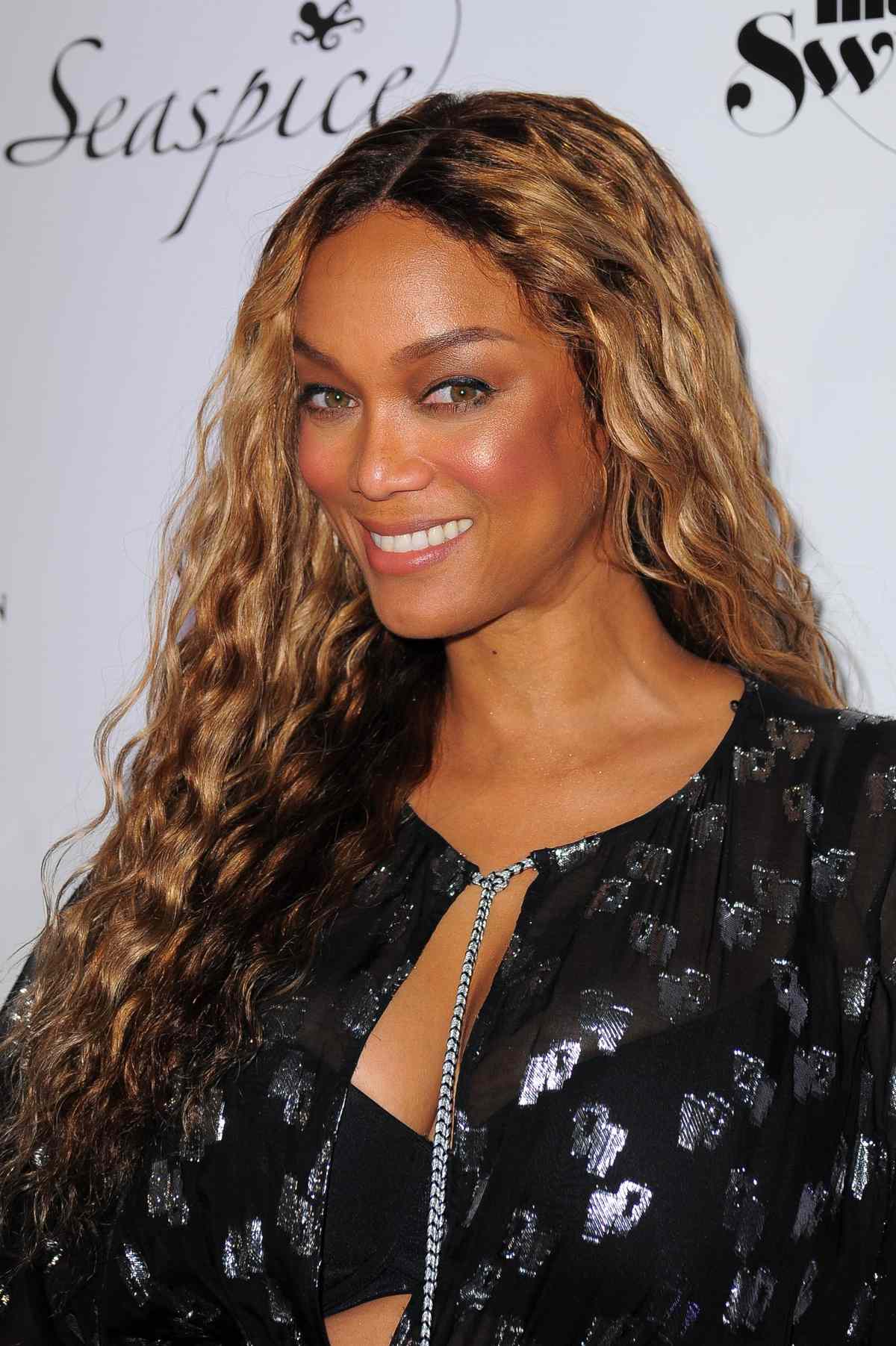
Next, we have the hummingbirds. They are flashy, sporting bright colors and sparkly highlights. They immediately take charge of the situation and drive out all competitors wherever they go, sometimes to the point of being bullies. Sometimes they disappear for a while, but they always come back, often staring at nearby humans as if to make sure they're the center of attention. Also, they don't eat much. They are, without a doubt...Tyra Banks.

Hummingbird = Tyra Banks

One of my favorite visitors is the cardinal. The cardinal rarely makes a fuss, but somehow it's always noticed. Cardinals generally travel as a mated pair, with one of them clearly outshining the other sartorially and attracting more notice because of its bright plumage. The human equivalent of cardinals is, no doubt...Prince William and Kate Middleton (but with the genders reversed, obviously).

Cardinals = Prince William and Kate Middleton

One of the more rare visitors to my feeder is the Carolina wren. It is one of the birds that I hear frequently, but see much less often. It has a gorgeous, melodic voice that I would gladly listen to for hours, and despite its generally drab plumage, it's quite lovely to look at. Its human equivalent is...Adele.

Carolina wren = Adele

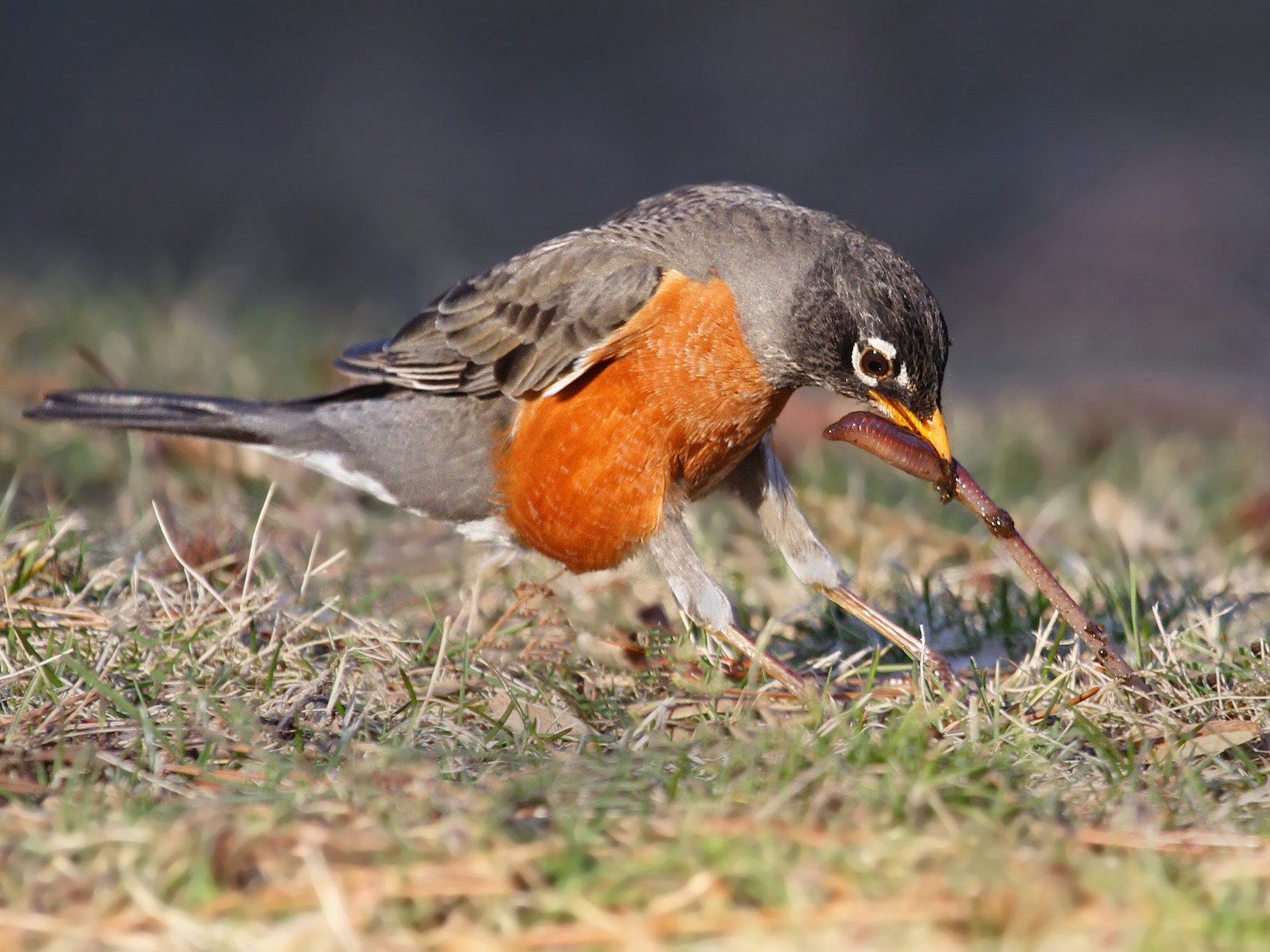
Although they don't care for the bird feeders, one of my most frequent visitors to the yard is the robin. Easily recognized by most people, the robin is known for its parenting style and will fiercely defend its young and its territory, often in a strident and unpleasant tone. Its food choices are thought by many to be rather unappetizing. The robin is...Gwyneth Paltrow.

Robin = Gwyneth Paltrow

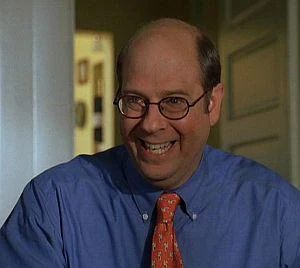
One of the shyer and more reticent birds in my yard is the woodpecker. Starting off very nervously, the woodpecker takes some time to get comfortable with being watched. It is somewhat awkward until it feels comfortable (and sometimes even then), preferring to let others go first and lurking in the background whenever possible. Its human counterpart is...perpetual second banana Stephen Tobolowsky (aka, "Hey, it's that guy!").

Woodpecker = Stephen Tobolowsky


What do you think? Am I right, or am I right??


Bookmark and Share

Monday, July 13, 2020

What I Have Learned About Birds

In the past month in my new home, I have probably done more bird-watching than I had in the prior 50 years combined. I have a large arched picture window outside my family room, with three feeders on hooks just outside the window: a hummingbird feeder, a suet feeder, and a seed feeder. I have spent countless hours watching the birds, trying to identify the less familiar ones, and even working on matching the songs and birdcalls I hear in the trees to the actual birds landing on the fence and the feeder. It has been quite an education. Here is what I've learned about the birds that have visited:

1. Titmice like to holler. They hardly ever land at the feeder without screeching their presence. They are not stealthy birds.
2. Ditto for bluejays. They crash-land on the hook then yell for a while before they think about eating.
3. Baby bluejays have super whiny voices.
4. Titmice travel in packs. It's incredibly rare to have a single titmouse visit the feeder without another arriving either with it or immediately afterwards, and often 3 or more.
5. Finches and titmice are good sharers. They are happy to eat at the feeder with other birds there, of the same or different species.
6. Woodpeckers are shy, and will wait until all the other birds are gone before coming to the feeder. They also usually sit on either the hook or the feeder for several minutes, looking nervous, until they get up the courage to eat. This occasionally includes sliding down the pole, ever-so-slowly, pretending they meant to do that.
7. Robins HATE bluejays. Like, HAAAAAAAAATE them. The robin will chase the bluejays out of the yard if they dare to approach the feeder while the robin (which, by the way, does not eat from any of the feeders) is in the yard. Even when it's one robin to three bluejays.
8. Bluejays are giant cowards.
9. Hummingbirds are tiny little bullies. They will take on any other bird that's nearby, from another hummingbird to multiple bluejays. They are not good sharers.
10. It's difficult to distinguish individual birds of most species; however, occasionally one individual will exhibit a distinctive behavior. Although some hummingbirds eat while hovering and some land on the rail and stand while they eat, we have one male who sits on top of the hook for a few minutes before and/or after he eats, as if establishing his sovereignty. He will not only chase away other birds, he will follow other hummingbirds around the yard, hollering at them in his squeaky little hummingbird voice. I have dubbed him "Cap," which is short for Captain Hook. It suits him.
11. Hummingbirds SQUEAK?!?? Yes, they do. Usually while flying, and nearly always when chasing another hummingbird.
12. Carolina wrens like to hang around near the feeder and sing, but rarely come to eat.
13. Goldfinches will sit at the feeder for 5-10 minutes at a time while they eat, never leaving their perch.
14. Titmice grab a single seed, fly to the top of the hook, hold the seed with their feet, peck it open and eat it, then FLING the seed hulls into the air before returning for another seed. They will do this for several minutes at a time.
15. Cardinals only graze on the ground, never on the feeder. They rely on the messy birds to knock seed onto the ground for them. Fortunately, there are plenty of messy birds.
16. Bluejays attempt to eat from the suet feeder, but they are so large and clumsy that they set the feeder to swinging and have to wait for the movement to stop so they can eat. After several attempts, they usually give up and eat the bits that have fallen into the rhododendron bush below, which provides much firmer footing (as well as some degree of concealment from the attack robin).
17. Hummingbirds only eat from the hummingbird feeder.
18. Bluejays only eat from the suet feeder.
19. Titmice prefer the seed, but will also eat the suet.
20. Woodpeckers prefer the suet, but will also eat the seed.
21. Hummingbirds like to hover in front of the window and peer inside, either before or after they eat. If you are outside, they will occasionally do the same to your face.
22. Everybody hides when the shadow of the turkey vulture passes overhead.
23. Chickadees are heard much more often than they are seen. Ditto for cardinals.
24. Hummingbirds can be very small. Dragonflies can be very large. They are easily confused, until they move. Hummingbirds occasionally drive away dragonflies. Not sure if they are also confused and think the dragonfly is another hummingbird, or maybe they're just jerks. I'm leaning toward the latter.
25. Much like children, birds often hang around and pose adorably right until you get your camera handy, at which point they either leave or present you with their least flattering side.

Oh - and one more thing to know about birds: Watching them is good for the soul.


Bookmark and Share

Thursday, July 2, 2020

Bird Cocktails

It's been quite a while since I've written a cocktail blog, so I figure I'm about due. And since I've been spending so much time in my new house watching the birds at my feeder, I thought it might be fun to do a blog on bird-inspired cocktails! Here are a few of my favorite feathered visitors and the delectable concoctions they inspire.

Woodpecker

Believe it or not, there is actually a cocktail called the woodpecker, and it is one of the simplest cocktails imaginable. Simply pour some vodka over ice in an old-fashioned glass and add a few dashes of bitters.

Hummingbird

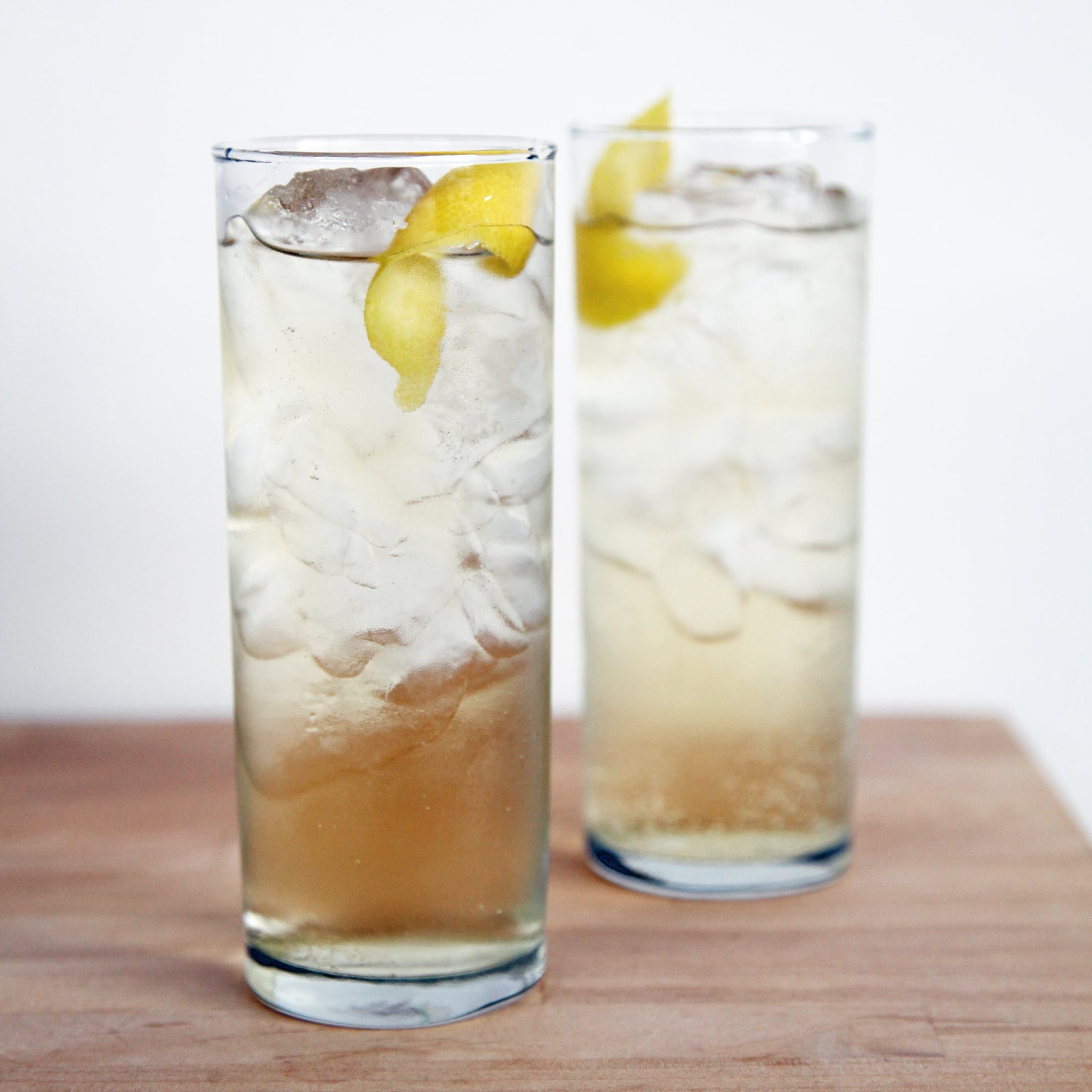
The hummingbird cocktail is also relatively simple: In a tall Collins glass with ice, stir together 2 oz champagne or sparkling wine, 1-1/2 oz St. Germain, and 2 oz club soda. Garnish with a twist of lemon.

Chickadee
The festive Chickadee Cocktail is created by putting two scoops of rainbow sherbet into a highball glass, then adding 4 oz coconut rum, 2 oz vodka, and 6 oz Sunny Delight orange drink (do not stir!), and adding a cherry for garnish.

Titmouse
I couldn't find a cocktail called a Titmouse, but believe it or not, there is a kind of vodka called "Two Titmice," and one of the recommended cocktails on their website was called the "Ta Ta Martini," which is something like a Cosmopolitan. In a shaker over ice, combine 2 oz Two Titmice vodka, 1/2 oz triple sec, and a splash of cranberry juice. Strain into a chilled martini glass with a sugared rim and garnish with a lemon twist.

Great Blue Heron


The Blue Heron cocktail is made by muddling 4 basil leaves and 2 teaspoons of sugar in an old fashioned glass, then adding 1 oz sparkling water and 3 tablespoons frozen blueberries and muddling again. Add some crushed ice along with 1 oz lime juice and 1-1/2 oz rum and stir. Garnish with a few blueberries on a skewer and a sprig of basil.

Blue Jay
The Blue Jay is a simple shot that combines equal parts vodka, blue curacao, and milk. Shake over ice and strain into a shot glass.

American Goldfinch

Although there is another extremely complicated cocktail called the Goldfinch, the American Goldfinch cocktail is simpler. In a cocktail shaker over ice, combine 4-1/2 oz bourbon, 1-1/2 oz dry curacao, 1 oz lemon juice, and 4 oz apple juice. Shake and strain into a chilled cocktail glass rimmed with brown sugar.

Robin
There are a number of robin-themed cocktail recipes out there, but the Robin's Nest looked the most festive and refreshing to me. In a cocktail shaker over ice, combine 1 oz vodka, 1/2 oz creme de cacao, and 1 oz cranberry juice; shake and strain into a chilled cocktail glass and garnish with a cherry.

Cardinal
With its striking coloring, it is no surprise that the cardinal has a number of cocktails named after it. The least obscure and most appetizing version I found is made by combing 1-1/2 oz rum, 1/2 oz maraschino cherry liqueur, 1 teaspoon triple sec, and 1 teaspoon grenadine in a cocktail shaker over ice, and straining into a cocktail glass. Garnish with orange peel.


Happy bird watching - and drinking!


Bookmark and Share