Showing posts with label 2017 Tony awards. Show all posts

Tuesday, June 13, 2017

2017 Tony Awards: Red Carpet Review

Sadly, the red carpet for the Tony awards gets much less coverage that most red carpet events.  I'm not sure why, because most theatrical performers are, not surprisingly, dramatic.  And we all love to dress up at the drop of a hat.  Yet I struggled to find a complete collection of red carpet photographs from last night's Tonys.  However, I did find photos of enough interesting looks to put together a review.  Here goes!

Kate Baldwin's one-shouldered cobalt blue satin wrap gown was stunning, particularly with her beautiful red bob and peaches-and-cream complexion.  The fabric was a bit wrinkled, but that almost worked into the intriguing seaming, and the tailoring was excellent. I loved the slight puffiness of the short train, which lent it some nice structure.  The cut was simple with just enough interesting details to be striking. A really lovely look.

I loved the fabric of Amanza Smith Brown's gown, with its embroidered red flowers on a white chiffon background.  I loved the way the A-line skirt flared softly and I liked the three white bands around the waist, but the bodice was not shaped correctly and looked very uncomfortable as well as overly revealing.  A slightly narrower V in the bodice and this look would have knocked it out of the park.

I wasn't sure if I liked Glenn Close's gown when I saw her sitting down, but I really liked it in full view.  I thought the patterning of the fabric was interesting and graceful, and almost slightly geometric.  The squared neckline was flattering, as was the slit in the wrapped skirt, both of which allowed some skin to show but in a restrained and classy way.  The styling was age appropriate without being matronly.  And the silvery blue color was stunning with Close's close-cropped silver hair, which set off those incredible cheekbones and intense eyes. A beautiful and elegant look.

Jenn Colella's dramatic black and white ensemble was one of the most striking looks of the evening, and one of my personal favorites.  Her slim black skirt was topped with a structured white bodice and full cutaway front overlay skirt.  The sharp diagonal angles of the neckline were balanced beautifully by the soft draping at the waist, and the tiny pops of bright red in her bag and lipstick were the perfect accents. She would have looked right at home on a Paris runway.

I liked Tina Fey's dress at a distance better than close up.  The fringe at the bottom of her openwork sheath dress worked for me, creating a subtle, textured flare, but the bits of eyelash fabric on the main body of the dress just looked messy and actually detracted from the lovely openwork of the fabric. The dress was a great silhouette on her, though, so overall, it was a nice look.

Sally Field also wore an age appropriate gown that was far from matronly.  Her midnight blue, off the shoulder lace sheath with train was flattering, if unremarkable. She wears this color often, and it sets off her dramatic coloring beautifully. The most positive aspect of this gown is that it fades into the background so that you focus on the wearer, not the dress. Which is not a bad thing.

Sutton Foster opted for a very traditional black beaded gown with plunging neckline and slightly full skirt.  Black is always lovely with her dark hair and pale skin, and the halter style bodice showed off her tall and slender figure to perfection.  Proof that simple can be striking.

 
Jane Houdyshell, Paula Vogel, and Anna Fausto-Sterling were three of several older women wearing striking pantsuits.  All three wore loose-fitting black pants and tunic style blouses topped with long, loose silver jackets.  Elegant, if a bit casual, these ladies looked comfortable but still right at home on the red carpet. Extra points to Fausto-Sterling for the touch of color in her soft turquoise scarf.

Keltie Knight sometimes hits and sometimes misses on the red carpet, but she's never afraid to take a risk.  In this case, however, that risk did not pay off.  The shape of the neckline is quite pretty, with its black scalloped lace, but the shoulders are too square and puffy, and the black granny panties with tight, see through lace pants were just plain ugly.  And her nearly nude makeup and boring hair aren't helping any. She's a stunningly beautiful woman, but this outfit does its best to conceal that fact.

I loved Mimi Lien's metallic gold flapper inspired gown.  The angled hemline was graceful and the horizontal bands of fabric across the bodice concealed just enough skin to avoid looking trashy.  I'm not sure whether the multiple gold chokers were part of the dress or not, but I loved them. There were just enough non-period details to make the dress couture instead of costumey. And the dress had really beautiful movement and swing. But the best part of the gown was how perfectly it echoed her fascinatingly melded vintage/contemporary design for Natasha, Pierre, and the Great Comet of 1812, for which she won the Tony for Best Scenic Design of a Musical.

I wanted to love Laura Linney's dress, I really did.  And I do love the silhouette, especially the shape of the bodice and the narrow belt tying in one of the colors of the print.  But the hem was too long and the fabric pattern was too busy.  I think I might have liked it at a cocktail length, but as a full length gown it was just too much and too busy.

Bette Midler's gown was surprisingly bland.  I loved the flared ruffles on the sleeves and the overall silhouette, but the simple neckline and drab fabric were just boring.  Change the neckline to a V or square neck and change the color to emerald or scarlet and it would have worked. Midler is just too big of a personality to wear such a bland dress. She did, however, end up taking home the Tony for Beat Leading Actress in a Musical, so that was a pretty nice accessory. 

Patina Miller's electric pink maternity gown was simple but pretty.  The color was terrific on her, but I would have loved just a few more interesting details.  Perhaps a touch of lace or scalloped finish at the neckline or a statement necklace or bracelet, or even a whimsical clutch would have given her that needed pop. But her pregnancy glow was the best accessory she could have had, and she did look truly lovely.

I loved the geometric patterns of Eva Noblezada's black and white ethnic inspired dress.  The chain of circles at the shoulders and hem softened the straight lines, and the peeps of skin at cleavage, waist, and thigh were modestly covered with lacing.  It was both visually interesting and flattering, and she wore it beautifully.

If I could have chosen any gown from the Tony awards to add to my own closet, it would have been this stunning jeweled halter worn by Cristina Ottaviano.  The bodice was encrusted with dark and light purple and amber jewels, which were spaced further and further apart towards the bottom of the dress, until revealing black fabric from the knees down.  It was a truly striking look, further emphasized by her sleek and hair and understated makeup.

Sarah Paulson is often a disaster on the red carpet, but in this case she was definitely on the well dressed list.  Her two piece gauzy white column puddled gracefully at the hem, and the texture of the fabric was just enough detail to make it interesting.The slight flare at the hem of the bodice broke up the silhouette beautifully and was a lovely change from a standard fitted sheath. Her deep red handbag and diamond chandelier earrings were the perfect finishing touches.

Cobie Smulders sported a whimsical ball gown with an interesting print that reminded me of Eric Carle illustrations.  The simple bodice and flared skirt needed no fancy details other than the bold print, and her simple shiny bob and minimal makeup gave her a fresh youthful look. A slightly different and very pretty look.
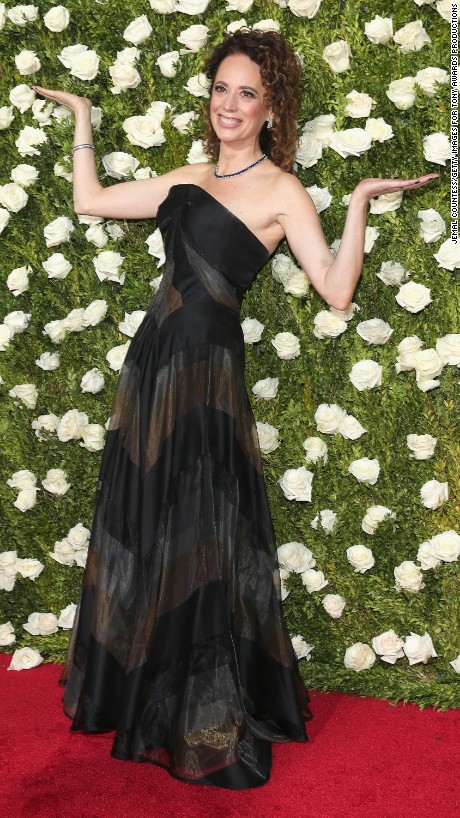
Rebecca Taichman wore another of my favorite looks of the evening.  Her flowing gown consisted of bands of black, silver, and copper, with just a few hints of see-through panels.  The beautifully curved diagonal lines were graceful and flattering, and the lightweight fabric looked airy and comfortable.  It was a lovely and subtle upgrade from basic black. Taichman took home the Tony for Best Direction of a Play, but she easily held her own fashion-wise with any of the on-stage performers. 

Chrissy Teigen's white and gold art deco column emphasized her curves in all the right places.  I loved the notched bodice and plain white skirt with two simple gold lines.  And of course, John Legend on your arm is always the perfect accessory.

I'm not sure what Uma Thurman was thinking in this shapeless black sack.  The deep v neckline was pretty, but the pushed-up sleeves, slightly too short skirt, and the pockets which were not big enough for her hands (which did not stop her from trying to use them, however) were simply not right for a red carpet event.  Too bad she didn't reuse one of her gowns from Cannes!

Liu Wen, on the arm of designer Zach Posen, looked positively ethereal in this floating, off the shoulder, floral print ball gown.  The softness of the fabric, paired with the fitted bodice, came off as feminine without being girly.  And the dark background of the print brings a certain maturity. Everything about this gown was well-thought-out and carefully designed, and the result was simply gorgeous.

And finally, we have Olivia Wilde in her bright red bathrobe.  The sleeves are a little too wide, the hem is a little too long, the front is a little too open, and the silhouette is a little too shapeless.  It just comes off as drab, which isn't easy to do in a red spangled gown. But it serves to prove that the devil really is in the details, and balance and proportion are crucial in any design.

 It would be unfair to close this review without including the award winners who were not pictured in my original photo source, so here is the list of major award winners for whom I could find photos. (Women only, simply because the men were uniformly well-dressed, and where's the fun in critiquing that?)

Best Leading Actress in a Play, Laurie Metcalf, wore a deep green satin gown with a heavily draped neckline and a-line skirt with a knee-length slit. From the front, the dress was almost dowdy, but the back featured a wide keyhole opening that was a startlingly sexy contrast to the restrained front, and bumped my opinion of the dress up several notches. Shame on the photographers for not capturing a rear view.

Best Featured Actress in a Play, Cynthia Nixon, wore a pale pink satin sheath with a huge bow and trailing tails at the back. The color was perfect on her, as was the silhouette. My only quibbles were that the hem was just a hair too short, and the deep orange shoes didn't work for me. But still, it was a simple and elegant look that suited her well.

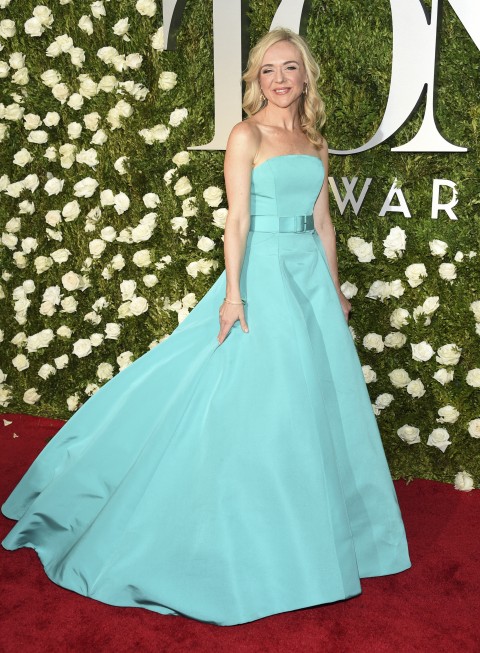
Another of my favorite looks of the night was worn by Best Featured Actress in a Musical, Rachel Bay Jones. Her strapless, Tiffany blue ballgown featured a full, flared skirt and a wide self-belt with buckle, and it really didn't need any other details. The fabric had such gorgeous body and structure that it floated instead of looking heavy or bulky as ballgowns sometimes do. And her softly waved blond hair and light, fresh makeup were just right for the simple style.

I am always fascinated by the range of outfits worn by costume designers on the red carpet, from completely bland to completely outrageous, but Jane Greenwood, who won for Best Costume Design of a Play, struck a beautiful middle ground. Her full black satin skirt and plain black round-necked top were basic, but served as the perfect canvas for her beautifully-tailored, Asian-inspired, watercolor print jacket. I loved the simple accessories of a black neck scarf, large black frogs on the jacket, and a small silver pendant. This is a designer who clearly knows her stuff.


Any fashions that caught your eye that I missed? Let me know in the comments!!


Bookmark and Share

Saturday, May 6, 2017

2017 Tony Awards Cocktails

I know that the Tony awards ceremony isn't until June 11th, but sometimes themed cocktails take some planning ahead (unlike my usual cocktail blogs, some of these recipes call for less familiar ingredients that you might not have on hand). You might even want to try out a few of these cocktails ahead of time to determine your favorite.

A Doll's House, Part 2
This show is a sequel to Henrik Ibsen's play, which ends with Nora walking out the door. Part 2 opens with her walking back in the same door. So what better cocktail to pair with it than Ibsen's Door? 
In a cocktail shaker with ice, combine 1-1/2 oz. gin, 3/4 oz. Amaro (or Campari), 1/2 oz. creme de cacao, and 1/2 oz. lemon juice. Shake well and strain into a chilled martini glass. 

Oslo
Since this play is all about the signing of a treaty, its signature cocktail is named after a treaty: The Elysee Treaty. 
Combine 4 parts cognac or brandy, 2 parts Jagermeister, 1 part simple syrup, and a few dashes of Angostura orange bitters in a cocktail shaker over ice and shake until well chilled. Strain into a chilled martini glass and garnish with a twist of orange peel. 

Come From Away
This play takes place in Newfoundland and is associated with air travel, which always makes me think of coffee, so its designated cocktail is the Newfoundland Night Cap - most authentic when made with Newfie Screech rum, but I won't tell if you use whatever rum you have on hand.

Place 1-1/2 tsp brown sugar in a coffee cup and pour 1-1/4 oz. rum over it. Fill with black coffee and top with whipped cream.

Dear Evan Hansen
Since the characters in this show are mainly high-schoolers, the "cocktail" associated with it is actually a mocktail: Ginger Peach Soda. 
In a small saucepan over medium-low heat, bring 1/2 cup water, 1/2 cup sugar, and 1 tablespoon grated fresh ginger to a gentle simmer, stirring often, until sugar is dissolved. Remove from heat, cover, and allow to steep for half an hour, then strain through a fine sieve to remove ginger, pressing with the back of a spoon to extract flavor. Refrigerate in a covered container until ready to use. Cut half a peach into slices and muddle in a large glass. Pour half a tablespoon of ginger syrup over peaches. Add ice and top off with seltzer. Stir well and garnish with mint leaves. 

Groundhog Day the Musical
Believe it or not, there is actually a cocktail called the Groundhog Day, which was apparently inspired by the Bill Murray film which served as the basis for this show. It's just about the simplest cocktail you could ever find. 
Fill a tumbler with ice and sweet vermouth. Garnish with a lemon twist. That's it!

Natasha, Pierre & the Great Comet of 1812
When I think of this musical, I think Russia, so I think vodka. But then I think comet, and I think Fireball. You really can't mix vodka and Fireball, since vodka is flavorless and will only serve to dilute the whiskey. So instead, we'll pair this show with a cocktail called the Devil's Advocate, which includes schnapps, which is nearly as apropos as vodka. (Note: There are a number of cocktails called the Devil's Advocate, but none with such appropriate ingredients as this one.)
Combine equal parts Fireball whiskey, spiced rum, and apple schnapps in a cocktail shaker over ice and strain into a lowball glass filled with ice, then top with 7-Up or Sprite. 

August Wilson's Jitney
There are plenty of "taxi" cocktails (Island Taxi, Tijuana taxi, etc.), but the "classic" Taxi seemed most appropriate here. 
In a cocktail shaker with ice, combine 5 parts gin, 5 parts dry vermouth, 1 part lime juice, and 1 part pastis (or Sambuca, or any other anise-flavored liqueur). Shake gently and strain into a cocktail glass. 

Lillian Hellman's The Little Foxes
Southern equals bourbon, so when I found a recipe for a bourbon-based cocktail called the Fox River, I knew I'd found the right cocktail for this show. 
Combine 4 oz bourbon with 1/4 ounce dark creme de cacao and 5 (yes, 5!) dashes of Angostura bitters in a cocktail shaker over ice. Shake and strain into a chilled martini glass. 

Falsettos
There are lots of drinks with the word "false" in them: false whiskey sour, false king, false idol, false start. But somehow the False God seemed most appropriate for this show.
In a cocktail shaker with ice, combine 1/2 oz. rum, 1 oz. coconut rum, and 1 oz. blue curacao and shake gently. Strain into a chilled cocktail glass and top with a splash of grenadine. 

Hello, Dolly!
There is a cocktail named for this show, created for a cocktail challenge in 2016: The Hello, Dolly. 
In a cocktail shaker with ice, combine 1-1/2 oz. gin, 1/2 cherry brandy, 1/3 oz. sweet vermouth, 2 dashes lemon bitters, and 2 dashes orange bitters. Shake gently and strain into a chilled cocktail glass. Garnish with a lemon twist. 


Bookmark and Share

Tuesday, May 2, 2017

Everything You Need to Know About This Year's Tony Nominees

If you're not a theatre fan, you probably don't care much about the Tony nominations (you probably also don't know why I spelled it "theatre" instead of "theater", but that's another blog for another day). But even non-theatre fans might be interested in some background about some of the shows that received Tony nominations this year. The shows with multiple nominations include the following:


  • A Doll's House, Part 2: Best Play, Best Leading Actor (Chris Cooper), Best Leading Actress (Laurie Metcalf), Best Featured Actress (Jayne Houdyshell and Condola Rashad), Best Costume Design (David Zinn), Best Lighting Design (Jennifer Tipton), Best Direction (Sam Gold)
  • Oslo: Best Play, Best Leading Actor (Jefferson Mays), Best Leading Actress (Jennifer Ehle), Best Featured Actor (Michael Aronov), Best Scenic Design (Michael Yeargan), Best Lighting Design (Donald Holder), Best Direction (Bartlett Sher)
  • Come From Away: Best Musical, Best Book (Irene Sankoff and David Hein), Best Original Score (Irene Sankoff and David Hein), Best Featured Actress (Jenn Colella), Best Lighting Design (Howell Binkley), Best Direction (Christopher Ashley), Best Choreography (Kelly Devine)
  • Dear Evan Hansen: Best Musical, Best Book (Steven Levenson), Original Score (Benj Pasek and Justin Paul), Best Leading Actor (Ben Platt), Best Featured Actor (Mike Faist), Best Featured Actress (Rachel Bay Jones), Best Lighting Design (Japhy Weideman), Best Direction (Michael Greif), Best Orchestrations (Alex Lacamoire)
  • Groundhog Day the Musical: Best Musical, Best Book (Danny Rubin), Best Original Score (Tim Minchin), Best Leading Actor (Andy Karl), Best Scenic Design (Rob Howell), Best Direction (Matthew Warchus), Best Choreography (Peter Darling and Ellen Kane)
  • Natasha, Pierre & the Great Comet of 1812: Best Musical, Best Book (Dave Malloy), Best Original Score (Dave Malloy), Best Leading Actor (Josh Groban), Best Leading Actress (Denee Benton), Best Featured Actor (Lucas Steele), Best Scenic Design (Mimi Lien), Best Costume Design (Paloma Young), Best Lighting Design (Bradley King), Best Direction (Rachel Chavkin), Best Choreography (Sam Pinkleton), Best Orchestrations (Dave Malloy)
  • August Wilson's Jitney: Best Revival of a Play, Best Featured Actor (John Douglas Thompson), Best Scenic Design (David Gallo), Best Costume Design (Toni-Leslie James), Best Lighting Design (Jane Cox), Best Direction (Ruben Santiago-Hudson)
  • Lillian Hellman's The Little Foxes: Best Revival of a Play, Best Leading Actress (Laura Linney), Best Featured Actor (Richard Thomas), Best Featured Actress (Cynthia Nixon), Best Costume Design (Jane Greenwood), Best Direction (Daniel Sullivan)
  • Falsettos: Best Revival of a Musical, Best Leading Actor (Christian Borle), Best Featured Actor (Andrew Rannells and Brandon Uranowitz), Best Featured Actress (Stephanie J. Block)
  • Hello, Dolly!: Best Revival of a Musical, Best Leading Actor (David Hyde Pierce), Best Leading Actress (Bette Midler), Best Featured Actor (Gavin Creel), Best Featured Actress (Kate Baldwin), Best Scenic Design (Santo Loquasto), Best Costume Design (Santo Loquasto), Best Lighting Design (Natasha Katz), Best Direction (Jerry Zaks), Best Orchestrations (Larry Hochman)
Other shows receiving nominations include: 
  • Plays/Play Revivals: Indecent, Sweat, Present Laughter, Six Degrees of Separation, Heisenberg, The Present, The Glass Menagerie, Arthur Miller's The Price, The Front Page, The Play That Goes Wrong
  • Musicals/Musical Revivals: Miss Saigon, War Paint, Anastasia, Bandstand, Holiday Inn the New Irving Berlin Musical


Let's take a quick look at the big nomination-getters.

A Doll's House, Part 2

The Background: Many of us may be familiar with Henrik Ibsen's play, A Doll's House, from having to read it in high school or college. You may even remember that the play ends with downtrodden wife, Nora, literally walking out the door and leaving behind her husband, Torvald, and their three children. Playwright Lucas Hnath wrote this play to answer the question, "But what happened afterwards?" Did Nora make her own way in life? Did Torvald manage to raise the children alone? Did either of them regret what happened? What did the children think about their mother leaving, once they were grown? It takes a daring playwright to write a sequel to a classic literary work, but judging by the long list of Tony nominations that this production received, his risk paid off. 

The Plot: The play begins, interestingly, with Nora knocking on the very same door we saw her walk through at the end of the original. Fifteen years have passed, and Nora has become a successful writer, but she has recently discovered that Torvald never divorced her. She has returned to request that divorce, since under Norwegian law at the time, a married woman was prohibited from conducting business without her husband's consent, making her writing illegal. We see the reaction of her nanny, her daughter, and her husband to her return.  

Interesting Factoids: Leading actor and actress, Chris Cooper and Laurie Metcalf, are familiar names even to non-theater-goers as well as hugely talented stage actors. Yes, that's the same Chris Cooper from the films American Beauty, The Bourne IdentityAdaptation (for which he received an Oscar), and Sea Biscuit. And yes, that's the same Laurie Metcalf from the Roseanne TV show and the voice of Andy's mom in The Toy Story films. Both have previous Broadway credits, Cooper in Of the Fields, Lately, and Metcalf in 5 other productions, 3 of which earned her previous Tony nominations (NovemberThe Other Place, and Misery). 

Oslo

The Background: This play premiered at Lincoln Center and played off-Broadway for nearly a year before transferring the entire cast to Broadway.

The Plot: The true story of a group of diplomats attempting to broker peace between Israel and Palestine. But, as one reviewer commented, this is not a play about politics, nor even about leaders. "Rather, it is about their deputies, and oftentimes about their deputies’ deputies." [Tal Kra-Oz, tabletmag.com]

Interesting Factoids: This production involves a number of previous Tony nominees and winners. Jefferson Mays won a Tony for I Am My Own Wife and was nominated for A Gentleman's Guide to Love and Murder. Jennifer Ehle has two Tony awards, for The Real Thing and The Coast of Utopia. Set Designer Michael Yeargan holds previous Tonys for The Light in the Piazza and South Pacific as well as a nomination for The King and I. Lighting Designer Donald Holder has Tonys for The Lion King and South Pacific, plus a whopping NINE additional nominations. Director Bartlett Sher has five Tony nominations plus a win for South Pacific

Come From Away

The Background: The airport in the town of Gander, Newfoundland, was a popular refueling stop until the jet age made most of those stops unnecessary, and it began to be used only for emergency landings. On September 11, 2001, 38 planes were forced to make emergency landings there due to the bombing of the Twin Towers, and the town somehow managed to accommodate all 6,700 passengers on those planes until transportation could be arranged to send them home. Producer Michael Rubinoff pitched the idea of making the story into a musical to several writers before finding takers in husband-and-wife writing team Irene Sankoff and David Hein. Sankoff and Hein flew to Gander for the 10th anniversary of the attacks, and spent a month interviewing people and conducting research for the script. 

The Plot: The play takes place over the course of five days, as the town residents open their halls, homes, and hearts to the stranded passengers. It was described by one reviewer as a "portrait of heroic hospitality under extraordinary pressure."

Interesting Factoids: Sankoff and Hein previously wrote a show called My Mother's Lesbian Jewish Wiccan Wedding (based on the real story of Hein's mother). Prior to its Broadway debut, Come From Away was performed in a hockey rink in the town of Gander where the actual events occurred, for the residents who inspired the production. 

Dear Evan Hansen

The Background: This original musical is based on an incident that happened during writer and composer Benj Pasek's high school career. 

The Plot: A shy, socially anxious teen writes himself a pep-talk letter, as advised by his therapist, but it gets stolen by another loner who later kills himself. The dead boy's family finds the letter and seeks Evan out, assuming the boys were friends, and looking for an explanation of why he killed himself. Evan gets caught up in a web of well-intentioned lies, enjoying the longed-for attention he is receiving, but being eaten by guilt. The themes of teen suicide and loneliness sound like a bleak show, but the result is actually upbeat, focusing on Evan's desire to do good and figure out what the right thing is to do. 

Interesting Factoids: Composers Benj Pasek and Justin Paul are the same team who scored the Oscar-winning film La La Land. As a publicity stunt, the song "Requiem" was made available for streaming for a 24-hour period a week prior to the release of the full original cast recording. The cast album debuted at #8 on the Billboard 200 chart. 

Groundhog Day the Musical

The Background: Based on the 1993 Bill Murray film, Groundhog Day. The book of the musical was written by Danny Rubin, who co-wrote the original screenplay with Harold Ramis. 

The Plot: A TV weatherman forced to cover the annual Groundhog Day celebration in Punxsatawney gets stuck reliving the same day over and over again. 

Interesting Factoids: Stephen Sondheim considered the film as source material for a musical, but decided that "to make a musical of Groundhog Day would be to gild the lily. It cannot be improved." Composer Tim Minchin also received a Tony nomination for his score for Matilda the Musical

Natasha, Pierre & the Great Comet of 1812

The Background: This musical was adapted from a section of the Leo Tolstoy novel, "War and Peace." The Broadway production seems to be a mix of period and contemporary looks and styles, both visually and musically. It is repeatedly described as "immersive," which seems to sum up much of the experience: the audience is surrounded by the coiled, multi-level stage and given vodka and pierogies during many performances. It's about soaring music and striking visuals. 

The Plot: I'll be honest: I've read at least half a dozen synopses of this show and I STILL can't figure out exactly what it's about. I think it's a bunch of Russians having affairs with inappropriate people. Some of them seem to feel guilty about it. Considering that the character descriptions given in the script are statements like, "Natasha is young," "Anatole is hot," and "Dolokhov is fierce, but not too important", I don't think the plot is really the point here. (See "vodka and pierogies" comment, above. Also, Josh Groban. Enough said.) 

Interesting Factoids: Composer and librettist Dave Malloy played Pierre in the original off-Broadway production. Groban plays the accordion onstage during the production. 

August Wilson's Jitney

The Background: Jitney was the eighth's play in Wilson's "Pittsburgh Cycle." Written and set in the mid-1970s, it was first produced in Pittsburgh (where it is set), with subsequent productions across the country through the late 1990s. 

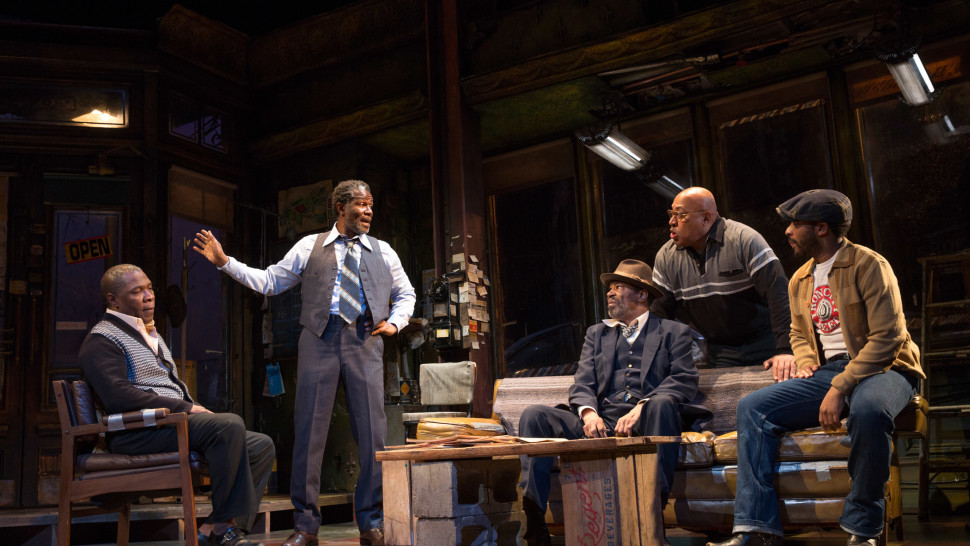
The Plot: The play follows the lives of a group of men working as jitney drivers, unlicensed cabbies in a Pittsburgh district where regular, licensed taxis refuse to drive. Troubles arise when the city makes plans to tear down their building to build housing projects and the boss's son comes home after a long prison sentence. Ben Brantley sums up the message of the play thusly: "That many of the societal problems faced by its characters remain almost exactly the same is shaming and sobering. Yet their collective voice is joyfully intoxicating. Jitney is a lament that has the affirmative ring of celebration."

Interesting Factoids: The Broadway revival began previews in December 2016, opened in January 2017, and closed in March 2017. It is the only one of the 10 "Pittsburgh Cycle" plays not to run on Broadway following its original off-Broadway run. 

Lillian Hellman's The Little Foxes

The Background: Hellman wrote the original play in 1939, the title of which is taken from Song of Songs 2:15: "Take us the foxes, the little foxes, that spoil the vines: for our vines have tender grapes." Hellman is said to have based the Hubbard family on her maternal grandparents and their family. 

The Plot: A greedy southern belle, Regina, and her two brothers scheme to manipulate her husband (who controls her fortune) into investing with a big-city developer. Regina is clearly a better businesswoman than her brothers or her husband, but she is frustrated at being forced into the traditional role of a Southern woman - who is not allowed to either handle or inherit money. Her shrewdness becomes bitterness and even rage.

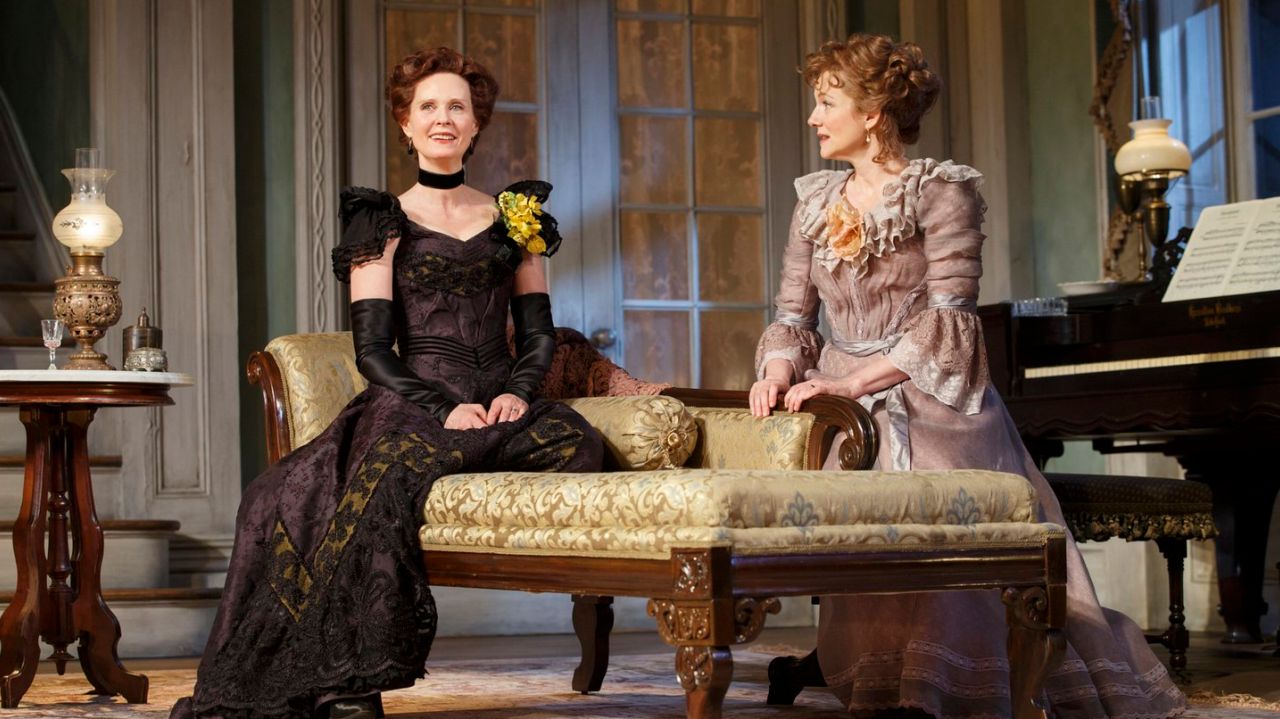
Interesting Factoids: Dorothy Parker suggested the title of the play to Hellman. Tallulah Bankhead played Regina in the original Broadway production. Hellman rewrote the stage version into a 1941 film script, which starred Bette Davis and many members of the Broadway cast. In 1956, the script was adapted into a television version starring Greer Garson. In the current revival, Laura Linney and Cynthia Nixon alternate the roles of Regina and sister-in-law Birdie.

Falsettos

The Background: The original production opened on Broadway in 1992, and was the combination of 2 of 3 one-act off-Broadway shows, The March of the Falsettos and Falsettoland.

The Plot: The show centers around Marvin, who has left his son Jason and his wife Trina to move in with his lover, Whizzer. Psychiatrist Mendel counsels Trina (finding himself attracted to her), Jason (who is uncomfortable with the thought that his father is gay), and Marvin (who is unsure of his love for Whizzer). Act 1 ends with Trina planning to marry Mendel, Marvin and Whizzer's relationship down the drain, Marvin and Trina's relationship in tatters, and Jason discovering girls - and that his father will be there for him, no matter what. In Act 2, Jason's upcoming Bar Mitzvah is threatening the tentative truce between Marvin and Trina, Jason is struggling with his invitation list, and Whizzer unexpectedly shows up, stirring up old feelings. Whizzer and Marvin rekindle their relationship, but it becomes clear that Whizzer is desperately ill and near death. Jason suggests they hold the Bar Mitzvah in Whizzer's hospital room and begs God for a miracle to save Whizzer's life. The play ends as Marvin and Whizzer's spirit reflect on what their lives would have been had they never been friends.

Interesting Factoids: The original production received 7 Tony nominations and won Best Book and Best Score. The revival was filmed by PBS on January 3 & 4, 2017, and is expected to be aired at a future date.

Hello, Dolly!

The Background: The original 1964 musical was based on Thornton Wilder's 1955 play "The Matchmaker" (which was Wilder's revision of his own 1938 play "The Merchant of Yonkers"). It was made into a film 5 years later, and was revived on Broadway in 1975, 1978, and 1995, in addition to the current revival.

The Plot: Widowed matchmaker Dolly Gallagher Levi takes on a rich but cantankerous client and decides that she's his perfect match.

Interesting Factoids: The working title of the original musical during out-of-town tryouts was "Call On Dolly", but when producer David Merrick heard Louis Armstrong's recording of "Hello, Dolly," he immediately changed the title. Clips from the 1969 movie were used in the film Wall-E. The song "Penny in My Pocket," originally sung by Vandergelder at the beginning of Act 2 but cut from the original Broadway production, is included in this revival.


Now go to your calendar and make a note to watch the Tony Awards on Sunday, June 11. Red carpet, here we come!


Bookmark and Share