Showing posts with label backyard birds. Show all posts

Wednesday, April 21, 2021

Backyard Birds, Part Deux

Last fall I posted a blog about the most common birds that I had been seeing at my feeder. But after a full year of living at this house, I've discovered a few more visitors that I thought it would be fun to add to the list. My first list included the titmouse, chickadee, goldfinch, cardinal, white-breasted nuthatch, hairy and downy woodpeckers, flicker, pileated woodpecker, mourning dove, blue jay, ruby-throated hummingbird, Carolina wren, Baltimore oriole, bluebird, mockingbird, catbird, phoebe, and red-tailed hawk. This one will cover the robin, junco, red-breasted nuthatch, cowbird, chipping sparrow, red-bellied woodpecker, song sparrow, Cooper's hawk, turkey vulture, and house finch. 


American Robin

Robins are harbingers of spring in my New England yard, although we sometimes have a few that hang around for most of the winter. This year for most of the winter I had flocks stopping to feast on the berries of my holly bushes on their way south. Robins have a distinctive bright red chest. They prefer worms and berries, so are often seen hopping along the ground. They often fly close to the ground as well. Their most distinctive calls are a loud repeated scold and a happy "cheer up! cheerily!" sounding call. They often build nests near houses, including in bushes and even in wreaths on doors.  Robins are quite territorial and will occasionally "fight" with the rearview mirrors on cars, thinking it's another bird. 

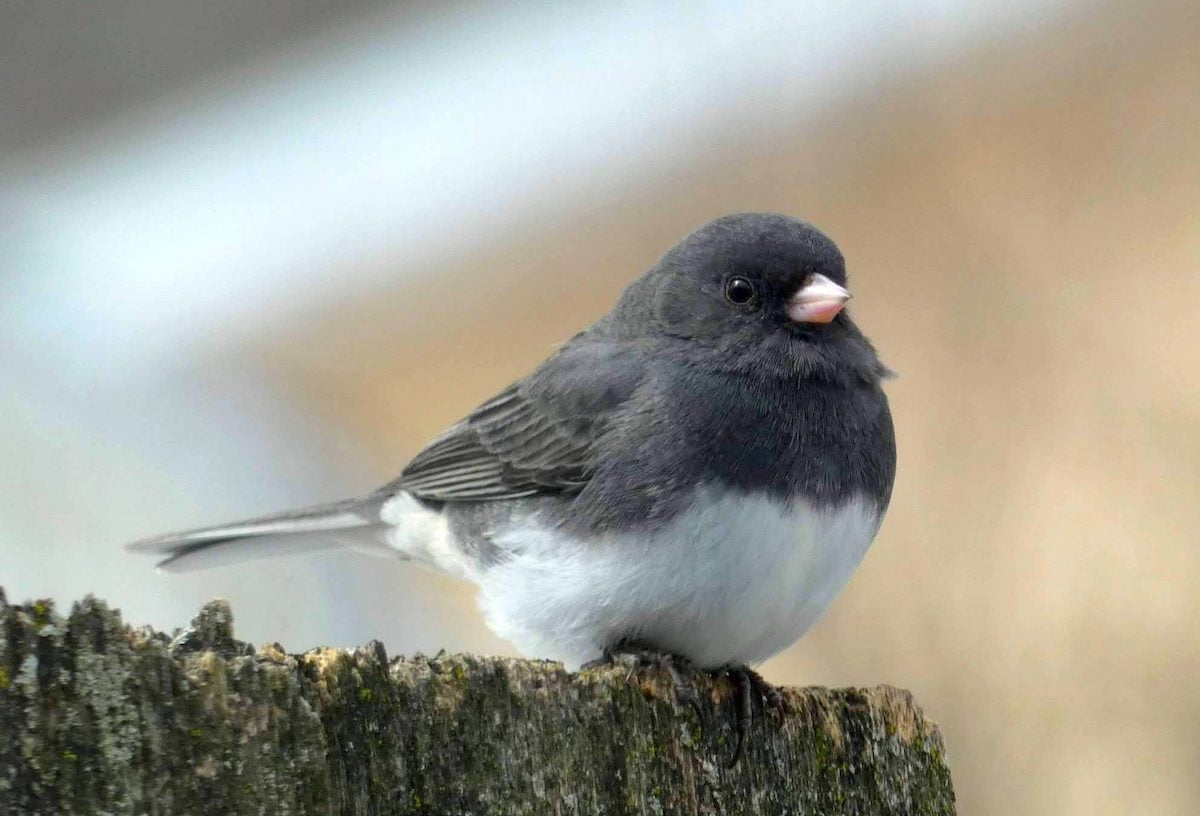
Dark-Eyed Junco

Although I tend to think of juncos as winter birds, they are around all year. Although similar in size to titmice and finches, they're easy to identify based on their white bellies which don't extend up to their chests and contrast nicely with their dark gray bodies. They also have yellow beaks. Juncos will come to a hanging feeder but more often forage on the ground. They don't make a lot of noise, but will occasionally let out a long chirring call or a repeated "chip chip" that reminds me of pinging a high tension wire. 

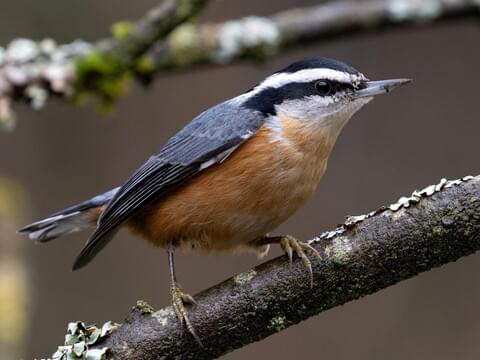
Red-breasted Nuthatch

I had never seen these fascinating little birds until living where I do now! They share a streamlined body shape with their larger cousins, the white-breasted nuthatches, and they also occasionally hang upside down on trees or feeders like them. They have a rusty-red belly and chest and a well-defined black-and-white eye stripe, and are about the size of a chickadee. They are somewhat aggressive with each other and with other birds and will often squawk and flap their wings to drive others away from the feeder. They have funny little squeaky, nasal voices that are easy to recognize once you've heard them. 

Brown-Headed Cowbird

Male cowbirds are very easy to identify, as their bodies are glossy black and their heads are brown. Females are more non-descript and are easy to confuse with the many mottled gray types of finches and sparrows, although both genders are noticeably larger. I try not to encourage the cowbirds, as not only are they fairly aggressive and drive other species away, but they lay their eggs in other birds' nests and leave them to care for their eggs! They have a wide variety of calls and frequently chitter at each other or even sing to themselves while they're at the feeder. 

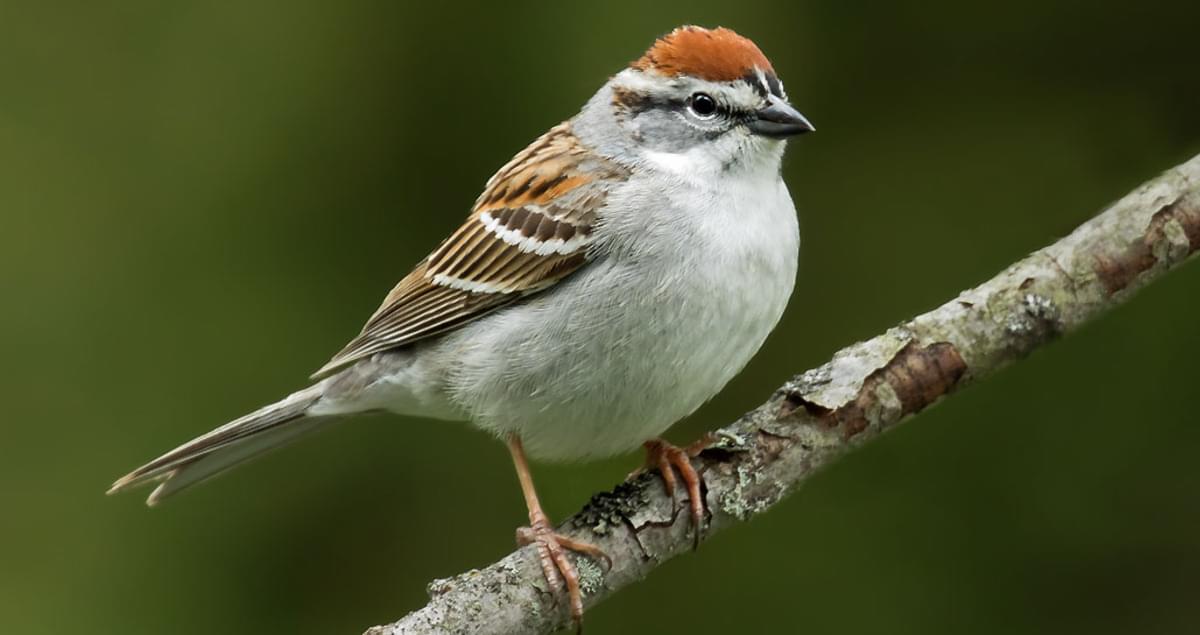
Chipping Sparrow

There are a lot of finches and sparrows that I struggle to differentiate between, but the chipping sparrow is relatively easy to identify, based on its small size, rusty red cap, and black eye stripe. The pattern and color on its wings is similar to a house sparrow, but it is much smaller and the rusty patch on the male house sparrow's head does not cover the top of the head. In addition to a long, sharp trill, it makes a repeated "chip chip chip" from which it gets its name.

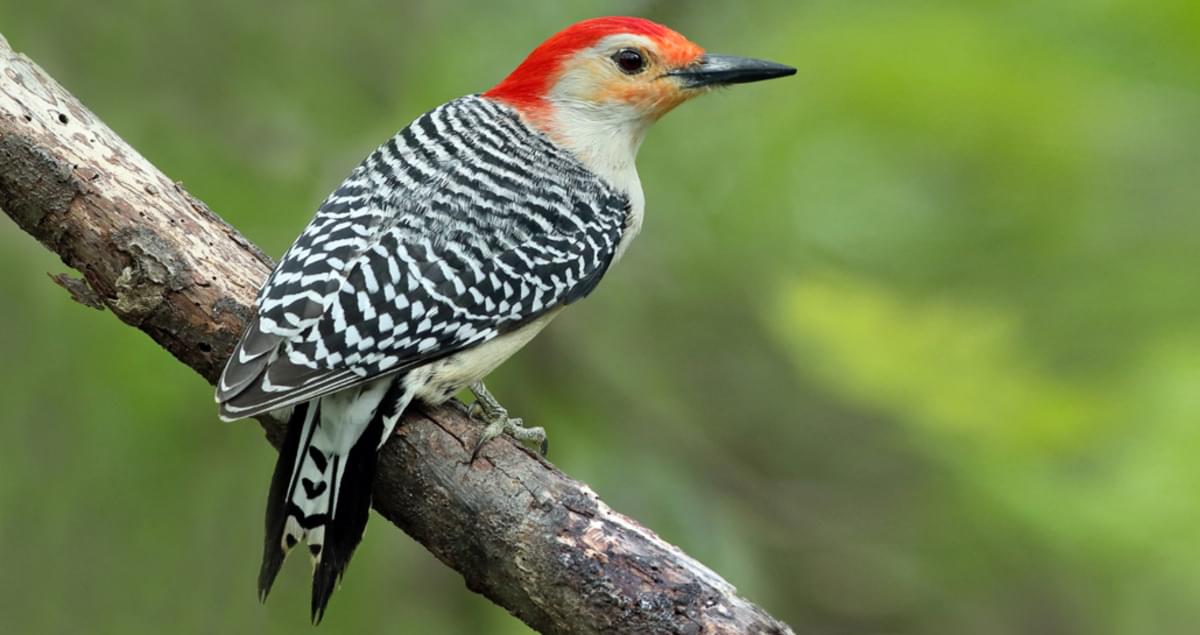
Red-Bellied Woodpecker

This woodpecker looks a lot like a flicker at first glance, but although they are the same size, the red on its head goes all the way over the top, and the black-and-white mottling is only on its wings and back, leaving its belly pure white, unlike the flicker's gray polka-dotted belly. They have a short, rasping squawk which is hard to describe but easy to recognize. I heard them in the trees many times before I finally saw one at the feeder. 

Song Sparrow

Another small finch/sparrow-type bird that can be hard to distinguish, the dark streaks on the song sparrow's belly help to identify it, as well as its brown eye stripes. Not surprisingly, the best way to identify it is through its long, melodic, trill-laden song, which you are most likely to hear early in the morning. Like many other sparrows, it also has a loud "chip! chip!" alarm call.

Cooper's Hawk
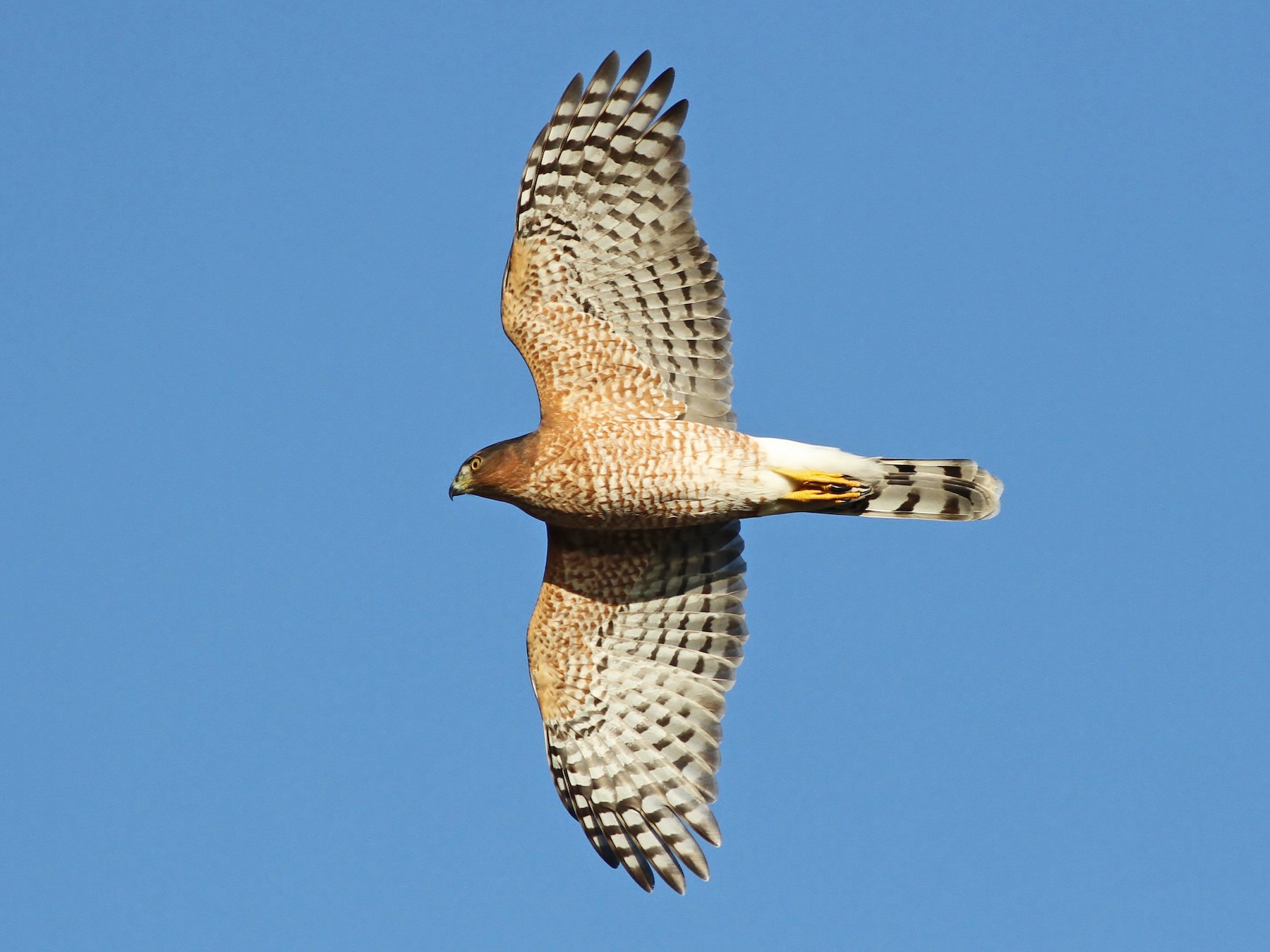
Along with red-tailed hawks, we frequently see Cooper's hawks loitering in the trees near the feeder, hoping to catch a plump mourning dove unawares. The easiest way to tell the two types of hawk apart is to look at the tail in flight. The red-tailed hawk's tail is not only distinctly reddish (usually although not always), it is also short and fan-shaped, while the Cooper's hawk has a much longer, narrower tail. 

Turkey Vulture
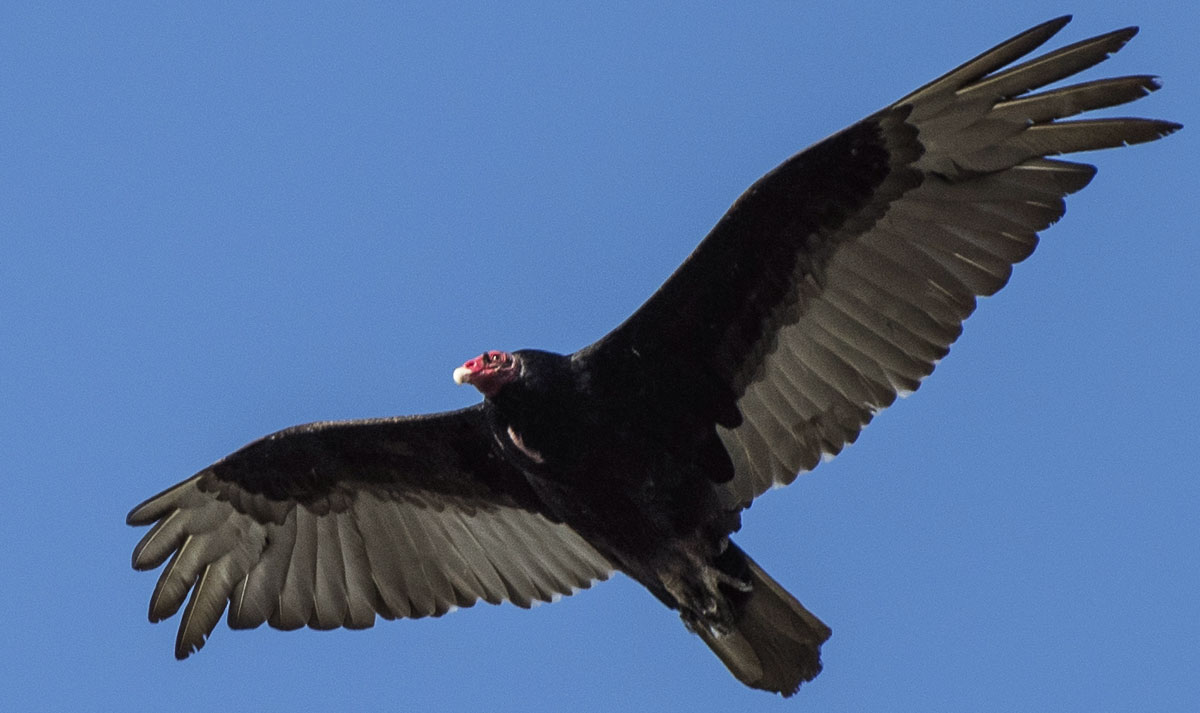
Another raptor we see regularly is the turkey vulture. Since the bright red head is often difficult to see while the birds are flying high overhead, the easiest way to distinguish them from the hawks we frequently see is their flight pattern. The vultures have a noticeable "bobble" when they soar, and they tend to hold their wings in more of a "V" position when seen head-on, as opposed to the flatter profile of most hawks. They are also larger than red-tailed hawks, but size can be hard to distinguish in flight. Although hawks will frequently roost in trees near the bird feeders watching for potential prey, the vultures have no interest in the songbirds that frequent backyard feeders. 

House Finch
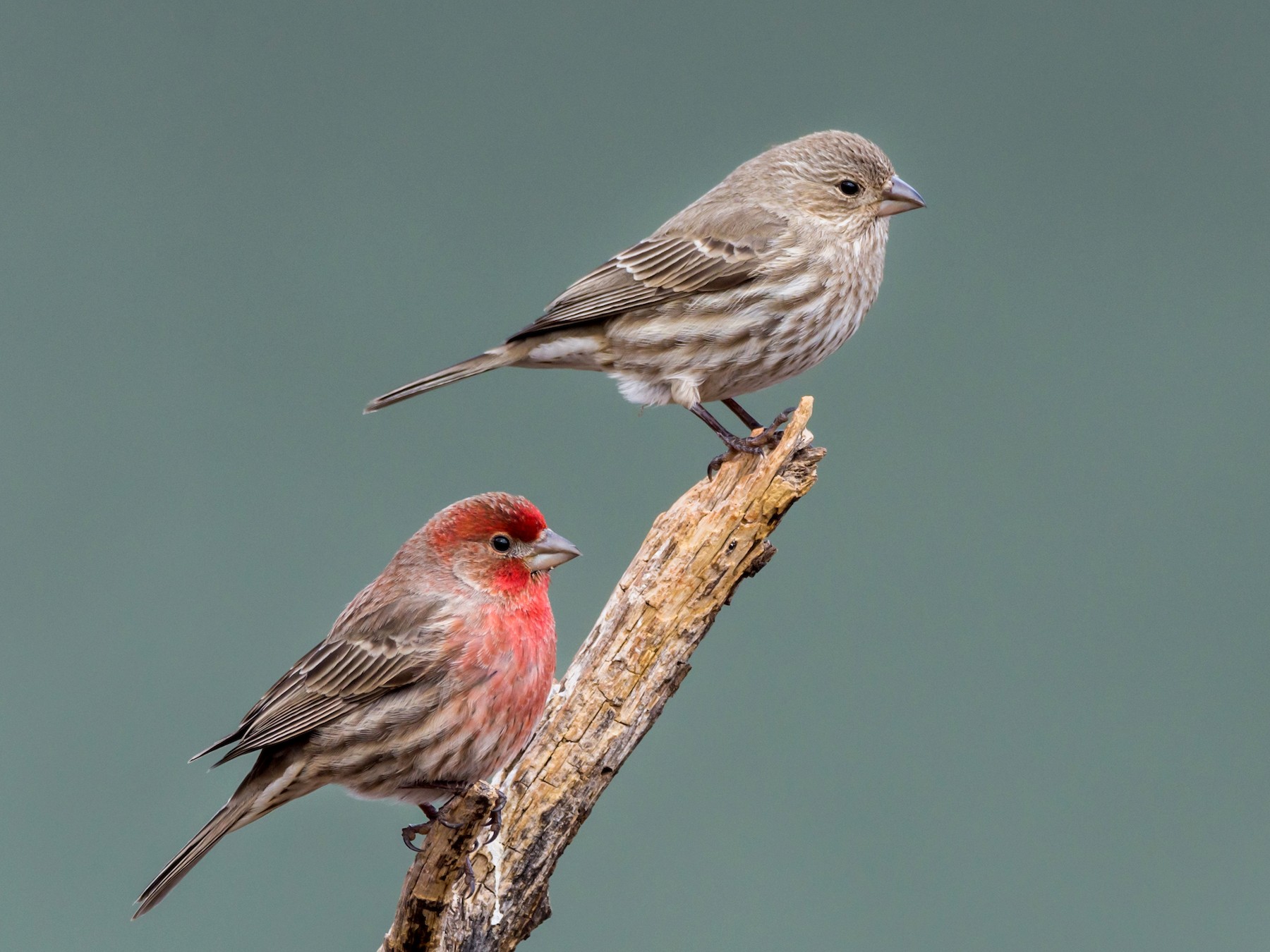
Let's start with a disclaimer: I cannot tell the difference between a male house finch and a purple finch. Even when I look at photographs comparing and contrasting the two, I can't see the differences described. So I'm grouping them together as house finches, merely because it sounds like house finches are more common. Another example of big differences in coloring between the sexes, the males have a bright to dark red faces and breasts, while the females are mottled brown all over. (Note: I learned while researching for this blog that finches are more likely to have sexual dimorphism than sparrows, so when trying to determine between the two, that's a good starting place!) The female finches closely resemble song sparrows, but lack the sparrow's head stripes, and the streaks on their bellies go all the way to their feet, as opposed to the sparrow's which fades out at the chest.


Now get out there and enjoy watching those birds!


Bookmark and Share

Friday, February 5, 2021

Photo a Day: My Happy Place

Anyone who reads my blog or my Facebook page with any kind of regularity is aware that I moved to a new house this past summer. We're in a much more rural location, and since our property includes a large section of woods, we get loads of wildlife and especially birds visiting our yard. 

There are many features about our new house that I LOVE, but one of my most favorite is that there are huge windows everywhere, so the rooms are beautifully sunlit. And my favorite windows are a trio of arched windows in the family room that look out past my birdfeeders and into the woods in the back yard. I have spent hundreds, perhaps thousands of hours in that room watching the birds (and the deer, and the opossums, and the groundhogs, and the chipmunks, and the squirrels). I fold laundry there, I cut out patterns there, I work on my laptop there, I plan den meetings and write Sunday School lessons there, I listen to music there, I enjoy cocktails with my husband there. It is truly My Happy Place. 


Much like spending time with my cats, spending time with "my" birds brings both laughter and serenity. The blue jays' silly antics, the squabbling of the juncos, and the robins' territorial displays all make me laugh, and the cooing mourning doves, the lovely markings of the flicker, the shyness of the woodpeckers, and the sweetness of the fledglings all bring me peace.  

My Happy Place.

Bookmark and Share

Wednesday, July 22, 2020

Cast of Characters

I have now lived in my new house for a little over a month, and in that time I've gotten to know many of the birds and critters that hang around. In fact, I've gotten to know them so well that I've named many of them. Let me share with you some of the characters that visit us regularly.

Lenny (and Jenny, and Benny, and Kenny, and Denny), the Bunnies

I can't take credit for naming the bunnies; my kids came up with the whole "-enny" naming scheme at our old house. We love watching the -ennies while we (and they) are enjoying dinner outside. Most of them are impossible to tell apart, but there is one who loves to flop down in the cool dirt at the side of the house, as well as several clearly younger, smaller bunnies, including the cutie in the video above.

Larry, Moe, and Curly, the Blue Jays

I'm pretty sure that Larry and Moe are Mom and Dad, and Curly is junior. Curly has a tendency to whine a lot, and he is also a bigger klutz than the other two combined (and that bar is set relatively high). They're all a little too big to sit comfortably on the suet feeder, so they have a habit of frantically flapping their wings while eating in an attempt to keep their balance. Larry and Moe teeter on the edge of control but Curly has fallen into the rhododendron on more than one occasion.

Captain Hook (aka "Cappy"), the Hummingbird

Most of the hummingbirds won't put up with another hummingbird at the feeder while they're eating, but Cappy takes it to the next level. Before he eats at the feeder, he sits on top of the hook it hangs from and surveys the area, as if daring other birds to come near. Should another bird approach while he's at the feeder, he chases it away, twittering furiously. And he doesn't just chase it a few feet away, he zooms around the yard following it for several minutes. He is clearly the alpha bird and makes sure everyone knows it.

Toby, the Groundhog

Toby is just a little guy, as groundhogs go, which makes me suspect he is a baby. He wanders around the back yard, hoovering weeds and clover like it's going out of style. He trundles around on his chubby little legs, staying as near as he dares when chased, cheekily peeking back at the aggressor (me) from his perch on top of a big rock at the edge of the woods. So far he's been quite well-behaved, not attempting to eat our herbs or tomatoes or even the flowers in the garden. As long as he only munches on the lawn and the weeds, I'm happy to have him around. Hopefully he's smart enough to understand that we'll leave him in peace as long as he stays away from the good stuff.

Stumpy and Wallenda, the Chipmunks

Stumpy was actually the very first animal I named at the new house. There were probably dozens of chipmunks that we saw on a regular basis, zipping back and forth between the pool yard, the gardens, and the woods, but Stumpy was distinctive because of his unusually short tail. Chipmunks, like warthogs, have a hilarious tendency to hold their tails straight up in the air when they run, so Stumpy was noticeable and identifiable even when moving.

Wallenda, on the other hand, may actually be more than one chipmunk, but since I have never seen two chippies attempt his acrobatics at the same time, I am inclined to think that Wallenda is a single individual. His distinctive behavior is his ability to climb the shepherd's crooks that the feeders hang from, and to acrobatically climb down into the feeders and gorge himself on the seeds inside. I have seen a number of chipmunks attempt this maneuver, but they all chicken out when they reach the top of the crook, or else they attempt to jump from post to feeder but fail miserably. Only Wallenda has displayed both the nerve and the physical ability to complete the maneuver.

Flower, the Skunk

Flower is the one animal on this list that I have never seen in person. But he (or she) makes an appearance several nights a week on our security camera, trundling around the pool yard in the middle of the night or the wee hours of the morning. And I assume he (or she) is also the cause of the occasional divot in the lawn that appears overnight. We have a terrible Japanese beetle problem, so Flower is welcome to eat as many adult beetles and grubs as he (or she) can hold. 

Rambo, the Attack Robin
I have yet to capture Rambo on film, mostly because his best work takes the form of sneak attacks. Rambo hates blue jays. I mean, he HAAAAAATES blue jays, with the fire of a thousand suns. He will not allow them to have anything to do with the bird feeders while he is in the yard. If he catches sight of them, he screeches and dive bombs them and chases them out of the yard. He simply explodes out of nowhere and scares the bejeebers out of them (and often me). Even when there are three of them and only one of him, he does not hesitate to attack. I know that robins are territorial but I've only seen them exhibiting this behavior against other robins. Maybe Rambo is color blind and thinks the jays are robins; I just don't know. All I know is that Rambo is the Snape to Larry. Moe, and Curly's Harry, Ron. and Hermione.

I'm sure that over the course of time, I'll get to know more of my furred and feathered neighbors. I just hope they're all as funny and fascinating as the ones I've met so far!

Bookmark and Share