Showing posts with label home schooling. Show all posts

Tuesday, September 8, 2015

Homeschooling: Day 1

Today is my first official day as a homeschooling mom.

This is what my kids looked like as they headed off, respectively, to preschool and back into our home classroom:

And this is what I looked like as I headed back into our home classroom:

Being the planner that I am, I have lists of topics and projects and resources and crafts. I have lesson plans and a ringbinder and evaluation charts. I have worksheets and educational websites and DVDs and library books. I SHOULD know what I'm doing: I have experience, I've done the research, I've put in the preparation time, and yet somehow I still feel like I'm flying by the seat of my pants. I still feel like I have no idea what I'm doing.

I can't help but be reminded of when I was pregnant with this very child, my son, my firstborn, and my husband and I attended a one-day birthing class led by a wonderful L&D nurse practitioner with two children of her own, who told the class, "Go ahead and write up a birthing plan. Write down exactly what you want to happen, exactly how everything should go, what all of your choices are under various circumstances. [She paused for a moment.] And then rip it up and throw it away, because you're not the one driving this bus. Your doctor isn't the one driving this bus. Your baby is the only one driving this bus, and your baby is the one who will be driving every decision that is being made from here on out. And the sooner you accept that, the easier the whole process will be for all concerned."

I can't help but think that this wise advice applies to homeschooling as well. After all, one of the main advantages of homeschooling is that you can tailor both the material and the teaching methods to the needs and personality of the individual child. And no matter how well I know my son, there's no predicting how he will respond to a certain type of problem, or how well he will take to a particular subject, or what kind of schedule will work for him, once we actually get into the nitty-gritty of a scheduled and structured (however loosely) school day.

So I may have a fabulous list of science projects that include stinky and messy (and vaguely dangerous) chemical experiments, but he may only be interested in cleaner and neater (and absolutely dangerous) electricity experiments. Maybe he won't want to go on a nature walk. Maybe I'll need to figure out different ways to introduce him to the worlds of science and nature. I may have all kinds of ideas about drawing pictures to illustrate the stories we read, but he might have no interest. Maybe I'll discover that he would rather dress up like one of the characters in the book we're reading and act out what we just read instead of drawing a picture of it.

But I'm willing to experiment. I'm willing to wade through my lists of ideas and options and opportunities and see what works for us. I'm willing to throw a whole bunch of educational spaghetti at the wall and see what sticks. I'm willing to take a page from my own notebook and come up with a hypothesis, test it out, and if it doesn't work, come up with a different hypothesis, and just keep testing.

It may be my son's home school, but he's not the only one who'll be learning a few things this year!


Bookmark and Share

Friday, September 26, 2014

What Is Homeschooling Like?

Even though I’m not “officially” homeschooling yet (my son misses the age cutoff and is not eligible for public kindergarten this year), I’m doing it formally enough that it occasionally comes up in conversation, and people often ask what it’s like to homeschool. Every homeschooler is different, so I can’t answer that question in the broadest sense, but I can share what homeschooling is like for us. Here’s an example of a typical homeschooling day for us.

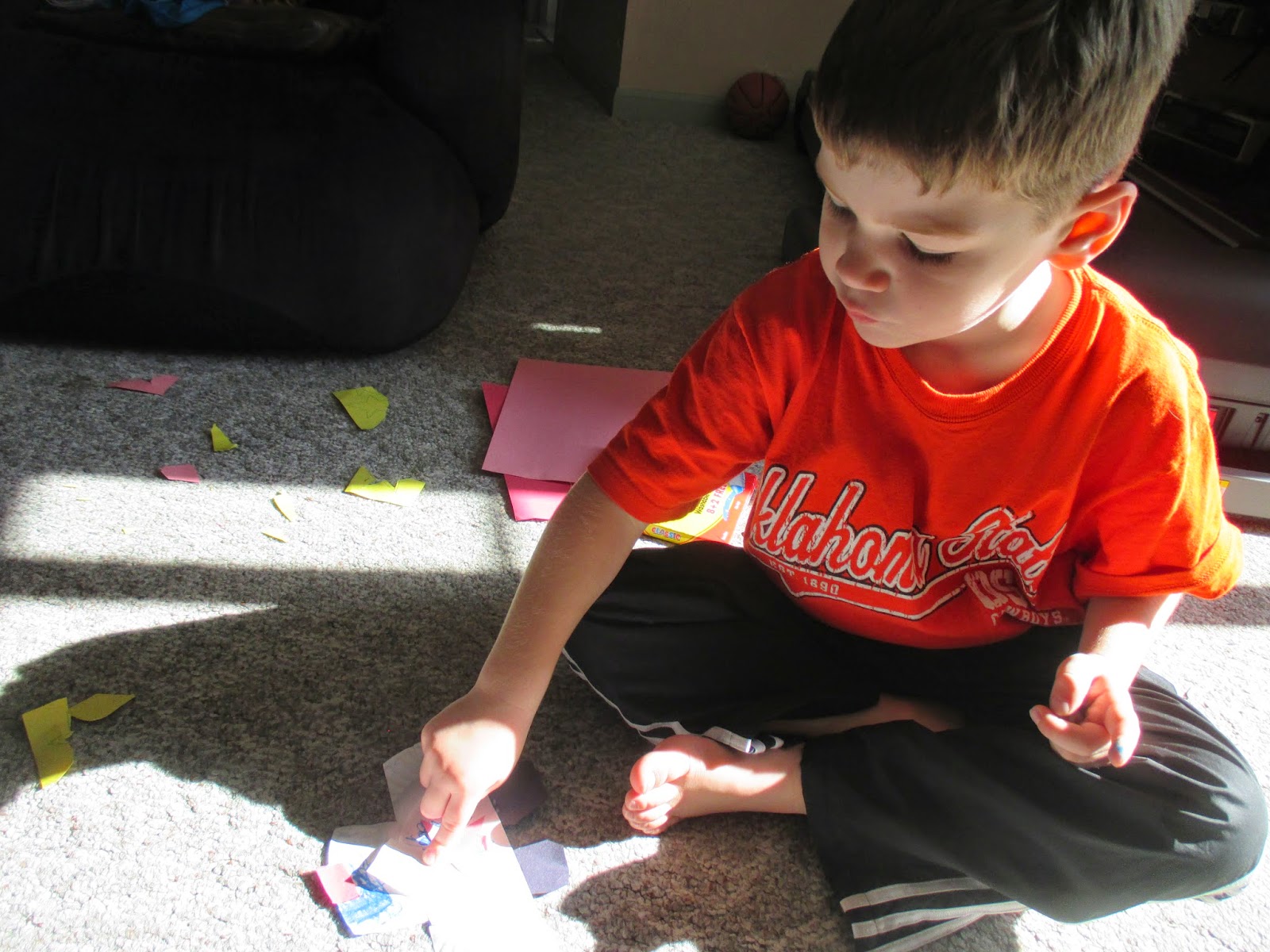
My son is naturally very curious, so I try to develop lessons based on what he’s interested in. Instead of having a separate math lesson, reading lesson, writing practice, etc., I try to tie them all together using something that he’s interested in. So I based this lesson on a police car craft that I found on Pinterest. 

I began by carefully writing out step by step instructions:
  1. Color the car blue.
  2. Cut out 2 black circles.
  3. Cut out 2 white squares.
  4. Cut out 1 red rectangle.
  5. Cut out 1 yellow star.


I gave him a paper plate that had been cut into the general shape of a car, a box of magic markers, a pair of scissors, a stack of construction paper with the appropriate shapes drawn on, and the page of directions. 

 In this single project, he had to 1) read, 2)  hold a marker properly, 3) follow sequential directions, 4) identify colors, 5) identify shapes, 6) master using scissors for both curved and straight cutting, and 7) use glue without making a big mess.

I followed this lesson by asking him to draw each of the shapes that he had cut out, and then had him figure out how to spell and write out the name of one of those shapes with help from alphabet flash cards.


From there we moved on to reading a library book about different kinds of vehicles (including police cars). As we read, we talked about the difference between nouns and verbs, figuring out which words were “things” (ambulance, policeman, siren, headlights) and which were “doing” words (drive, stop, help, fly). After that, we watched a “Schoolhouse Rock” DVD, starting with songs like “Verb: That’s What’s Happening” and “A Noun Is a Person, Place or Thing,” then we moved on to a little American history with “The Shot Heard ‘Round the World” and “The Great American Melting Pot” and a bit of math with “Elementary, My Dear” and “Figure Eight,” all with appropriate discussion as we went along. And then we finished off the lesson by practicing writing numbers with more help from flash cards and workbook pages.

The nicest part of home schooling is being able to set our own pace and our own schedule. We can take breaks whenever one of us needs one and plow through when we happen to be on a roll. If we find ourselves on an interesting tangent, we can go with it instead of having to steer back to the original topic. Sometimes we take a wiggle break because we feel like it; sometimes we skip a boring book and find one that’s more exciting at the moment; sometimes we scrap a lesson altogether and find something else that works for us. Sometimes we get much more in depth than I'd anticipated and go two or three lessons at a time. If one of us is having a crabby morning, we can work on fun projects like crafts or coloring or cooking, and work on the harder or less interesting stuff after lunch when we’ve both gotten our second wind. Sometimes we "double-dip" by thinking of different kinds of ocean animals while we're swimming or practice walking like different kinds of animals while we're having a stretch break. We can even do lessons after dinner or on weekends to make up for breaks we’ve taken during the day. 

Making our own schedule also means we can be inspired by anything and everything around us. At the grocery store, we talk about nutrition, how plants grow, and where different fruits come from. We read the signs at the end of each aisle and talk about why the foods are grouped together the way they are. While we’re making brownies, we talk about the different ways we can measure things and we practice reading and following directions. In the car the other day, my son saw someone smoking a cigarette and asked what it was, and it segued into a discussion of health, how we breathe, and the meaning of the word “consequences”.

To quote John Dewey, “Education is not preparation for life; education is life itself.” And, in turn, life itself is education. 


Bookmark and Share

Wednesday, September 17, 2014

Sticker Storytelling

Roughly two weeks into my home schooling journey with my son, I have discovered what is easily the skill with which he struggles most: writing. He has no problem with writing in terms of ideas; he has been telling stories - both repeating ones he's heard and creating stories of his own - since he was able to talk. Give him a character or a topic and he'll happily spin a wild yarn for you. But the act of getting those words onto paper is brutally difficult for him. Holding the marker, forming the letters, keeping the words from falling off the page...you'd think I was asking him to create life.

So I've been searching the internet, reading home schooling and kindergarten teacher blogs, and looking through books to find some creative ideas of how to help make writing practice more interesting and less frustrating for him. Writing in a tray of pudding, or jello or Kool-Aid powder, or sand, or shaving cream; and writing on a chalkboard or dry erase board seemed like great suggestions, but he wasn't terribly enthusiastic. I tried making letter flashcards that he could copy. I made dotted outlines he could trace. I read an article written by a kindergarten teacher who has her students draw a picture and then write a few words about it daily, and I laughed (a little enviously). I couldn't imagine how long it would be before my son would be interested in writing an entire sentence, never mind doing it every single day. But then, I had a sticker epiphany.

My son is moody about drawing pictures: some days he'd draw robots and space aliens all day long, but other days he has zero interest. But I've yet to offer him stickers and be turned down. So this morning, when his little sister was playing with stickers and he asked to make a sticker picture, I was struck with inspiration. I told him he could make a sticker picture, but afterwards he had to tell me a story about it and then we would work together to write one sentence about it. He considered that for a moment, then apparently decided that his love for stickers outweighed his hate of writing, and took me up on it.

I let him choose 10 stickers to put on a piece of construction paper. The Melissa and Doug sticker book we were using has literally hundreds of stickers with a different theme for each page: farm animals, jungle animals, ballerinas, fairies, princes and princesses, bugs and butterflies and flowers, a tea party, and paper dolls (did I mention it was his sister's sticker book?). He flipped right to the prince and princess page and chose a unicorn, a princess, a tiara, several sceptres, a palace, a rainbow, a flower, and several hearts. He carefully put them on the page, layering stickers on top of each other to create a sceptre topped with a flower and a rainbow and another topped with a heart. He studied his artwork carefully for several minutes and then, without any prompting from me, began to tell me all about the princess who lived in the beautiful castle and who had a pet pony (he hasn't much use for unicorns) who used his magic to make the princess special sceptres. After much discussion (and several reminders that the shorter the sentence he chose, the less he would have to write), he came up with this manageable sentence: "The princess has a pony."

I braced myself and got out my pack of flashcards. I reminded him that the beginning of a sentence starts with a capital letter, and together we figured out what letter the word "The" starts with (starting with a diphthong was not my best decision). I laid out the appropriate flashcard, went over where each line starts and the order to make them in, and handed him a crayon with bated breath.

To my surprise, he started to hold the crayon in his fist then corrected his grip without my saying a word, then drew a huge - but surprisingly neat - capital T. I laid out the lowercase h flashcard, and stopped him when he began to make a capital H instead. He corrected it but then got all upset that the mistake made the h look like there was a capital A in the middle of it. But I reassured him that this was just practice and it was okay if there were mistakes, and he soon settled down and kept going. We carefully repeated each word to figure out what sound and what letter came next. Letter by painstaking letter, words began to form on the page. All we could fit on the front of the page was "The prince" so we continued on the back with "ss has a pony." (Technically, it says "has a pony. ss" since he doesn't always remember to start at the top of a new page.) He ran out of steam halfway through so I wrote "a pony" for him, but at least he was willing to tell me which letters to write.


It's just a start, but it gives me hope that someday he will experience the joys of writing that I feel every time I put words to paper. I want him to feel the same thrill that I do at being able to express my thoughts and feelings through words. Even if he doesn't end up being a writer, I want him to be a good communicator. Because he has so much to say!!!

Bookmark and Share

Wednesday, September 10, 2014

A is for "Assessment"

My son is not quite 5, and therefore he missed the kindergarten cutoff for this year. So I’m dipping my toe (and his, as well) into the homeschooling pool and teaching him some kindergarten skills myself. As a starting point, I found a wonderful online assessment tool based on the kindergarten common core standards, and this morning I went through it with him to see what he already knows and what he still has to learn. And here’s what I discovered: My kid is a genius.

Well, okay, he’s not really a genius. But he is about 90% done with learning kindergarten language skills, anyway. He’s reading on a second grade level (he breezes through words like “nebula,” “hydration,” and “illustrator” without blinking, including figuring out what they mean from context clues); he can spell and write simple words like “cat” and “pig” and “no” without prompting; and he can describe the settings, characters, and plot of a simple story. I introduced the concept of syllables to him and literally within minutes he could tell me how many syllables are in the word “refrigerator” or “despicable” or “antidisestablishmentarianism” (okay, not that last one, although I’m sure he could have figured it out if I’d actually given him that one). This is one smart kid.

Really, the one skill he’s weak on is writing. Not the spelling or expressing himself part, but simply the physical act of writing, of holding a pen or pencil and actually forming the letters on the page. And the hardest part of teaching the physical act of writing is that it only comes through repetition and practice. Which is the bane of a smart, active little boy’s existence. He doesn’t want to sit and write stuff, he wants to get out there and do it! And this is where the creative part of teaching comes in. This is where I have to come up with ideas of how to help him understand the freedom that will come with being able to express himself in writing. This is one of his first big lessons in delayed gratification, and learning why it pays to do the boring stuff now so you can do the fun stuff later.

So we’ll start with making the fun stuff as immediately “later” as possible. I think I’ll start by having him write words like “jump” and “hop” and “run” and rewarding him for writing them by letting him DO them. Then I’ll have him write words like “pig” and “robot” and “soccer” and reward him by letting him draw pictures of them. We can try writing a single letter a few times and then running around the house to find as many things as we can that start with that letter. (We’ll count them, too, just to sneak in an extra math lesson!) And then maybe we can move on to writing words like “space” and “superhero” and “toilet” and then we can go to the library and find a book about each of those things.


It’s going to be an exciting journey for both of us – probably a little frustrating sometimes, certainly somewhat boring sometimes, definitely often confusing and occasionally scary. But I have no doubt that we’ll both learn a lot – about ourselves and how we think, and about each other and how the other person thinks. But the best part of the journey is that we’ll be taking it together. 


Bookmark and Share

Thursday, September 4, 2014

Home Schooling: The Saga Begins

My son turns 5 this November, so he misses the cutoff for starting kindergarten this year. But he’s already reading on about a second grade level, he can do basic math, he understands a lot of fairly advanced scientific principles, and he can write fairly well (with a little – okay, a LOT – of prompting). Add that to the fact that he’s as tall as your average second (or third!) grader, and it’s clear that it’s time to start home schooling.

My husband and I had actually talked about home schooling as an option long before now. But given my son’s situation, it seems like an obvious solution: home school informally this year, see how it works out for both of us, continue officially for a year or two if it does, and then plug him into public or private school wherever he fits socially and intellectually at the time instead of basing his placement on his birth date alone.

So with area schools starting next week – and his weekly gymnastics and twice-a-week preschool class as well – it makes sense for us to start home schooling next week, too.

Frankly, I’m terrified.

At a certain level, I know I can do this. My mom was an elementary school teacher and a children’s librarian, so I grew up surrounded by worksheets, educational books, and crafts and projects appropriate for kindergarten and first grade. I spent one summer myself teaching grades kindergarten through sixth in a one-room schoolhouse using government curriculum, and I taught preschool Sunday School for years. So I’m not exactly unprepared for this adventure. And yet, when it’s your own child’s educational base and future you’re putting into place, it’s a lot of pressure.

Anyone who knows me well can tell you what I do when I’m under pressure: I research. I look things up, I read books, I search for online articles, I ask other people for their opinions and advice. And I’ve been doing my research for this project for months, even years. My starting place was an excellent book that my husband found for me, called The Year of Learning Dangerously by Quinn Cummings. Ms. Cummings is a former child actor, author, and “free spirit” who opted to home school her daughter in middle school. Much like me, she began her home schooling journey by thorough research. Her book hilariously details how she researched various styles of homeschooling, including dressing as a cult member to crash a home schooling convention and offering to chaperone a stranger’s home school prom. Despite its often tongue-in-cheek humor, her book offers an excellent outline of both the history of home schooling and the many theories and schools of thought regarding the practical application of home schooling.

One of the aspects of her book that I most enjoyed was her description of how home schooling has changed over the years. Home schoolers are no longer predominantly strictly conservative Christian families who home school in order to protect their children from the world (not that there’s anything wrong with that). These days, many families are opting to home school because of learning disorders, bullying, behavioral issues, transportation issues, allergies, and hundreds of other reasons. The variety of home schoolers is as widely-varied as the types of home schooling.

And speaking of types of home schooling, no longer is home schooling inevitably a mom and a single purchased curriculum. Now, home schooling can be done by a parent, a tutor, or an online classroom teacher. And curricula can include bits and pieces from numerous sources, single units purchased piecemeal, online texts, or even no curriculum at all (often called “unschooling”).

With all the choices out there, it’s a little overwhelming. And yet, it’s also reassuring. If one option doesn’t seem to be working out for us, there are dozens of other approaches to try. And with so many families home schooling in so many different ways, there’s plenty of support out there to tap into.

And so, I brace myself to begin. In the words of John Dewey, “Education is not preparation for life; education is life itself.” Let’s go embrace life!

Bookmark and Share