Showing posts with label lesson plans. Show all posts

Monday, March 16, 2020

COVID-19 Lesson Plans: Day 1

I have a 3rd-grader and a 4th -grader at home, so I'll be posting our daily lesson plans and schedule, in case anyone would like to borrow them!

7-8:30am: Up, make breakfast, clean up breakfast dishes, get dressed, brush teeth and hair, free play.

8:30-9am: Penmanship practice. My 3rd-grader is learning cursive, so I made her a worksheet with examples of cursive capital letters A through G to carefully copy. My 4th grader has terrible printing, so I had him practice some of the letters he most struggles with: r, m, n, b, and d. After individual letter practice, I had each of them copy a few sentences from one of their favorite books and we went over any problems (letters that floated in midair, uneven letter size, not enough space between words or letters, etc.)

9-9:45am: Scavenger hunt walk. I gave each of them a clipboard with the following list of things to look for: a robin with something in its mouth, someone walking a dog, a wreath on a door, a bicycle, green shoots, fuzzy buds, a flower blossom, a hawk, a kid playing outside, someone pushing a stroller, Easter decorations, St. Patrick's Day decorations, a rabbit (real or otherwise), and a lost glove or mitten. We saw everything on our list except a hawk and someone pushing a stroller!

9:45-10am: Math worksheets. My 3rd-grader worked on an adding fractions worksheet and a subtracting fractions worksheet, and my 4th-grader worked on an ordering fractions worksheet and a converting decimals to fractions worksheet.

10-10:20am: Snack break! My 4th-grader continued working on showing his work while my 3rd-grader made tea and toasted peanut butter sandwiches for us to share.

10:20-10:45:  Current events. The Time Magazine for Kids website has some great articles on COVID-19 and what we need to do as a society and as individuals to protect ourselves and break the cycle of transmission (specifically, this article and this one). We discussed how our family could change our behavior to keep ourselves safe.

10:45-noon: Creative time. I gave them the options of drawing, practicing their instruments, building with Legos, or baking with me. They opted for baking, with drawing and Legos during rising and baking time. We made this recipe for white bread, but first we watched Alton Brown's video about yeast.

Noon-1pm: Lunch break and free time! Access to Chromebooks permitted - and very much appreciated by both scholars.

1-1:30pm: Reading time. Each child gets to choose their own book and read quietly to themselves.

1:30-2pm: ELA. Both kids are working through the Khan Academy "Reading: Literature" practice pages. They both tend to read and comprehend above their grade level, so they're starting with the Grade 4 and Grade 5 pages. 

2-2:20pm: Music. My 3rd-grader continued working on Khan reading while my 4th-grader practiced trombone.

2:20-3pm: Art and music. My 4th-grader is working on making sculptures from recycled materials in his art class at school, so we decided to continue that lesson. Crumpled paper, tin foil, old gift wrap, twist ties, tape, empty bottles, cardboard boxes, and bits of fabric were all fair game. My 3rd-grader took a break to practice her cello, then started collecting materials for her art project. We'll continue to work on our art later in the week.

3-3:30pm: Cincinnati Zoo Facebook Live stream! Today's featured animal was Fiona the hippo. The Zoo is offering a Facebook Live program every weekday at 3pm. After the Live event, we took a quiz about hippos. We didn't get all the questions right, but we did pretty well!

3:30-4:30pm: I sent the kids outside to play in the yard while I make some plans for tomorrow's lesson. Phew, we survived the first day!


Bookmark and Share

Friday, September 26, 2014

What Is Homeschooling Like?

Even though I’m not “officially” homeschooling yet (my son misses the age cutoff and is not eligible for public kindergarten this year), I’m doing it formally enough that it occasionally comes up in conversation, and people often ask what it’s like to homeschool. Every homeschooler is different, so I can’t answer that question in the broadest sense, but I can share what homeschooling is like for us. Here’s an example of a typical homeschooling day for us.

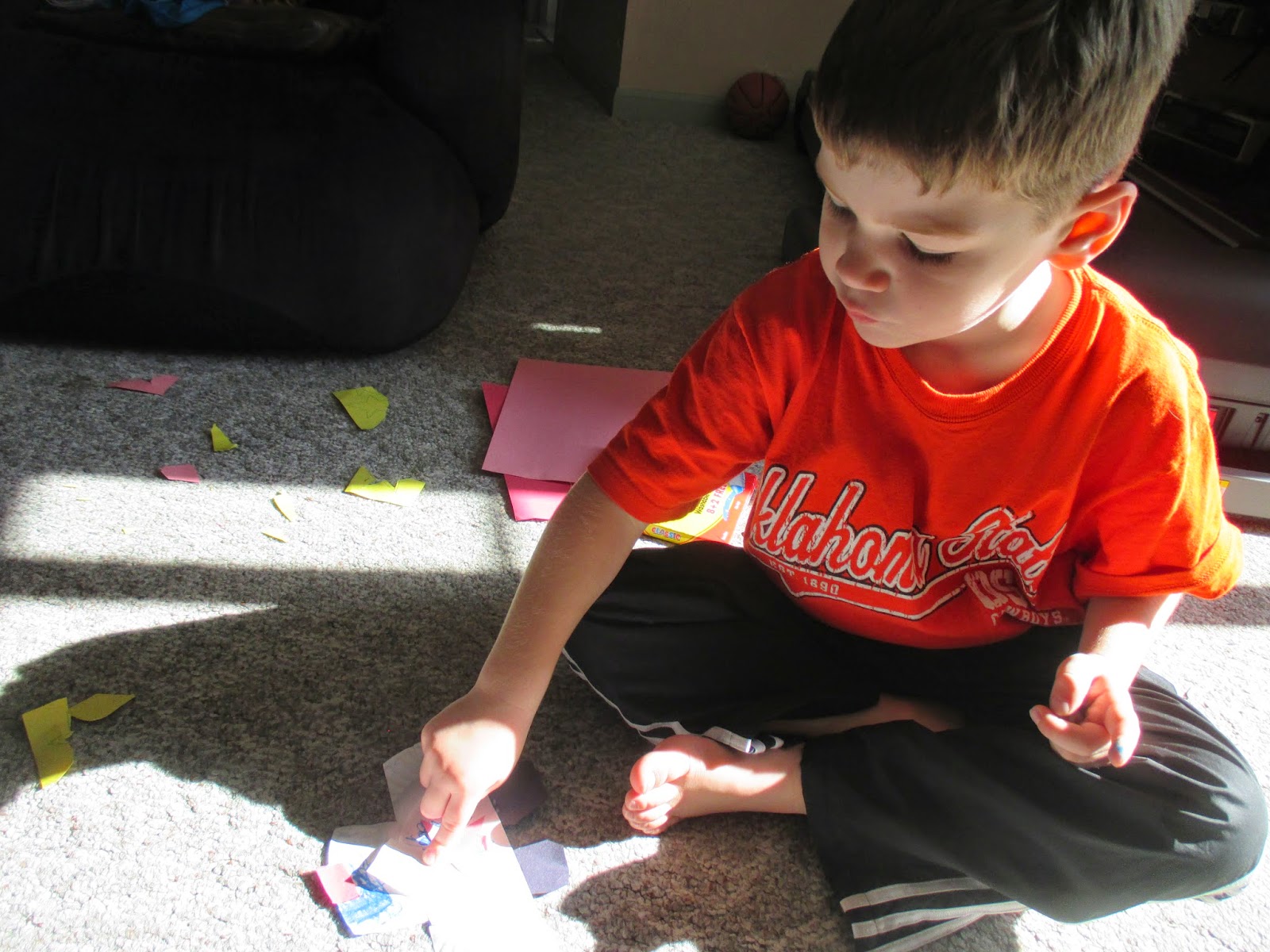
My son is naturally very curious, so I try to develop lessons based on what he’s interested in. Instead of having a separate math lesson, reading lesson, writing practice, etc., I try to tie them all together using something that he’s interested in. So I based this lesson on a police car craft that I found on Pinterest. 

I began by carefully writing out step by step instructions:
  1. Color the car blue.
  2. Cut out 2 black circles.
  3. Cut out 2 white squares.
  4. Cut out 1 red rectangle.
  5. Cut out 1 yellow star.


I gave him a paper plate that had been cut into the general shape of a car, a box of magic markers, a pair of scissors, a stack of construction paper with the appropriate shapes drawn on, and the page of directions. 

 In this single project, he had to 1) read, 2)  hold a marker properly, 3) follow sequential directions, 4) identify colors, 5) identify shapes, 6) master using scissors for both curved and straight cutting, and 7) use glue without making a big mess.

I followed this lesson by asking him to draw each of the shapes that he had cut out, and then had him figure out how to spell and write out the name of one of those shapes with help from alphabet flash cards.


From there we moved on to reading a library book about different kinds of vehicles (including police cars). As we read, we talked about the difference between nouns and verbs, figuring out which words were “things” (ambulance, policeman, siren, headlights) and which were “doing” words (drive, stop, help, fly). After that, we watched a “Schoolhouse Rock” DVD, starting with songs like “Verb: That’s What’s Happening” and “A Noun Is a Person, Place or Thing,” then we moved on to a little American history with “The Shot Heard ‘Round the World” and “The Great American Melting Pot” and a bit of math with “Elementary, My Dear” and “Figure Eight,” all with appropriate discussion as we went along. And then we finished off the lesson by practicing writing numbers with more help from flash cards and workbook pages.

The nicest part of home schooling is being able to set our own pace and our own schedule. We can take breaks whenever one of us needs one and plow through when we happen to be on a roll. If we find ourselves on an interesting tangent, we can go with it instead of having to steer back to the original topic. Sometimes we take a wiggle break because we feel like it; sometimes we skip a boring book and find one that’s more exciting at the moment; sometimes we scrap a lesson altogether and find something else that works for us. Sometimes we get much more in depth than I'd anticipated and go two or three lessons at a time. If one of us is having a crabby morning, we can work on fun projects like crafts or coloring or cooking, and work on the harder or less interesting stuff after lunch when we’ve both gotten our second wind. Sometimes we "double-dip" by thinking of different kinds of ocean animals while we're swimming or practice walking like different kinds of animals while we're having a stretch break. We can even do lessons after dinner or on weekends to make up for breaks we’ve taken during the day. 

Making our own schedule also means we can be inspired by anything and everything around us. At the grocery store, we talk about nutrition, how plants grow, and where different fruits come from. We read the signs at the end of each aisle and talk about why the foods are grouped together the way they are. While we’re making brownies, we talk about the different ways we can measure things and we practice reading and following directions. In the car the other day, my son saw someone smoking a cigarette and asked what it was, and it segued into a discussion of health, how we breathe, and the meaning of the word “consequences”.

To quote John Dewey, “Education is not preparation for life; education is life itself.” And, in turn, life itself is education. 


Bookmark and Share