Showing posts with label happiness. Show all posts

Wednesday, March 11, 2015

Lent Photo a Day: Wise

There are certain traits, certain skills, certain aspects of who each of us is, which are innate at birth. Some people are born musical: they can carry a tune, pick out a harmony, and match a rhythm without conscious thought. Some people are born athletic: they are naturally coordinated, aware of their own body’s abilities, graceful. Some people are born smart: they have the ability to learn quickly with very little assistance, they are able to make connections between seemingly unrelated facts or ideas, they can take a concept and visualize it in a different context.

But there are other traits that must be either earned or learned. No-one is born with the ability to play an instrument; it takes at least trial and error and experimentation, if not lessons from an experienced teacher or an explanation from a book or manual. No-one is born knowing how to play a sport; there are skills to be mastered, rules to be learned, strategies to be studied. No-one is born with wisdom; it is the product of experience, of analyzing how life works, of observing and thinking about and understanding the world.

Most of these learned traits build on a natural skill: a musical person can more easily learn to play an instrument, an athlete can more quickly master the physical skills required for a certain sport. But being smart does not necessarily make it easier to become wise, and being simple does not necessarily make it more difficult. In fact, the opposite is often true.

Yesterday, I wrote about knowledge, and how it is a tool that must be used, and used with skill, in order to matter and to be practical. Wisdom is the acquired skill that is needed to use knowledge to its fullest potential. Most of the time, wisdom comes through years of experience, through watching the results of one’s own decisions and the decisions of those around. But sometimes wisdom can be clouded by our experience, instead of being clarified by it. Sometimes wisdom comes through the simplest observations of a child. Sometimes, the wisdom of an inexperienced child is the simplest and yet the most profound wisdom of all.


I wanted to include a famous quote about wisdom or being wise, and when I looked up some possibilities, there were many familiar choices: Benjamin Franklin’s “Early to bed and early to rise makes a man healthy, wealthy, and wise,” or Voltaire’s “Is there anyone so wise as to learn by the experience of others?” or “Shakespeare’s “A fool thinks himself to be wise, but a wise man knows himself to be a fool.” But in the end, I realized that the most appropriate choice was both the simplest and perhaps the most profound, and certainly the most appropriate when speaking of the wisdom of children: “Be happy. It’s one way of being wise.”


Wise.

Bookmark and Share

Wednesday, February 12, 2014

Reasons My Kids Are Laughing

Yesterday I posted a list of reasons my kids cry – or, more accurately, nonsensical reasons my kids cry. Fortunately, my kids are generally very happy, contented children, and they find as many nonsensical reasons to laugh as they do to cry. They laugh not only at things that tickle their fancy for whatever reason, but sometimes just for pure joy and happiness. So in the spirit of fairness, here are some of the things that have made them laugh in the past 24 hours or so.
  •         She found her purple truck behind the couch.
  •         I sang “Peter Peter Penguin” with him.
  •         She got to jump on the trampoline.
  •         I gave him an English muffin with his name spelled out in honey.
  •         She woke up from her nap.
  •         I put on an episode of “Team Umizoomi.”
  •         We listened to “Frog Trouble” on CD.
  •         We listened to “Broken Piano” on CD.
  •         We sang along to “The Heartache Song” on CD.
  •         I let him wear his Iron Man sneakers.
  •         I let her take off her own shoes.
  •         I let him take off his pants.
  •         I let her take off her pants.
  •         I let her wear her “sparkly coat.”
  •         I took off her “sparkly coat.”
  •         We had ice cream for lunch.
  •         We “skated” on the ice on the front steps.
  •         I let him kick a snowbank the entire length of the front walkway.
  •         I gave her another cup of apple juice.
  •         He gave her back the toy she wanted to play with.
  •         She brought him the toy he wanted to play with.
  •         They whacked each other with the toys they were playing with.
  •         I gave her a blue glittery sticker.
  •         She found Sock Monkey.
  •         We listened to Bach AND Beethoven.
  •         I let her have two pillows.
  •         He wrote his name without any help.
  •         I let them play with scotch tape.
  •         She stuck a crayon between her toes.
  •         I let them draw with markers.
  •         I let her have a Hershey’s kiss.
  •         He squished a moth on the wall.
  •         It’s Playdate Day.
  •         I let her get a clean spoon from the drawer by herself.
  •         I let her lick the table.
  •         I got him another gummy worm.

Now, if you compare this list to yesterday’s list, you’ll note a significant similarity. Almost everything that made them cry at one time made them laugh at another, or at least everything that made them cry was remedied in a way that made them laugh. The lost was found, treats that had been denied were allowed, they got what they wanted, or for whatever reason they were decided that what they had was a good thing, after all.

Maybe this is why my kids’ sadness is so transitory and short-lived: either a little bit of patience or a small change in attitude is all they need to turn sadness into joy. I should take a lesson from my wise children.

Bookmark and Share

Thursday, December 5, 2013

Happy Dance

Kids who are too young to have the words to describe their emotions somehow have little difficulty expressing themselves. They don’t need words; they have their bodies. When you see a small child stamping her feet, there is no doubt that she is expressing frustration. When a little boy throws himself down and punches the ground with his fists, he is clearly angry. And when children spin around exuberantly, wriggling their entire bodies in sheer ecstasy, everyone around is perfectly aware of their happiness. Their joyful dance reminds me of a happy puppy. After all, puppies are perhaps the most perfect example of expressing emotion physically. What does a puppy do when it’s happy? It wags its tail so hard that its entire body follows suit. It wriggles joyfully. It prances and jumps and races back and forth. And small children do the same thing.

There are different degrees of physical happiness, of course. At meal times, my daughter often performs something our family refers to as the “Happy Tummy Dance.” It involves raising her arms in the air and shrugging her shoulders alternately. A particularly exuberant Happy Tummy Dance might include wriggling back and forth in her seat as well (this is more common when dessert is involved). A scrunched up nose is also occasionally part of the choreography, as is a head bob. My son, when happy or excited, tends to perform a full-body version of the Happy Puppy Wriggle: he races around the room, pausing only to stamp his feet rhythmically, wiggle his hips, punch the air, and even spin on the floor like a break dancer.

But beyond merely expressing emotion, I find that these physical expressions of happiness (and of sadness and anger, for that matter) tend to inspire that emotion. When I’m feeling a bit down and I join my kids in doing one of their happy dances, I immediately feel more cheerful. (More silly, but also more cheerful.) If I’m eating a rather boring lunch and I stop to do the Happy Tummy Dance with my kids, suddenly my lunch becomes more exciting and interesting. If my kids seem to be bored and listless, convincing them to take a few minutes to do a crazy happy dance instantly puts them in a better mood.


So the next time you’re fighting off the blues, take a moment to do a little Happy Puppy Wriggle. Toss your hair, throw up some jazz hands, shake your salsa hips, tap your toes, pirouette down the hall. And if anyone gives you the fish eye, grab them and get them to join in. I bet you’ll both walk away from that encounter with a smile on your face. Although you probably won’t walk. You’ll skip.


Bookmark and Share

Monday, May 17, 2010

Excitement, Exuberance, and Exultation

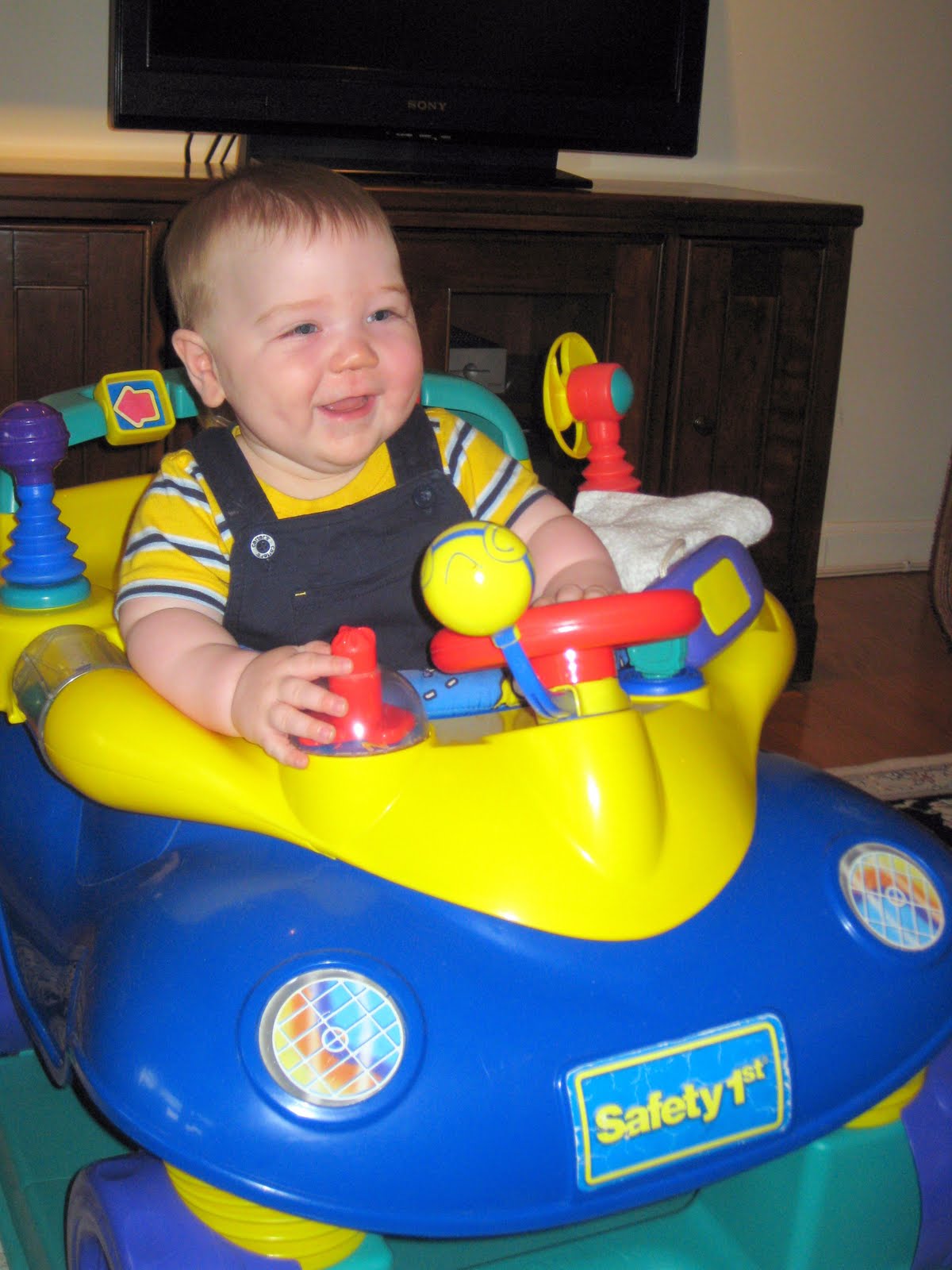
Ryan is very a happy little guy in general, but lately he sometimes gets so happy that he can’t help but let it all out in a delighted drawn-out shriek that I can only explain as an absolute overflow of excitement, exuberance, and exultation. For example, last night he was happily bouncing in his bouncy chair while Herb and I were having dinner, and every once in a while, he’d start giggling, then stand up on his very tiptoes, stretch his arms open wide, and let out a long joyous screech that dissolved back into a delighted squeal at the end. I can’t describe it in any other way than as audible joy.


How wonderful to be so happy that you can’t help but let it out verbally! Think back to the happiest moments of your life – don’t they all include some kind of vocal outburst? A “woo-hoo” or “yippee” or “hallelujah”? An “Amen” or “hot damn” or “yahoo”? There’s something about a vocal expression of excitement that somehow completes that moment. It gives you an emotional release.

I guess the flip side is true, as well. Misery and anger and frustration are often best expressed in some kind of noisy outburst, whether it be a rebel yell or a primal scream or a Charlie Brown-esque “AARRRGGGHHHH!!!” Releasing your emotions, whether positive or negative, is a wonderfully cathartic part of the human experience. And it obviously isn’t strictly verbal, because Ryan has no concept of “verbal” yet. He just knows he has something inside him that needs to be released in sound form – and he releases it, with great gusto.

When you stop and think about it, it’s amazing how good non-verbal babies are at expressing their emotions audibly in a very understandable way. There’s no mistaking that joyous screech for unhappiness, and there’s no mistaking an unhappy wail for joy. Ryan makes different noises for discomfort, for pain, for hunger, for frustration, and for tiredness. He makes different noises for curiosity, for interest, for excitement, and for happiness. It’s a shame that most adults aren’t as clear about their emotions. It’d make life much easier sometimes if we let our emotions be as apparent as babies’. Now if you’ll excuse me, I’m going to go make myself some lunch. Yippee!!!!!
Bookmark and Share