Friday, August 7, 2015

"Wonderful Town"


I often post comments or review of shows that are put on by the Reagle Music Theatre of Greater Boston. This summer, they've already put on some terrific productions: "Guys and Dolls" starring Brent Barrett in June, and "Kiss Me, Kate" starring Rick Hilsabeck and Sarah Pfisterer in July. And tonight, their final summer production opens: "Wonderful Town."

Sadly, this charming little show is not terribly well-known. The musical was written in 1953, based on a 1940 play titled "My Sister Eileen" which, in turn, was based on  a series of short stories published in the New Yorker by Ruth McKenney. The book of the musical was written by the authors of the play, Joseph A. Fields and Jerome Chodorov, the lyrics were written by the well-known Broadway team of Betty Comden and Adolph Green, and the music was composed by Leonard Bernstein. The original Broadway production starred Rosalind Russell as Ruth, and the 2003 revival starred Donna Murphy (who grew up in nearby Topsfield MA), and later Brooke Shields.


The story is set in 1935, when Ruth and Eileen Sherwood, a pair of young sisters from Ohio, move to Greenwich Village. Witty but plain Ruth is an aspiring writer, and lovely and popular Eileen is an aspiring actress.


The two find themselves a stereotypical cheap apartment, which shakes nearly to pieces on a regular basis due to nearby subway construction, and which is filled with a stream of crazy and fascinating people, including neighbors Wreck the football player and his girlfriend Helen, heavily-accented and volatile landlord Mr. Appopolous, returning "customers" of former tenant Violet, some Brazilian navy cadets, various assorted artsy residents of their Christopher Street neighborhood, and three of Eileen's admirers: Frank, the manager of the local Walgreen's; Bob, a magazine editor; and Chick, a newspaper reporter.


Ruth becomes frustrated at rejection after rejection of her stories, while Eileen is enjoying her popularity despite her lack of success in finding an acting job. Eileen gets arrested for accidentally causing a riot, but in typical fashion, charms the entire police force. Ruth promises to bail her out, but in the meantime, Mr. Appopopolous threatens to evict them - until Eileen gets a job offer as a nightclub singer, and he relents, realizing she'll have a regular paycheck. The night of her first performance, Eileen panics and pulls Ruth onstage to join her.


The two are a hit, and to add to the jubilation, Chick appears with a job offer from his paper for Ruth, and Bob declares his love for her, and they all live happily ever after.


The score of the show includes a number of catchy (if not exactly familiar) tunes: Ohio ("Why, oh why, oh why-oh, why did I ever leave Ohio?"), One Hundred Easy Ways ("You're met a charming fellow and you're out for a spin. The motor fails and he just wears a helpless grin. Don't bat your eyes and say, 'What a romantic spot we're in.' Just get out, crawl under the car, tell him it's the gasket and fix it in two seconds flat with a bobby pin. That's a good way to lose a man."), A Little Bit in Love, and Wrong Note Rag. The ensemble dance numbers, including Conquering New York, Conga, and Swing, keep the energy level high and showcase the fun dance styles of the 30s.


I have not seen Reagle's production yet, but if the quality is anywhere near the previous summer shows, there will be gorgeous sets and costumes, spectacular dancing, wonderful voices, and lots of fun to be had with the residents of Christopher Street. Get your tickets now!


Wednesday, August 5, 2015

Art Appreciation for Kids


My kids really enjoy watching shows about art. Mostly they watch shows about kids making their own art ("Artzooka" being one of their favorites), but every now and then I'll notice their attention being grabbed by a painting on "Antiques Roadshow" or a sculpture in some garden on "Rick Steves' Europe".  Kids are perfectly capable of enjoying - and understanding - classical art, a lot more so than I sometimes give them credit for. Just this afternoon, my daughter was painting with fingerpaints, forming a flower from a series of dots, and she announced to me, "Mama, I'm doing pointillism!" and then when my husband asked her what she knew about pointillism, she informed him that's how the artist Seurat painted. She's four, and she knows who Seurat is and the style he painted in. My kids are definitely ripe for some art appreciation.

So here are a few famous works of art that I think most young children can appreciate and understand.

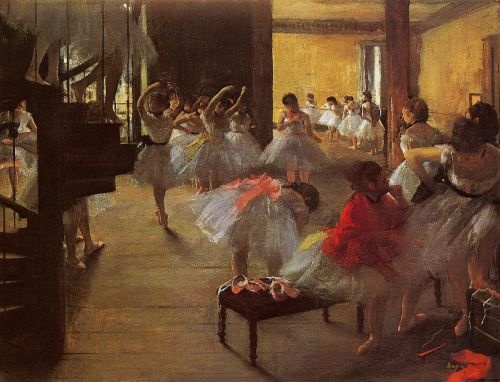
The Dance Class (Edgar Degas, 1874)
The theme of ballerinas in tutus will obviously appeal to little girls, but even young boys should appreciate the sweeping movement of the dancers' arms and the full tutus, and the vivid splashes of pink and red and gold among the white. Looking closely at the painting, they can see that, unlike a photograph or a more realistic painting, the lines are blurred and smudged, representational instead of realistic. They can see how the bright gold at the rear of the painting draws the eye, and how the graceful curves of the ballerinas contrast with the starkly straight perpendicular lines of the ceiling, beams, and stairway bannister.

The Gulf Stream (Winslow Homer, 1899)
Most little boys may not appreciate ballerinas, but nearly all of them will appreciate sharks. Homer's painting of a lone man in a tiny boat surrounded by sharks is both exciting and terrifying. The detail in the roiling sea and the wooden boat are contrasted with the simple representations of the sharks. The sailor's posture implies resignation, almost calmness. It's a good painting to discuss context: How did the sailor get there? Did he set off alone? What happened to everyone else? How long has he been there? Do you think he will survive?

A Young Hare (Albrecht Durer, 1502)
The realism and sharp detail of Durer's painting is a good contrast to Degas' painting. Every individual hair is shown, rich depths of colors and textures, the softness of the hare's coat, the sharpness of his claws. The angle of the ears makes you feel like you can see him turning them at the slightest sound, and the tensed muscles in the haunches are prepared to make a huge spring to safety. Durer's stylized "AD" signature and the date on the painting are an interesting feature for children who love writing their names on their own artwork.

David (Michelangelo, 1504)
A different kind of realistic artwork, Michelangelo's famous nude is sure to bring a titter or two from youngsters. But this statue shows why artists need to study human anatomy and physiology, and it is a glorious celebration of a young, strong human body. The musculature, the counterbalance of the lifted arm and the outthrust hip, the angles of the limbs all show the artists understanding of the workings of the human body.

Composition with Large Red Plane, Yellow, Black, Gray and Blue (Piet Mondrian, 1921)
Abstract art may be difficult for children to understand at first, but very soon they realize that much of their own art is abstract! You don't have to draw or paint something, you can simply draw or paint shapes that look interesting to you. Visual interest can come not from the subject of a painting, but from an aesthetic enjoyment of the lines and colors and shapes and how they are juxtaposed.

Starry Night (Vincent Van Gogh, 1889)

The rich blues and golds, the swirling movement, the dominance of the sky over the diminutive town, the stylized glow of the moon and stars are all intriguing to the young eye. Children can easily see the contrast of the simple, realistic, geometric lines of the buildings with the fantastical dreaminess of the sky. For slightly older children, this painting can also spark a discussion of van Vogh's mental illness and depressive episodes, and how they affected his art. Even younger children can understand how an artist's mood and outlook had an impact on both the subjects and the style of his or her art.

Red Canna (Georgia O'Keeffe, 1924)
O'Keeffe's flower paintings show that an artist can depict a closeup of an object, rather than having to show a whole scene. The bold blocks of color faithfully represent the flower without needing to include every tiny bit of shading and detail. It shows how an object can be reduced to abstract shapes but still be recognizable as the original object.

Guernica (Pablo Picasso, 1937)
Cubism is fascinating to children - how can you see multiple surfaces of an object at the same time? Many of Picasso's works are interesting studies in perspective and dimensionality. But Guernica also serves to create a very emotional impact using unusual juxtapositions of subjects. The agony on the faces, surrealistic as they are, is undeniable. The way that lines are created by the edges of color blocks, the cartoonlike lack of shadowing and shading, and the additional of detail through a few simple lines are techniques that children can understand and appreciate.

The Persistence of Memory (Salvador Dali, 1937)
Dali's famous melted clocks show that realistic objects can be represented in unrealistic ways. Many elements of the painting could actually exist - the tree, the cliff, the sand - but the artistic shows them in imagined and unexpected ways. This is a good painting to use to discuss how it makes the observer feel, and what it makes them think about. Why would the painter want to show the clocks melting? Can they serve their purpose as they are shown? What do you think Dali meant to say about time with this painting?

Christina's World (Andrew Wyeth, 1948)
I've always loved the graceful simplicity of this painting. The light, the silhouettes, the shading. And I've loved wondering about it: What is she looking at? Why did the artist choose not to show her face? Why is she in the middle of a field? Is she lonely or is she happy to be alone? The artist's techniques are also interesting to study: the texture of the field fading from crisp in the foreground to blurry in the background, the delicate shadows and curves of the subject's pink dress contrasting with the stark gray lines of the buildings.


These are only ten of the dozens, even hundreds of works of art that can be used to introduce children to the world of wonder and beauty that is art through the ages. What favorites would you choose to examine with a budding young artist or art appreciator?

Tuesday, August 4, 2015

Adventures in Birthday Cakes, August 2015 Edition

My daughter’s 4th birthday isn’t until next Sunday, but the family is coming over today to celebrate her birthday, so last night I baked her birthday cake. Well, last night we baked her birthday cake. Because both she and her 5-1/2-year-old brother wanted to help. Well, “help.”

Actually, my son is quite helpful in the kitchen. He’s good at reading directions, and cracking eggs, and stirring batter, and measuring things. His biggest problem in the kitchen is that he’s a licker. And when there are batter-covered spoons and bowls about, temptation abounds. However, as long as I keep an eye on him, he really can be a help.

My daughter, however, is another story entirely. My biggest issue with her helping is that she is incapable of being quiet. She offers a running commentary throughout the process: “What do we do next, Mama Chef? Are these the bowls we need? Can I lick this? Gotta stay away from the stove, it’s hot. Are we making a purple cake? Can I put the sprinkles on? Did you buy purple sprinkles? Did you hear Opie barking? Where’s Daddy? Can I have my princess castle now?” And on and on. It’s hilarious, but exhausting. And distracting. But since I want both of my kids to be comfortable and competent in the kitchen, I invited them to help.


You could say that my daughter’s helping started before we even got as far as the kitchen. She had originally asked me to make her a “Starfire from Teen Titans Go” cake, which involves an elaborate animated character with large eyes and pink hair and which would require more artistic talent than I could ever dream of having. I was figuring I’d have to get some of that edible photo paper and ink and print out a picture of Starfire to slap on top of a sheet cake. And then last week, she changed her mind and insisted she wanted a purple cake. just a purple cake. No shapes, no characters, just purple. With butterfly candles, or at least some form of butterfly involvement. Needless to say, I was thrilled at the change of plans. So we went to the grocery store so I could pick up a white cake mix and some white frosting. And then, she spotted this. And this.

It’s endorsed by Duff Goldman. That’s a good sign, right?

It really is vanilla flavored and not grape. But your brain really, REALLY wants it to be grape.

And she fell in love. The only thing better than purple cake with purple frosting is apparently rainbow cake with purple frosting. Well, it wasn’t much more expensive than the plain cake mix, and it would save me from having to figure out how to dye the cake purple, so I figured why not?

So I had the kids wash their hands and put on their aprons, and we were ready to go!

We run a “shoes optional” kitchen.

I let them take turns breaking the eggs, and was impressed that I didn’t have to fish out a single eggshell. Of course, I realized after I had them break the eggs into the cake mix that I was only supposed to have used the egg whites, but eggs, egg whites…po-TAY-to, po-TAH-to, right?  Moving on. But not for long for one of our chefs, who was busted licking a spoon not three seconds after I warned him not to lick the spoon. Banished amidst many tears. Chef #2 was warned to learn from the error of her brother’s ways and managed to stir the batter for nearly a minute before deciding this baking without licking deal was boring and wandering off. 


I finished the mixing and lined up the series of bowls needed to divide the batter into 6 batches for coloring. I figured that Chef #2 would enjoy stirring in the colors, but once she realized that the beaters were now available for licking, she informed me that I could do it myself. 

Note the elegant set of matching bowls. Apparently we eat a LOT of lobster bisque from Costco. 

She’s a double-fisted batter licker. 

Most of the colors looked nice and vibrant, but that purple was kinda sketchy. 

The directions said to carefully pour half of each color of batter into the centers of the two pans, pouring carefully so as not to disturb the previous colors. It wasn’t as difficult as it sounded, and as I added each color, the layers below spread out to fill each pan like a giant pair of eyeballs. 


Yeah, the purple was still looking pretty sketchy. 

Giant eyeballs peering back at me as I’m peering at them through the oven door. Isn’t this a scene from a Stephen King novel?

While the cake was in the oven, I went downstairs to comfort the still sniffling Chef #1. And what better comfort than a spoon and a lickable bowl of his favorite color of cake batter? 

I swear, no Smurfs were harmed in the creation of this image.

And since Daddy is also a known fan of licking bowls, beaters, and anything else with batter on it…

Shoes-optional kitchen; pants-optional office.

Finally the oven timer played its happy little tune, the “toothpick inserted into the center of the cake” came out clean, and the pans sat cooling (and smelling delectable) until it was time to unmold them. And then: disaster struck!

This part of the cake came out of the pan…

 But this part of the cake didn’t.

Well, that’s what frosting is for, right? I’ll stick it back together, good as new. Shh, don’t tell.

Nah, nobody’ll notice anything.

A plain boring old round layer cake is…well, plain and boring, so I decided to cut the circles in half and put them back to back to make a butterfly shape. Cutting the unbroken bottom layer in half was easy enough, but cutting the broken top layer was a bit of a challenge. Luckily, the cake was moist enough that the pieces stuck together long enough that I could glue them in place with frosting. 

Frosting covers a multitude of sins, a fact for which I am very grateful.

A quick peek at the side view shows only a passing resemblance to the photo on the package, but the purple is at least slightly less dismal than before it baked. It does look significantly less like a bad acid trip than the photo on the package, so that’s a plus, right?

Finally, I coated the whole shebang with a thick layer of frosting to hide any imperfections, then it was time to add the final details: pink and purple sprinkles, as requested by the birthday girl; a candy cane with the curve broken off to form the butterfly’s body – but what to use for antennae? I didn’t have any Twizzlers on hand and I couldn’t find either the package of drinking straws or the bag of pipe cleaners that I KNOW are around the house somewhere. But as I dug through the kitchen junk drawer, I found a wacky curly straw that I had hidden because it’s a nightmare to wash. Aha! A few snips from a pair of sturdy scissors and I had myself two exotically curly butterfly antennae. 


It may lack the glamour and detailing of some of my past cake creations, but it meets all the criteria requested by the birthday girl: It’s purple, there are sprinkles, and there is a butterfly. I’d say it’s another winner!

Bookmark and Share

Monday, August 3, 2015

A Piece of Magic is a Hat

I love hats. I love wearing them, I love when other people wear them, I love decorating them, I love shopping for them. I love looking back at the hats of other eras, and I love modern hats. But it makes me sad that not many people share my love for hats these days – or at least, not many people wear hats these days. The problem seems to be that many people aren’t sure when a hat is appropriate, what type of hat is appropriate at an event, and where to even buy a hat!

 I’d like to help bring back the hat with this handy guide for when it is appropriate to wear a hat, and what type of hat is most appropriate for a given occasion, and links to where to purchase a variety of types (and prices) of hats.

If you’re looking for a basic, practical hat to wear to the beach, gardening, or a backyard barbeque, a sun hat is the kind for you. A sun hat is a practical way to both keep your skin protected from the sun and keep cool. A sun hat should have a large brim, and should be of a relatively lightweight, breathable fabric or woven straw. A sunhat can be quite plain, decorated with only a simple hatband or occasionally a bow, or can be a bit more decorative, made from colorful straw or fabric or adding a small bow or pretty ribbon.

Here are a few examples of practical sunhats and where to find them:


If you’d like something a bit dressier, but still practical for keeping the sun off, try a garden party hat: medium- to large-brimmed, but more elaborate or more decorated than a sun hat – in other words, it’s the more fashion-forward version of a sun hat. Both straw and fabric hats are appropriate.


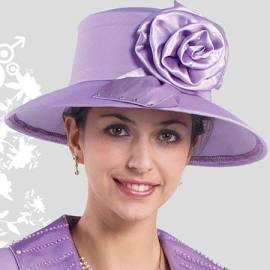
The lavender hat above is lightweight and has a wide enough brim to keep off the sun, making it practical, but the elegant shape and satin flower also make it appropriate to wear for a slightly more formal occasion, say, an outdoor wedding or an Easter church service. Here are a few other hats that can be worn for dressier occasions. Keep in mind that if you’re at an event where guests will be seated, your hat should not be overly large, to avoid blocking the view of guests behind you. 


Another nice option for any event when your hat needs to be kept to a minimum is a fascinator. A fascinator has a small base attached to a headband, pinned to the hair, or held on with an elastic, and can range in style and size from small and dainty to elaborate and ornate. Fascinators surged in popularity after Prince William’s wedding to Kate Middleton, but they’ve been around for decades. They’re easy enough to make yourself if you’re creative and have access to a glue gun (or a stapler), but if you prefer to get one pre-made, here are a few lovely options.  


Are these fascinators too simple and delicate for you? Are you dying to REALLY make a statement with your hat? Then here are the heavy-hitters of the ladies’ hat world: the Kentucky Derby hats. Now, Kentucky Derby hats do, in fact, include more traditional (and demure) styles such as church hats and fascinators. But the queens of the Derby Hats are the giant, elaborate statement hats. Hats like these (note: when you look at some of the prices, remind yourself that it’s not just a hat, it’s an investment):


And if you’d prefer to make a statement with style rather than size, how about a lovely vintage-inspired hat, perhaps one of these?


Still not convinced of the wonderful role hats could have in your life? Here are a few more thoughts on hats from some people who are wiser (or at least more famous) than I.

“You can put it on and say, "Hey you, person without a hat! I've got something you don't! How did I get it? Probably by being worth more to society.” (Alice LeGrow)

“Wearing a hat is like having a baby or a puppy; everyone stops to coo and talk about it.” (Louise Green)

“A hat is a flag, a shield, a bit of armor, and the badge of femininity. A hat is the difference between wearing clothes and wearing a costume; it’s the difference between being dressed and being dressed up; it’s the difference between looking adequate and looking your best. A hat is to be stylish in, to glow under, to flirt beneath, to make all others seem jealous over, and to make all men feel masculine about. A piece of magic is a hat.” (Martha Sliter)

“...For when a woman puts on a hat, A transformation oft takes place: Self-confidence and self-respect, Show in the lady's face. She accents her femininity; She stands tall, with shoulders back; Even when her derriere, Is clothed in jeans or slacks. I think tomorrow is a say-something-hat day.”  (Vida Boheme)
 

Here’s my “say-something hat.” Where’s yours?


Bookmark and Share