Showing posts with label Disney princesses. Show all posts

Friday, May 12, 2017

In Praise of Princesses

I think I've blogged on this topic before, but I overheard someone making a disparaging remark about all the "Disney princess stuff" marketed towards little girls and how horrible it is, and I felt a need to address the issue again.

I don't deny that Disney is a marketing machine, and that they create whatever will sell. And little girls do love the glamour of princesses. But I don't think that the stories of these princesses are completely without value, even the early Disney princess films which are often accused of depicting vapid, helpless women who live only to find and marry a prince. In fact, I think that nearly every Disney princess can teach a young girl a valuable lesson. Let's take a look at each of the princesses on the "official Disney princess" list, in the order that their movies were released.

Snow White is one of the youngest of the Disney princesses, and one with perhaps the most difficult story. Despite being a legitimate princess in her own right, she is forced to work like a servant, yet never complains, and in fact, actively seeks ways to be cheerful as she works. Her cheerful demeanor and sweet spirit endear her to all around her, which saves her life when her jealous stepmother's attempt to murder her is foiled because the huntsman cannot bring himself to kill her. Her life is saved again when she befriends the seven dwarves, willingly taking on a servant's role, and in return they protect her from the evil queen. Snow White teaches my daughter to be patient in the face of adversity, and not to be afraid of hard work. And that even princesses need to do hard work sometimes!

Next we have Cinderella. She is treated cruelly by her stepmother and stepsisters, but she continues to be kind and well-mannered towards them. She never returns cruelty for cruelty or unkindness for unkindness. Like Snow White, she isn't afraid of hard work, and she is appreciative when her friends help her, even if they are only mice and birds. In fact, she treats her little animal friends, her stepfamily, and Prince Charming all the same way, with politeness and kindness. And she never loses hope that her dreams will someday come true. Cinderella teaches little girls to be kind to everyone, from the least important to the most important, and to keep a positive attitude in the face of adversity.

Sleeping Beauty is an interesting Disney princess, because she spends most of her movie asleep. But even so, her story teaches some positive lessons. For example, her friends, the three good fairies and her little animal friends, all stand by her and help her when she is at her most helpless, so her story teaches us to trust in and rely on our friends. It is also significant that the Prince is only able to defeat the evil queen when he is armed with the Sword of Truth and the Shield of Virtue, reminding us that good can triumph over evil.

Ariel, the Little Mermaid, is somewhat different from the prior princesses in that she has a father - but one whom she rebels against, which results in her becoming entangled with the deceitful Sea Witch. In the end, her father sacrifices himself to save her, which teaches children that even when your parents make rules that you don't like, they're for your own good, and that even when you make mistakes, your parents will be there to help get you out of trouble. Ariel's curiosity about humans also teaches little girls that curiosity and learning are good things (and that ignorance will cause you to do silly things like combing your hair with a fork).

Belle from "Beauty and the Beast" is a more obvious role model than the previous princesses, in that she is clearly shown to be smart, curious, and self-sufficient. Her story begins when she sacrifices her own safety to protect her father. But like the princesses before her, her kindness and sweet spirit endears her to everyone, even the Beast, and this is what saves her in the end. Her lesson is that both learning and kindness will serve you well.

Princess Jasmine from "Aladdin" could easily be a spoiled princess waiting for a prince to come and rescue her, but instead, she fights against years of cultural oppression and refuses to marry at her father's will. She takes her fate into her own hands, refusing to be made into a "prize". The girl has a pet tiger, for heaven's sake - how is she not a strong-willed woman who makes her own choices and takes care of herself?? She teaches girls to stand up for themselves and what they think is right, even if everyone around them thinks otherwise.

One of the things I love most about Pocahontas is her physicality. She is strong and lithe, and has great endurance. She literally runs circles around John Smith. And she has remarkable knowledge about the world around her - the trees, the plants, the animals, the river. She cares for the world - and the people - around her with great devotion. She teaches girls the importance of conservation.

Mulan saves China, man. What more do we need to say about her? Seriously, she disguises herself as a man and fights in a WAR to save her father and her country. She works harder than everyone around her in order to be prepared for what she needs to do. Mulan is the rock star of the Disney princess canon, in my opinion.

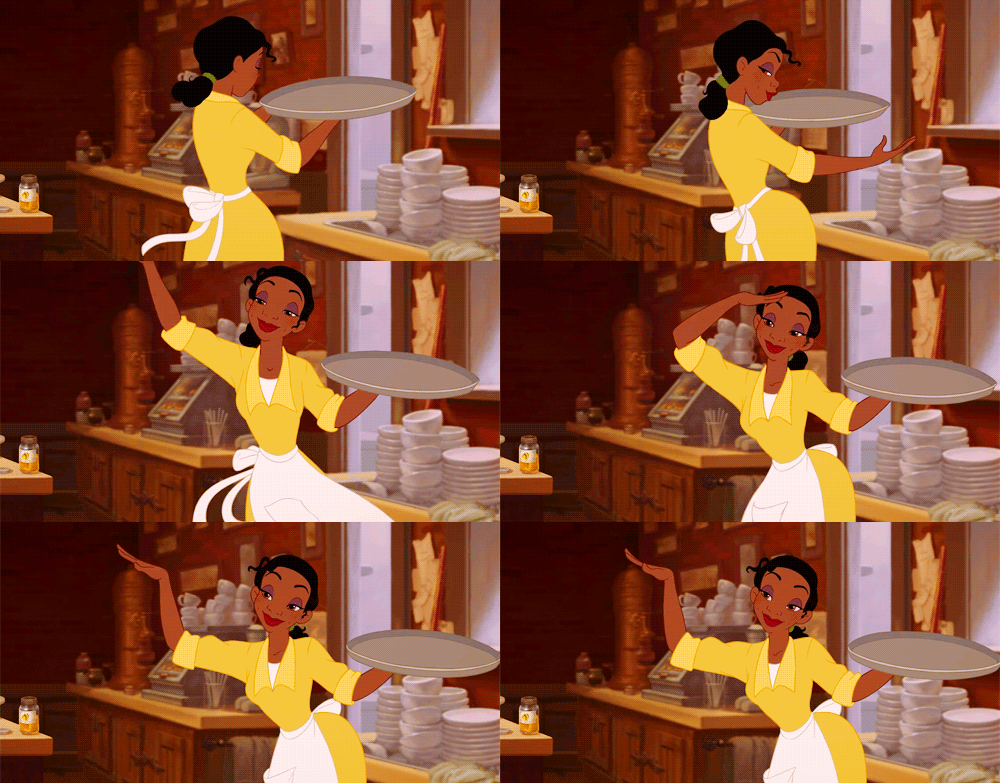
Tiana, from "The Princess and the Frog", is another character who begins her story as a commoner but ends up marrying the prince - and, like Belle, she falls in love with the prince when he is in non-human form. Tiana differs from princesses like Snow White and Cinderella in that, although also dreaming about a better future, Tiana is actively working to fulfill her dream. An aspiring chef, she works as a waitress to earn money to buy herself a restaurant. Her relationship with her prince is more of a side effect of her following her dream rather than the dream itself. In fact, she only kisses the prince at the beginning because he offers her enough money to buy her restaurant in exchange for breaking the spell which has turned him into a frog. She's a smart businesswoman, a devoted friend, and a feisty, strong-willed, and independent woman. She may not be one of the most popular Disney princesses, but she's arguably one of the most admirable ones.

Rapunzel from "Tangled" is another princess who takes care of herself  and occasionally her prince, as well. She and Eugene are much more of a team than many previous princesses and princes. She boasts a long list of skills, from cooking, to sewing, to painting, to writing poetry, to wielding a mean frying pan. She teaches girls that they can do anything they want - or need - to do.

Merida is not only a princess, but a princess slated to become the queen of her clan. As such, she has been trained from a young age to be a fighter, a diplomat, and a lady. Much like Princess Jasmine, Merida rebels against the cultural norm of marrying her parents' choice. Merida is undeniably brave but also undeniably impetuous, a combination which gets her both into and out of some serious scrapes. She teaches young women to trust in their own strength and not to blindly obey, yet to listen to the wise advice of their elders. She also depicts a realistic relationship with her mother that is both difficult and devoted.


Finally, we have Anna and Elsa. They are not technically part of the official Disney princess roster, but I am including them due to their popularity. (And because my 5-year-old daughter would never forgive me.)

Anna and Elsa have different lessons to teach. Elsa is an example of the contrast between being afraid of your own potential and taking ownership of and mastering your own skills. Anna, on the other hand, jumps into everything impulsively and without thought, which often gets her into trouble. But when she does stop and think about her actions and how they affect other people, her relationships become mature, and her devotion to those she loves allows her to be self-sacrificing and generous.

So what has my daughter learned from these princesses? To be kind to all, to work hard but cheerfully, to be curious and learn all she can about the world around her, to fight against what is wrong and to fight for what is right, to trust her friends, and to work hard to achieve her dreams. I think those are all worthwhile lessons, don't you think?


Bookmark and Share

Wednesday, November 19, 2014

The Princess Problem

My daughter is a typical 3-year-old in many ways: She loves to dance. She loves to squeal. She loves to play with dolls and figurines. And she loves to dress up like a Disney princess.


Back in my day, the fascination with Disney princesses was simple. We watched the movies (if we were lucky enough to have a VCR and a collection of Disney videos), we sang the songs (which we had learned from vinyl records), and we wore the dresses (if we happened to have a mom who could sew). And no-one thought anything about it except that it was cute.

But today, many people have less than positive opinions of Disney princesses. Some complain that they are too helpless, that they teach our daughters to wait for a man to come rescue her, that they are terrible role models of complacency and symbols of female subservience. I, however, disagree. I think that every Disney princess has a positive lesson to teach our children, both male and female.

Snow White and Cinderella, for example, were both raised in a family where they were neglected and abused. And yet, they both maintained their sweet, kind, loving, and hard-working natures. In Disney's versions, neither princess tried to get vengeance on her family, even when she had the power to do so. Isn't that a positive role model?

Ariel, on the other hand, was adored by her father to the point of being spoiled. But instead of sitting back and expecting everything she wanted to be handed to her, she explored the world around her and found a way to learn on her own, discovering that there was a whole world beyond what she knew. She pushed herself beyond the boundaries of familiarity and braved the unknown. Isn't that a positive role model?

And how about Mulan? She realized that she could not protect her family's honor the way they wanted her to, so she found another way to do it. She could have simply run away, leaving her family in shame. But instead, she put herself in danger so that those she loved would be safe. She became a warrior. Isn't that a positive role model?

Belle, who is not only beautiful but smart, is devoted to her father, also to the point of sacrificing herself and her own future to save him. And her kindness and compassion is so great that she is able to see past the Beast's ugly, angry exterior and recognize the sadness and loneliness inside. Isn't that a positive role model?

Jasmine is an interesting case, being a princess who is aware that she is being forced into a subservient role which she does not want. She rebels against the society that tries to force her into a marriage which she did not choose, and in the end, uses her power and privilege to make the world a better place. Isn't that a positive role model?

Rapunzel, similar to Ariel, has a parent (in this case, a mother) who loves her to the point of smothering her, purportedly keeping her "safe" from the world, but in reality, keeping her from learning and exploring on her own. Rapunzel also manages to escape her boundaries and discover the world around her, embracing all its warts as well as its beauty. Isn't that a positive role model?

What about the most recent of the Disney princesses, the sisters from "Frozen"? Each struggles with rejection early in life, Elsa feeling forced by her parents to hide who she is, Anna feeling rejected by the older sister whom she loves. But both put their own comfort aside for the good of the people of their kingdom, going through trials which eventually teach them to ask for help and work together. Aren't those positive role models?

So when my daughter begs to put on her Snow White costume, or her Cinderella costume, or her Little Mermaid costume, I will let her do so without reservations. I'll remind her that Snow White worked hard making the beds, cleaning, and cooking dinner for her "family." I'll remind her that Cinderella did as she was asked without complaining, even when it seemed unfair. I'll remind her that Ariel learned everything she could about what was around her, and studied it with an open mind. I'll remind her that each of these women made choices about their own lives, and lived with the consequences, for good or for evil. I'll remind her that they loved and respected their parents, that they loyally stood by their friends, and that they took their destinies into their own hands instead of complacently accepting their fates.

But best of all, they did it all while wearing glittering gowns and great shoes. And there is absolutely nothing wrong with that.


Bookmark and Share

Tuesday, April 1, 2014

Photo A Day, Day 1: Something Purple

For some people, “something purple” might be a difficult subject to capture easily on film. It’s not a color that everyone has in their wardrobe; it’s not a common color for interior or exterior paint; there isn’t likely to be a car in that particular shade parked nearby. But for anyone with a daughter under the age of, say, 18, purple is common. And for anyone with a daughter under the age of, say, 8, purple is ubiquitous.


I have a 2-1/2 year old daughter, therefore my life is filled with purple. My daughter has purple pajamas, she has purple dresses, the blanket on her bed is purple, she dresses up in a purple tutu, she has a pair of purple sneakers, she has a purple purse, her favorite toys are a purple My Little Pony and a Matchbox Holley Shiftwell (a car from the movie Cars 2 who just happens to be – you guessed it – purple), a full one-third of her hair bow collection is purple. Her favorite snack is even purple grapes! But the one item that pretty much sums up her love of purpleness is her Purple Princess Cup.


Although I chose to feature Princess Rapunzel in this view (she does, after all, wear a purple gown), you can see glimpses of Princess Belle to the right and Princess Jasmine to the left. Also featured are Princess Aurora (Sleeping Beauty), Princess Snow White (no, no one ever seems to call her princess, but I don’t know why and it doesn’t seem fair, so I’m granting her the honorary title), and Princess Cinderella. The plethora of princesses certainly makes it special to her, but her true love for this cup is rooted in the fact that it is purple. The background is purple, the cap is purple, this sucker is PURPLE. This is, unquestionably, the Purple Cup.

I know that the color is what makes it special because she does not refer to it as her “princess cup,” but rather as her “purple cup.” That might not seem notable, except for the fact that all the other cups are consistently referred to as the “Minnie Mouse cup,” the “Buzz and Woody cup,” and the “car cup,” never the “red cup,” the “orange cup,” or the “blue cup.” What makes this cup special to her is that it is so very, very purple.

I don’t know why I’m surprised that she’s so attracted to purple. It is the color of royalty, after all, purple.

Bookmark and Share

Monday, October 8, 2012

What a Character!


One of the special parts of going on a Disney vacation is getting to meet all your favorite characters: Mickey, Minnie, Donald, Daisy, Goofy, Pluto, Chip and Dale, Captain Hook, Peter Pan, Cinderella, Belle, Sleeping Beauty…the list goes on and on. And for most children, that is indeed a highlight. Little girls, especially, like to dress up like their favorite princesses and carry around autograph books so everyone they meet can sign them. But there are always a few children who are, let’s call it, “hesitant” to meet the characters.

My kids fell neatly into each of those categories. My one-year-old daughter, who refuses to go to the arms of even a familiar babysitter without several minutes of coaxing, would reach out excitedly for every character in a 100-foot radius. But my three-year-old son, who is basically fearless, would not go near a single character until the very last night of our vacation. The photograph pretty much sums it up:
 
If you look closely, you’ll notice that Donald’s left hand has my daughter’s hand in a death grip, to prevent her from continuing to molest his beak. And my son, although smiling for the camera, has a death grip of his own on Daddy, his exposed belly button and rucked-up shorts evidence of the prior struggle to get him even that close to the creepy giant duck. This was pretty typical of every character encounter we had.
One of our favorite evening activities aboard the Disney Fantasy was the family dance parties in D Lounge. Various DJs or live musical acts provided the music, and one of the many bubbly, energetic staffers was on the floor with a microphone coaxing everyone to join in the dancing, or occasionally teaching a simple line dance. Most evenings, one character or another would make an appearance and join in the dancing. On formal night, Chip and Dale came, dressed to the nines in their tuxedos. Katie chased them around until they literally had to peel her off so another child could have a turn. Ryan hid in a chair at the back of the lounge until they left.
What really surprised me was that my son not only hated the non-talking, “giant head” type characters, but also the human characters such as the princesses and even Peter Pan. My daughter ran over to Princess Belle the first chance she got and admired her beautiful gown and gloves, but as you can see, my son was desperately koala-ing onto Mama. Really? How can anyone not want to go right up to this lovely princess and say hello?
Even as I was writing this blog, my daughter spied this photo and began cooing and attempting to climb on my lap to get closer. My son checked it out as well, with the commentary, “Hey, that’s me. I was very sad and scared.”
In another five years or so, when we’re ready to take another trip like this, I’m sure both kids will have completely changed their thinking about these characters. At ages 5 and 7, it’s likely that my daughter will be dressed like a princess herself, although awestruck and shy about approaching the real princesses, and my son will probably be chasing around all the villains with a plastic sword (Captain Hook, I’m looking at you). I’ll apologize for both of their behaviors in advance.
 
But I, at least, will be delighted to meet each and every one of you!


Bookmark and Share